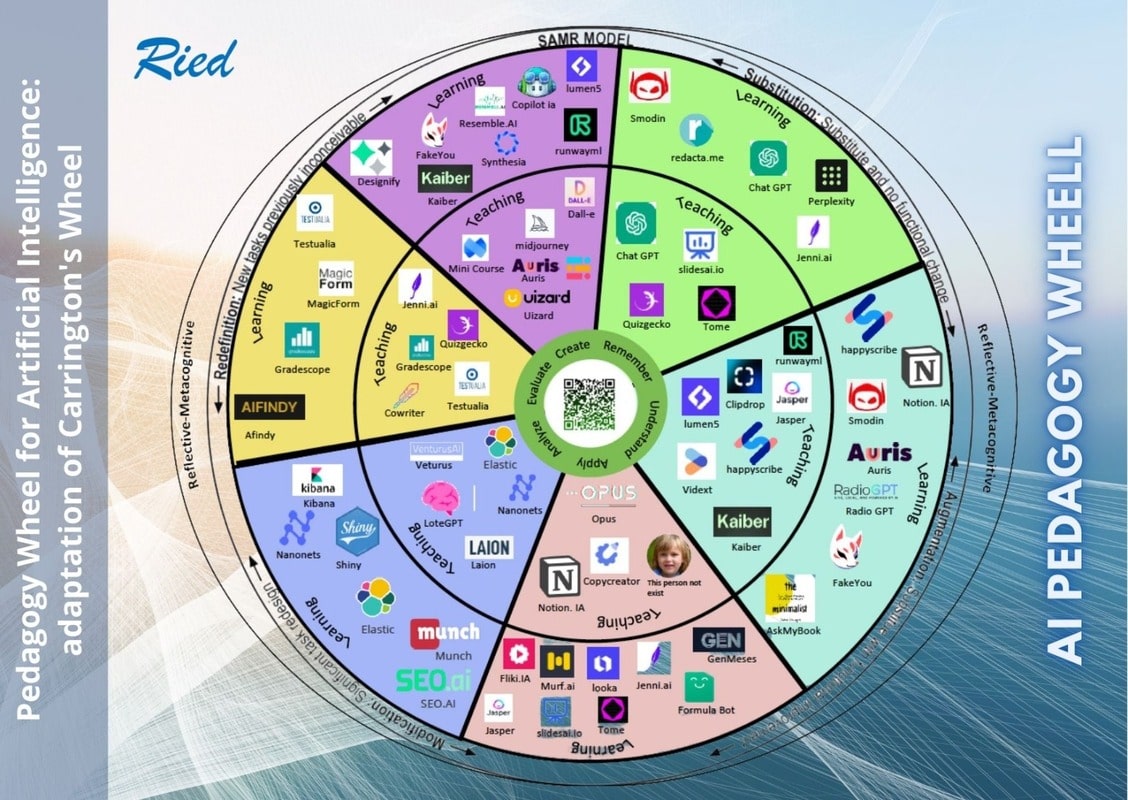
Rueda de la Pedagogía para la inteligencia artificial: adaptación de la Rueda de Carrington
DOI:
https://doi.org/10.5944/ried.27.1.37622Palavras-chave:
inteligencia artificial, tecnologías disruptivas, Rueda de Carrington, taxonomía de Bloom, modelo SAMRResumo
La integración efectiva de la Inteligencia Artificial (IA) en la educación es necesaria para aprovechar sus beneficios en el proceso de enseñanza-aprendizaje. Este artículo propone la adaptación de la Rueda de la Pedagogía de Carrington a una Rueda de la Pedagogía para la IA, con el fin de ofrecer un marco pedagógico para integrar la IA en la educación. La metodología de investigación utilizada se basa en una revisión y mapeo sistemático junto a un estudio bibliométrico del análisis de co-ocurrencia de términos para identificar los clusters temáticos relevantes que respalden científicamente la necesidad de la adaptación de la Rueda. La nueva rueda atiende a los cuatro clusters obtenidos (Integración de la IA para mejorar la educación, Uso de tecnologías educativa en el proceso de enseñanza y aprendizaje, Diseño e innovación pedagógica y Educación Sostenible y Ética) y presenta anillos concéntricos que explican cómo incorporar gradualmente la IA en diferentes niveles cognitivos (Taxonomía de Bloom) e integración tecnológica (Modelo SAMR) ambos adaptados a la IA, con ejemplos de herramientas y aplicaciones. Además, se incluye un nivel Reflexivo-Metacognitivo que aborda la ética y responsabilidad en el uso de la IA. En conclusión, la rueda adaptada a la IA es una opción viable para mejorar la eficacia y eficiencia de la educación, con la condición de que los docentes participen en la planificación y ejecución del proceso de enseñanza y aprendizaje para garantizar su éxito. Cabe mencionar la importancia de mantener la rueda actualizada debido a la aparición constante de nuevas aplicaciones.
ARTÍCULO COMPLETO:
https://revistas.uned.es/index.php/ried/article/view/37622/27989
Downloads
Referências
Akgun, S., & Greenhow, C. (2022). Artificial intelligence in education: Addressing ethical challenges in K-12 settings. AI and Ethics, 2(4), 431-440. https://doi.org/10.1007/s43681-021-00096-7
Arrieta, A. B., Díaz-Rodríguez, N., Del Ser, J., Bennetot, A., Tabik, S., Barbado, A., Garcia, S., Gil-Lopez, S., Molina, D., Benjamins, R., Chatila, R., & Herrera, F. (2020). Explainable Artificial Intelligence (XAI): concepts, taxonomies, opportunities and challenges toward responsible AI. Information Fusion, 58, 82-115. https://doi.org/10.1016/j.inffus.2019.12.012
Baidoo-Anu, D., & Owusu Ansah, L. (2023). Education in the era of generative artificial intelligence (AI): Understanding the potential benefits of ChatGPT in promoting teaching and learning. Available at SSRN 4337484. https://doi.org/10.2139/ssrn.4337484
Bhutoria, A. (2022). Personalized education and artificial intelligence in United States, China, and India: A systematic Review using a Human-In-The-Loop model. Computers and Education: Artificial Intelligence, 3, 1-18. https://doi.org/10.1016/j.caeai.2022.100068
Bloom, B., & Krathwohl, D. (1956) Taxonomy of Educational Objectives: The Classification of Educational Goals, by a committee of college and university examiners. Handbook I: Cognitive Domain. Longmans. https://doi.org/10.1086/459563
Bostrom, N. (2014). Superintelligence: Paths, Dangers, Strategies. Oxford University Press.
Carrington, A. (2015). The Pedagogy wheel–it’s not about the apps, it’s about the pedagogy. TeachThought. https://www.teachthought.com/technology/the-padagogy-wheel/
Carrington, A. (2016). Professional development: The pedagogy wheel: It is not about the apps, it is about the pedagogy. Education Technology Solutions. https://educationtechnologysolutions.com/2016/06/padagogy-wheel/
Carrington, A. (2017). La rueda de la Pedagogía. Recursos educativos de la CED. https://ced.enallt.unam.mx/blogs/recursosced/recursos-de-interes/la-rueda-de-la-pedagogia-1/
Castaneda, A. U. (2023). Un viaje hacia la inteligencia artificial en la educación. Realidad y Reflexión, (56), 121-136. https://doi.org/10.5377/ryr.v1i56.15776
Celik, I. (2023). Towards Intelligent-TPACK: An empirical study on teachers’ professional knowledge to ethically integrate artificial intelligence (AI)-based tools into education. Computers in Human Behavior, 138, 107468. https://doi.org/10.1016/j.chb.2022.107468
Cerchiaro C. E., Barras Rodríguez, R. A., Curiel Gómez, B. N., & Bustamante Meza, L. Y. (2021). Metacognición y resolución de problemas en niños escolarizados. European Journal of Education and Psychology, 14(2), 1-23. https://doi.org/10.32457/ejep.v14i2.1570
Chen, L., Chen, P., & Lin, Z. (2020). Artificial intelligence in education: A review. IEEE Access, 8, 75264-75278. https://doi.org/10.1109/access.2020.2988510
Cooper, G. (2023). Examining science education in ChatGPT: An exploratory study of generative artificial intelligence. Journal of Science Education and Technology, 32, 444-452. https://doi.org/10.1007/s10956-023-10039-y
Cope, B., Kalantzis, M., & Searsmith, D. (2021). Artificial intelligence for education: Knowledge and its assessment in AI-enabled learning ecologies. Educational Philosophy and Theory, 53(12), 1229-1245. https://doi.org/10.1080/00131857.2020.1728732
Drigas, A., Mitsea, E., & Skianis, C. (2023). Meta-Learning: Α Nine-Layer Model Based on Metacognition and Smart Technologies. Sustainability, 15(2), 1668. https://doi.org/10.3390/su15021668
Duha, M. S. U. (2023). ChatGPT in Education: An Opportunity or a Challenge for the Future? TechTrends, 1-2. https://doi.org/10.1007/s11528-023-00844-y
Garcia-Utrera. L., Figueroa-Rodriguez, S., & Esquivel-Gámez, I. (2014). Modelo de Sustitución, Aumento, Modificación, y Redefinición (SAMR): Fundamentos y aplicaciones. In I. Esquivel-Gámez (Coord.), Los Modelos Tecno-Educativos: Revolucionando el aprendizaje del siglo XXI (pp. 205-220). DSAE-Universidad Veracruzana. https://www.researchgate.net/publication/273754983_Modelo_de_Sustitucion_Aumento_Modificacion_y_Redefinicion_SAMR_Fundamentos_y_aplicaciones
Huang, J., Shen, G., & Ren, X. (2021). Connotation analysis and paradigm shift of teaching design under artificial intelligence technology. International Journal of Emerging Technologies in Learning (iJET), 16(5), 73-86. https://doi.org/10.3991/ijet.v16i05.20287
Lameras, P., & Arnab, S. (2021). Power to the teachers: an exploratory review on artificial intelligence in education. Information, 13(1), 14. https://doi.org/10.3390/info13010014
Luckin, R. (2018). Machine Learning and Human Intelligence: The Future of Education for the 21st Century. UCL Press.
Matta, J., Salakas, B., Salerno, G., & Sultana, E. (2016). Will using an iTunes U course with the Padagogy Wheel result in effective individualised learning? Australian Educational Leader, 38(2), 44-49.
Pedro, F., Subosa, M., Rivas, A., & Valverde, P. (2019). Artificial intelligence in education: Challenges and opportunities for sustainable development. International Journal of Educational Technology in Higher Education, 16(1), 1-15. https://doi.org/10.21125/inted.2020.0644
Porayska-Pomsta, K. (2016). AI as a methodology for supporting educational praxis and teacher metacognition. International Journal of Artificial Intelligence in Education, 26, 679-700. https://doi.org/10.1007/s40593-016-0101-4
Puentedura, R. R. (2014). SAMR and TPCK: A hands-on approach to classroom practice. http://www.hippasus.com/rrpweblog/archives/2014/12/11/SAMRandTPCK_HandsOnApproachClassroomPractice.pdf
Renz, A., & Vladova, G. (2021). Reinvigorating the discourse on human-centered artificial intelligence in educational technologies. Technology Innovation Management Review, 11(5). https://timreview.ca/sites/default/files/article_PDF/TIMReview_2021_May%20-%201_1.pdf
Salas-Pilco, S. Z., Xiao, K., & Hu, X. (2022). Artificial intelligence and learning analytics in teacher education: A systematic review. Education Sciences, 12(8), 569. https://doi.org/10.3390/educsci12080569
Selwyn, N. (2019). Should Robots Replace Teachers? AI and the Future of Education. Polity Press. https://doi.org/10.1109/icac353642.2021.9697300
Siemens, G., & Baker, R. S. (29 de abril – 2 de mayo, 2012). Learning analytics and educational data mining: Towards communication and collaboration [Resumen de conferencia]. Proceedings of the 2nd International Conference on Learning Analytics and Knowledge. Nueva York, NY, EE. UU. ACM. https://doi.org/10.1145/2330601.2330664
Skavronskaya, L., Hadinejad, A., & Cotterell, D. (2023). Reversing the threat of artificial intelligence to opportunity: a discussion of ChatGPT in tourism education. Journal of Teaching in Travel & Tourism, 23(2) 253-258. https://doi.org/10.1080/15313220.2023.2196658
UNESCO. (2021). International Forum on AI and the futures of education developing competencies for the AI era. United Nations Educational, Scientific and Cultural. https://unesdoc.unesco.org/ark:/48223/pf0000377251
Wiley, D. (2023). AI, instructional design, and OER. Improving learning. https://opencontent.org/blog/archives/7129
Yuskovych-Zhukovska, V., Poplavska, T., Diachenko, O., Mishenina, T., Topolnyk, Y., & Gurevych, R. (2022). Aplicación de la Inteligencia Artificial en la Educación. Problemas y Oportunidades para el Desarrollo Sostenible. CEREBRO. Investigación amplia en inteligencia artificial y neurociencia, 13 (1Sup1), 339-356. https://doi.org/10.18662/brain/13.1Sup1/322
Zhang, Z., Zhang, J., & Cai, M. (31 de julio-2 de agosto, 2018). The Design and Practice of the Flipped Classroom Teaching Model Based on the Pedagogy Wheel [Presentación en conferencia]. 2018 International Symposium on Educational Technology (ISET), Osaka, Japan. https://doi.org/10.1109/ISET.2018.00028
Downloads
Publicado
Como Citar
Edição
Secção
Licença
Direitos de Autor (c) 2023 Eva Jiménez García, Natalia Orenes-Martínez, Luis Antonio López-Fraile

Este trabalho encontra-se publicado com a Licença Internacional Creative Commons Atribuição 4.0.
As obras que são publicadas neste revista estão sujeitas ao seguintes termos:
1. Os autores cedem de forma não exclusiva os direitos de exploração dos trabalhos aceitos para sua publicação a "RIED. Revista Iberoamericana de Educação a Distância", garantem à revista o direito de ser a primeira publicação do trabalho e permitem que a revista distribua os trabalhos publicados sob a licença de indicada no ponto 2.
2. As obras são publicadas na edição eletrônica da revista sob uma licença Creative Commons Atribuição 4.0 Internacional (CC BY 4.0). Podem copiar e redistribuir o material em qualquer suporte ou formato, adaptar, remixar, transformar, e criar a partir do material para qualquer fim, mesmo que comercial. Você deve atribuir o devido crédito, fornecer um link para a licença, e indicar se foram feitas alterações. Você pode fazê-lo de qualquer forma razoável, mas não de uma forma que sugira que o licenciante o apoia ou aprova o seu uso.
3. Condições de auto-arquivo. Permite-se e incentava-se aos autores difundir eletronicamente a versõ OnlineFirst (versão avaliada e aceita para publicação) de su obra antes de sua publicação, sempre com referência a sua publicação na RIED, já que favorece sua circulação e difusão mais cedo e com isso um possível aumento em sua citação e alcance entre a comunidade acadêmica. Color RoMEO: verde.