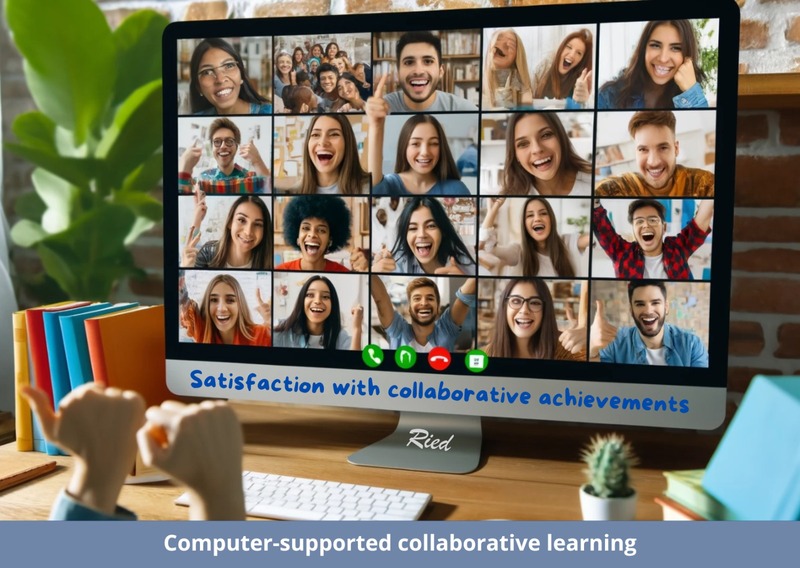
Computer-supported collaborative learning
DOI:
https://doi.org/10.5944/ried.27.2.40208Keywords:
collaborative learning, higher education, distance education, humanistic approach, group interactionsAbstract
In line with the requirements of a transformed industry, higher education has incorporated practices and tools allowing its students to apply technology to their professional practice. However, university commitment goes beyond facilitating technical skills, given that without a humanistic basis, those skills alone are not sufficient to meet the true challenges of the 21st century. Collaborative learning involves training for technology-mediated collaboration, and its pedagogical approach considers both the improvement of individual learning in contact with the group and the development of a culture of collaboration. The ability to collaborate is, in itself, typical of the 21st century. Both the field of higher education and the corporate environment recognize that collaborative learning tools are one of the three communication technologies that contribute most to university teaching. The challenges that go along with this involve training teachers, whose competencies conflict with university students’ growing interest in making use of a technologically-mediated collaborative culture. Therefore, working collaboratively is particularly important when institutions, or teachers individually, want to adopt a humanistic culture in digital formats, proposing a documented framework supported by scientific evidence that addresses the intersection of knowledge, pedagogy and the group’s socio-emotional level.
Downloads
References
Asif Qureshi, M., Khaskheli, A., Ahmed Qureshi, J., Ali Raza, S., & Qamar Yousufi, S. (2021). Factors affecting students’ learning performance through collaborative learning and engagement. Interactive Learning Environments, 31(4), 2371-2391. https://doi.org/10.1080/10494820.2021.1884886
Borge, M., Ong, Y. S., & Rosé, C. P. (2018). Learning to monitor and regulate collective thinking processes. IJCSCL, 13(1), 61-92. https://doi.org/10.1007/s11412-018-9270-5
Garrison, D. R., Cleveland-Innes, M., & Fung, T. S. (2010). Exploring causal relationships among teaching, cognitive and social presence: Student perceptions of the community of inquiry framework. Internet and Higher Education, 13(1), 31-36. https://doi.org/10.1016/j.iheduc.2009.10.002
Glenn, M., & D’Agostino, D. (2008). The Future of Higher Education: How Technology Will Shape Learning. New Media Consortium, 1-27.
Gómez-Aguilar, M., Roses-Campos, S., & Farias-Batlle, P. (2012). The academic use of social networks among university students. [El uso académico de las redes sociales en universitarios]. Comunicar, 38, 131-138. https://doi.org/10.3916/C38-2012-03-04
Hernández Sellés, N., González Sanmamed, M., & Muñoz Carril, P. C. (2014). La planificación del aprendizaje colaborativo en entornos virtuales. Comunicar, 42, 25-33. https://doi.org/10.3916/C42-2014-02
Hernández-Sellés, N., Muñoz-Carril, P. C., & González-Sanmamed, M. (2020). Interaction in computer supported collaborative learning: an analysis of the implementation phase. International Journal of Educational Technology in Higher Education, 17(23), 1-13. https://doi.org/10.1186/s41239-020-00202-5
Hernández-Sellés, N., Muñoz-Carril, P. C., & González-Sanmamed, M. (2023). Roles del docente universitario en procesos de aprendizaje colaborativo en entornos virtuales. RIED-Revista Iberoamericana de Educación Superior, 26(1), 59-82. https://doi.org/10.5944/ried.26.1.34031
Martin, F., Kumar, S., & She, L. (2021). Examining higher education instructor perceptions of roles and competencies in online teaching. Online Learning, 25(4), 187-215. https://doi.org/10.24059/olj.v25i4.2570
Noguera, I., Guerrero-Roldán, A. E., & Masó, R. (2018). Collaborative agile learning in online environments: Strategies for improving team regulation and project management. Computers & Education, 116, 110-123. https://doi.org/10.1016/j.compedu.2017.09.008
Pereira, S., Fillol, J., & Moura, P. (2019). Young people learning from digital media outside of school: The informal meets the formal. [El aprendizaje de los jóvenes con medios digitales fuera de la escuela: De lo informal a lo formal]. Comunicar, 58, 41-50. https://doi.org/10.3916/C58-2019-04
Piki, A. (2022). Re-imagining the Distributed Nature of Learner Engagement in Computer-Supported Collaborative Learning Contexts in the Post-pandemic Era. Lecture Notes in Computer Science, 13316. https://doi.org/10.1007/978-3-031-05064-0_13
Saito, K. (2022). El capital en la era del Antropoceno. Ediciones B.
Sobko, S., Unadkat, D., Adams, J., & Hull, G. (2020). Learning through collaboration: A networked approach to online pedagogy. E-Learning and Digital Media, 17(1), 36–55. https://doi.org/10.1177/2042753019882562
Srnicek, N. (2018). Capitalismo de plataformas. Caja Negra.
Wen, L. (2022). Influence of Emotional Interaction on Learners’ Knowledge Construction in Online Collaboration Mode. International Journal of Emerging Technologies in Learning, 17(2), 76-92. https://doi.org/10.3991/ijet.v17i02.28539
Xiulin, M., Jingjing, L., Jing, L., & Chenyu, F. (2023). An empirical study on the effect of group awareness in CSCL environments. Interactive Learning Environments, 31(1). 38-53. https://doi.org/10.1080/10494820.2020.1758730
Yeşilyurt, E., & Vezne, R. (2023). Digital literacy, technological literacy, and internet literacy as predictors of attitude toward applying computer-supported education. Education and Information Technologies, 18, 9885-9911. https://doi.org/10.1007/s10639-022-11311-1
Downloads
Published
How to Cite
Issue
Section
License
Copyright (c) 2024 Núria Hernández-Sellés, Pablo César Muñoz-Carril, Mercedes González-Sanmamed

This work is licensed under a Creative Commons Attribution 4.0 International License.
The articles that are published in this journal are subject to the following terms:
1. The authors grant the exploitation rights of the work accepted for publication to RIED, guarantee to the journal the right to be the first publication of research understaken and permit the journal to distribute the work published under the license indicated in point 2.
2. The articles are published in the electronic edition of the journal under a Creative Commons Attribution 4.0 International (CC BY 4.0) license. You can copy and redistribute the material in any medium or format, adapt, remix, transform, and build upon the material for any purpose, even commercially. You must give appropriate credit, provide a link to the license, and indicate if changes were made. You may do so in any reasonable manner, but not in any way that suggests the licensor endorses you or your use.
3. Conditions for self-archiving. Authors are encouraged to disseminate electronically the OnlineFirst version (assessed version and accepted for publication) of its articles before publication, always with reference to its publication by RIED, favoring its circulation and dissemination earlier and with this a possible increase in its citation and reach among the academic community.