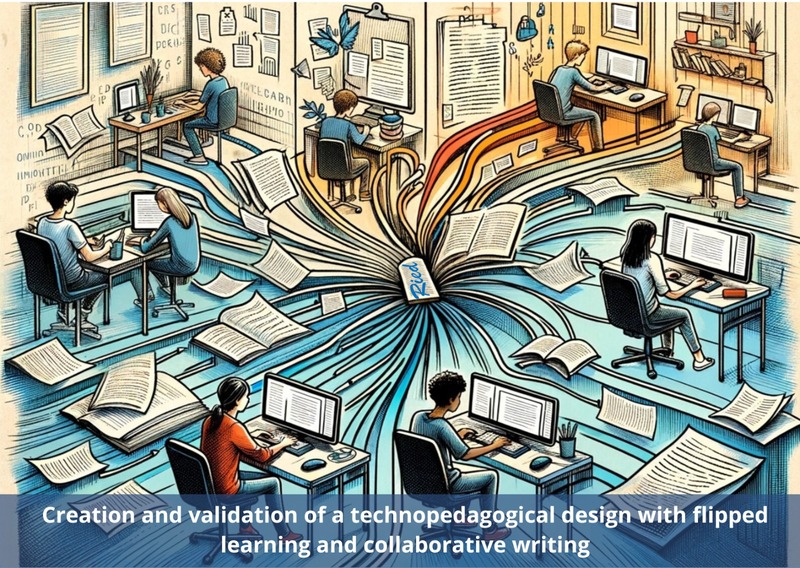
Creation and validation of a technopedagogical design with flipped learning and collaborative writing
DOI:
https://doi.org/10.5944/ried.27.2.38995Keywords:
learning strategies, flipped learning, collaborative writing, technopedagogical design, validityAbstract
Academic writing is a complex transversal competence that still represents a challenge for the development of university education. This challenge involves improving the capacity for argumentation, organization of ideas, and linguistic skills through the implementation of appropriate practices in didactic processes. The objective of this research is to create and validate a technopedagogical design with flipped learning and collaborative writing (TPD-FLCW) to enhance the production of academic texts. The research was conducted with Peruvian university engineering students (diagnostic stage = 89 and experimental stage = 40) and 16 expert professors. The ADDIE model with five phases was used: analysis, design, development, implementation, and evaluation. The initial diagnosis revealed that students had difficulties in academic writing. Based on these results, the proposal was designed and validated with the participation of judges (CVC > 0.9; KFleiss > 0.3, p < 0.05). The application in the experimental group showed significant improvements in the essays produced before and after the intervention (p < 0.05; ĝ > 1.20). Additionally, the students' assessment was positive, and they reported having improved their writing skills, autonomy, and teamwork capacity. It is concluded that the TPD-FLCW proves to be effective and adequate for learning academic writing, and its use is recommended for learning other types of texts.
Downloads
References
Acosta, G. E. R., Cedeño-Tapia, S. J., Diaz-Jurado, L. C., Escalona-Márquez, L. N., Ramírez-Pérez, T., & Vargas, E. C. (2023). Importancia de la lectoescritura académica en la formación de estudiantes de enfermería. Gaceta Medica Boliviana, 46(1), 51-58. https://doi.org/10.47993/gmb.v46i1.631
Amineh, R. J., & Asl, H. D. (2015). Review of constructivism and social constructivism. Journal of Social Sciences, Literature and Languages, 1(1), 9-16.
Andueza-Correa, A. (2022). ¿Cómo ayudaste al estudiantado a resolver su dificultad?: Análisis de las estrategias empleadas por tutores y tutoras de escritura. Revista Electrónica Educare, 27(1), 1-19. https://doi.org/10.15359/ree.27-1.14000
Baldwin, M. P., Fanguy, M., & Costley, J. H. (2019). The effects of collaborative note-taking in flipped learning contexts. Journal of Language and Education, 5(4), 25-35. https://doi.org/10.17323/jle.2019.9726
Barreda-Parra, A., Núñez-Pacheco, R., Turpo-Gebera, O., Diaz-Zavala, R., & Heras, J. E. L. (2023). Perception of Academic Writing in University Students. Human Review. International Humanities Review, 21(2), 401-410. https://doi.org/10.37467/revhuman.v21.5076
Bergmann, J., & Sams, A. (2012). Flip your Classroom. Reach Every Student in Every Class Every Day. International Society for Technology in Education.
Chura-Quispe, G., & García Castro, R. A. (2024). A techno-pedagogical design for the production of academic essays in university students. Contemporary Educational Technology, 16(1), ep 486. https://doi.org/10.30935/cedtech/14022
Chura-Quispe, G., García-Castro, R., Llapa-Medina, M., & Salamanca-Chura, E. (2022). Efecto del Flipped Classroom virtual en la escritura académica: autopercepción de universitarios [The effect of the virtual Flipped Classroom on the academic writing: selfperception of university students]. Pixel-Bit. Revista de Medios y Educación, 65, 121-148. https://doi.org/10.12795/pixelbit.92509
Courtney, M., Costley, J., Baldwin, M., Lee, K., & Fanguy, M. (2022). Individual versus collaborative note-taking: Results of a quasi-experimental study on student note completeness, test performance, and academic writing. Internet and Higher Education, 55, 100873. https://doi.org/10.1016/j.iheduc.2022.100873
Da Fonseca, J. R., Roehrig Teixeira, L., & Arenas Carmona, D. (2021). Socioconstructivism, literacy and working with icts during the coronavirus pandemic in 2020. Texto Livre, 14(2), 1-10. https://doi.org/10.35699/1983-3652.2021.34333
Direkci, B., Akbulut, S., Şimşek, B., Gülmez, M., & Nalçacıgil Çopur, E. (2022). Analysis of pre-service teachers’ argumentation-based academic writing process. Frontiers in Psychology, 13, 1-16. https://doi.org/10.3389/fpsyg.2022.1040332
Ebron, G., & Mabuan, R. (2021). Flipped Learning Approach in Teaching Writing in a University Setting: Students’ Experiences, Preferences and Perspectives. TESOL International Journal, 16(4), 161-183.
Fanguy, M., & Costley, J. (2021). Creating a framework for understanding and defining flipped learning. Journal of Educators Online, 18(1), 1-14. https://doi.org/10.9743/JEO.2021.18.1.2
Festas, I., Seixas, A., & Matos, A. (2023). Escrita a partir de fontes e suas relações com o plágio em estudantes universitários. Educação e Pesquisa, 49, e252586. https://doi.org/10.1590/s1678-4634202349252586por
Godoy, L. (2021). Solving disagreements: Multiple cases study about interaction during digital collaborative writing. Onomazein, 53, 61-83. https://doi.org/10.7764/onomazein.53.06
Hernández, L., & Muñoz, L. (2012). Usos de las tecnologías de la información y la comunicación (TIC) en un proceso formal de enseñanza y aprendizaje en la Educación Básica. Zona Próxima, 16, 2-13. https://www.redalyc.org/pdf/853/85323935002.pdf
Hess, A. N., & Moseley, J. L. (2016). Conducting formative evaluation online from planning to execution. College and Research Libraries News, 77(2), 66-69. https://doi.org/10.5860/crln.77.2.9442
Hsu, H. C. (2020). The impact of task complexity on patterns of interaction during web-based asynchronous collaborative writing tasks. System, 93, 102328. https://doi.org/10.1016/j.system.2020.102328
Huang, A. Y. Q., Lu, O. H. T., & Yang, S. J. H. (2023). Effects of artificial Intelligence–Enabled personalized recommendations on learners’ learning engagement, motivation, and outcomes in a flipped classroom. Computers and Education, 194, 104684. https://doi.org/10.1016/j.compedu.2022.104684
Ito, M., Gutiérrez, K., Livingstone, S., Penuel, B., Rhodes, J., Salen, K., Schor, J., Sefton-Green, J., & Watkins, S. C. (2013). Connected learning: An agenda for research and design. Digital Media and Learning Research Hub.
Jeong, H., & Hmelo-Silver, C. E. (2016). Seven Affordances of Computer-Supported Collaborative Learning: How to Support Collaborative Learning? How Can Technologies Help? Educational Psychologist, 51(2), 247-265. https://doi.org/10.1080/00461520.2016.1158654
Khojasteh, L., Hosseini, S. A., & Nasiri, E. (2021). The impact of mediated learning on the academic writing performance of medical students in flipped and traditional classrooms: scaffolding techniques. Research and Practice in Technology Enhanced Learning, 16(1). https://doi.org/10.1186/s41039-021-00165-9
Koehler, M. J., Mishra, P., & Cain, W. (2015). ¿Qué son los Saberes Tecnológicos y Pedagógicos del Contenido (TPACK)? Virtualidad, Educación y Ciencia, 6(10), 9-23. https://doi.org/10.60020/1853-6530.v6.n10.11552
Kurt, S. (2018). ADDIE Model: Instructional Design. Educational Technology. https://educationaltechnology.net/the-addie-model-instructional-design/
Laal, M., & Ghodsi, S. M. (2012). Benefits of collaborative learning. Procedia. Social and Behavioral Sciences, 31, 486-490. https://doi.org/10.1016/j.sbspro.2011.12.091
Lindeiner-Stráský, K. von, Stickler, U., & Winchester, S. (2022). Flipping the flipped. The concept of flipped learning in an online teaching environment. Open Learning, 37(3), 288-304. https://doi.org/10.1080/02680513.2020.1769584
Lowry, P. B., Curtis, A., & Lowry, M. R. (2004). Building a taxonomy and nomenclature of collaborative writing to improve interdisciplinary research and practice. Journal of Business Communication, 41(1), 66-99. https://doi.org/10.1177/0021943603259363
Martínez-López, J. I., Barrón-González, S., & López, A. M. (2019). Which are the tools available for scholars? A review of assisting software for authors during peer reviewing process. Publications, 7(3). https://doi.org/10.3390/publications7030059
Navarro, F., & Mora-Aguirre, B. (2019). Teorías implícitas sobre escritura académica y su enseñanza: contrastes entre el ingreso, la transición y el egreso universitarios. Universitas Psychologica, 18(3), 1-16. https://doi.org/10.11144/Javeriana.upsy18-3.tiea
Niess, M. L. (2005). Preparing teachers to teach science and mathematics with technology: Developing a technology pedagogical content knowledge. Teaching and Teacher Education, 21(5), 509-523. https://doi.org/10.1016/j.tate.2005.03.006
Owen, H., & Dunham, N. (2015). Reflections on the use of iterative, agile and collaborative approaches for blended flipped learning development. Education Sciences, 5(2), 85-103. https://doi.org/10.3390/educsci5020085
Özdemİr, O., & Açik, F. (2019). Development of written expression skills with flipped learning instruction: An embedded mixed method study. Hacettepe Egitim Dergisi, 34(4), 1075-1091. https://doi.org/10.16986/HUJE.2019048710
Palau, R., & Fornons, V. (2022). Flipped Learning y su distribución de los tiempos de aprendizaje: Una experiencia en educación secundaria. Pixel-Bit. Revista de Medios y Educación, 64, 235-264. https://doi.org/10.12795/pixelbit.92948
Papert, S., & Harel, I. (1991). Situating Constructionism. In I. Harel & S. Papert (Eds.), Constructionism (pp. 1-16). Ablex Publishing.
Pedrosa, I., Suárez Álvarez, J., & García Cueto, E. (2014). Evidencias sobre la Validez de Contenido: Avances Teóricos y Métodos para su Estimación. Acción Psicológica, 10(2), 3-20. https://doi.org/10.5944/ap.10.2.11820
Pham, V. P. H. (2023). The Impacts of Collaborative Writing on Individual Writing Skills. Journal of Psycholinguistic Research, 52(4), 1221-1236. https://doi.org/10.1007/s10936-023-09939-2
Roohani, A., & Rad, H. S. (2022). Effectiveness of Hybrid-Flipped Classroom in Improving Efl Learners’ Argumentative Writing Skill. Teflin Journal, 33(2), 349-366. https://doi.org/10.15639/teflinjournal.v33i2/349-366
Roxas, M. J. (2023). Collaborative Research Writing in the New Normal: Students’ Views, Challenges, Coping Strategies, and Takeaways. Journal of Learning for Development, 10(2), 297-311. https://doi.org/10.56059/jl4d.v10i2.829
Santiago, R., & Bergmann, J. (2018). Aprender al revés (1ra. Ed.). Paídos Educación.
Sargent, J., & Casey, A. (2020). Flipped learning, pedagogy and digital technology: Establishing consistent practice to optimise lesson time. European Physical Education Review, 26(1), 70-84. https://doi.org/10.1177/1356336X19826603
Shafiee Rad, H., Namaziandost, E., & Razmi, M. H. (2022). Integrating STAD and flipped learning in expository writing skills: Impacts on students’ achievement and perceptions. Journal of Research on Technology in Education, 1-17. https://doi.org/10.1080/15391523.2022.2030265
Shanks, J. D., & Young, S. W. H. (2019). Applying Attributes of Contemplative Technopedagogy to a Social Media Assignment. Frontiers in Education, 4, 1-11. https://doi.org/10.3389/feduc.2019.00048
Siemens, G., & Fonseca, D. (2007). Conectivismo: Una teoría del aprendizaje para la era digital. Humanas Virtual. http://www.humanasvirtual.edu.ar/wp-content/uploads/2013/12/Siemens2004-Conectivismo.pdf
Stahl, G. (2004). Group cognition: Computer support for building collaborative knowledge. In Group Cognition. The MIT Press. https://doi.org/10.7551/mitpress/3372.001.0001
Storch, N. (2019). Collaborative writing. Language Teaching, 52(1), 40-59. https://doi.org/10.1017/S0261444818000320
Sundari, H., & Febriyanti, R. H. (2023). Collective Scaffolding in Virtual Collaborative Writing: A Study during Emergency Remote Teaching in Indonesia. Studies in English Language and Education, 10(1), 16-40. https://doi.org/10.24815/siele.v10i1.25039
Suwantarathip, O., & Wichadee, S. (2014). The effects of collaborative writing activity using Google docs on students’ writing abilities. Turkish Online Journal of Educational Technology, 13(2), 148-156.
Svenlin, M., & Jusslin, S. (2023). Thinking brainstorming as otherwise in collaborative writing: A rhizoanalysis. Linguistics and Education, 77, 101218. https://doi.org/10.1016/j.linged.2023.101218
Tan, E., & Carnegie, S. (2022). ‘It’s not plagiarism, it’s a bad use of power phrasing’: Assessment of home and international student (mis) understandings of citation practice. Innovations in Education and Teaching International, 59(3), 285-295. https://doi.org/10.1080/14703297.2020.1844779
Thai, N. T. T., De Wever, B., & Valcke, M. (2023). Feedback: an important key in the online environment of a flipped classroom setting. Interactive Learning Environments, 31(2), 924-937. https://doi.org/10.1080/10494820.2020.1815218
Thirakunkovit, S., & Boonyaprakob, K. (2022). Developing Academic Writing Skills through a Task-Based Approach: A Case Study of Students’ Collaborative Writing. REFLections, 29(3), 526-548. https://doi.org/10.61508/refl.v29i3.261319
Traverso, C. V. (2023). Modelo de clasificación del agente evaluador según relaciones de poder: ¿qué evalúa quién evalúa? Revista Brasileira de Educação, 28, 1-19. https://doi.org/10.1590/s1413-24782023280011
Umutlu, D., & Akpinar, Y. (2020). Effects of different video modalities on writing achievement in flipped English classes. Contemporary Educational Technology, 12(2), ep270. https://doi.org/10.30935/cedtech/7993
Van Dijk, T. A. (1992). La ciencia del texto (3ra ed.). Paidós.
Vygotsky, L. S. (1978). Mind in Society. In The American Journal of Psychology. Harvard University Press. https://doi.org/10.2307/1421493
Yuliani, T., Kurniawati, N., & Siswayani, P. (2023). Engaging Indonesian students in “read, reread, list, compose” strategy to enhance paraphrasing skill. Journal of Education and Learning, 17(2), 195-205. https://doi.org/10.11591/edulearn.v17i2.20438
Zhang, M., Gibbons, J., & Li, M. (2021). Computer-mediated collaborative writing in L2 classrooms: A systematic review. Journal of Second Language Writing, 54, 100854. https://doi.org/10.1016/j.jslw.2021.100854
Zhao, X., & Yang, Y. (2023). Impact of social media-supported flipped classroom on English as a foreign language learners’ writing performance and anxiety. Frontiers in Psychology, 13, 1-12. https://doi.org/10.3389/fpsyg.2022.1052737
Zou, D., Xie, H., & Wang, F. L. (2022). Effects of technology enhanced peer, teacher and self-feedback on students’ collaborative writing, critical thinking tendency and engagement in learning. Journal of Computing in Higher Education, 166-185. https://doi.org/10.1007/s12528-022-09337-y
Downloads
Published
How to Cite
Issue
Section
License
Copyright (c) 2024 Gilber Chura-Quispe, Raúl Alberto García Castro, Gladys Pilar Limache Arocutipa, Bianca Daisa Laura De La Cruz

This work is licensed under a Creative Commons Attribution 4.0 International License.
The articles that are published in this journal are subject to the following terms:
1. The authors grant the exploitation rights of the work accepted for publication to RIED, guarantee to the journal the right to be the first publication of research understaken and permit the journal to distribute the work published under the license indicated in point 2.
2. The articles are published in the electronic edition of the journal under a Creative Commons Attribution 4.0 International (CC BY 4.0) license. You can copy and redistribute the material in any medium or format, adapt, remix, transform, and build upon the material for any purpose, even commercially. You must give appropriate credit, provide a link to the license, and indicate if changes were made. You may do so in any reasonable manner, but not in any way that suggests the licensor endorses you or your use.
3. Conditions for self-archiving. Authors are encouraged to disseminate electronically the OnlineFirst version (assessed version and accepted for publication) of its articles before publication, always with reference to its publication by RIED, favoring its circulation and dissemination earlier and with this a possible increase in its citation and reach among the academic community.