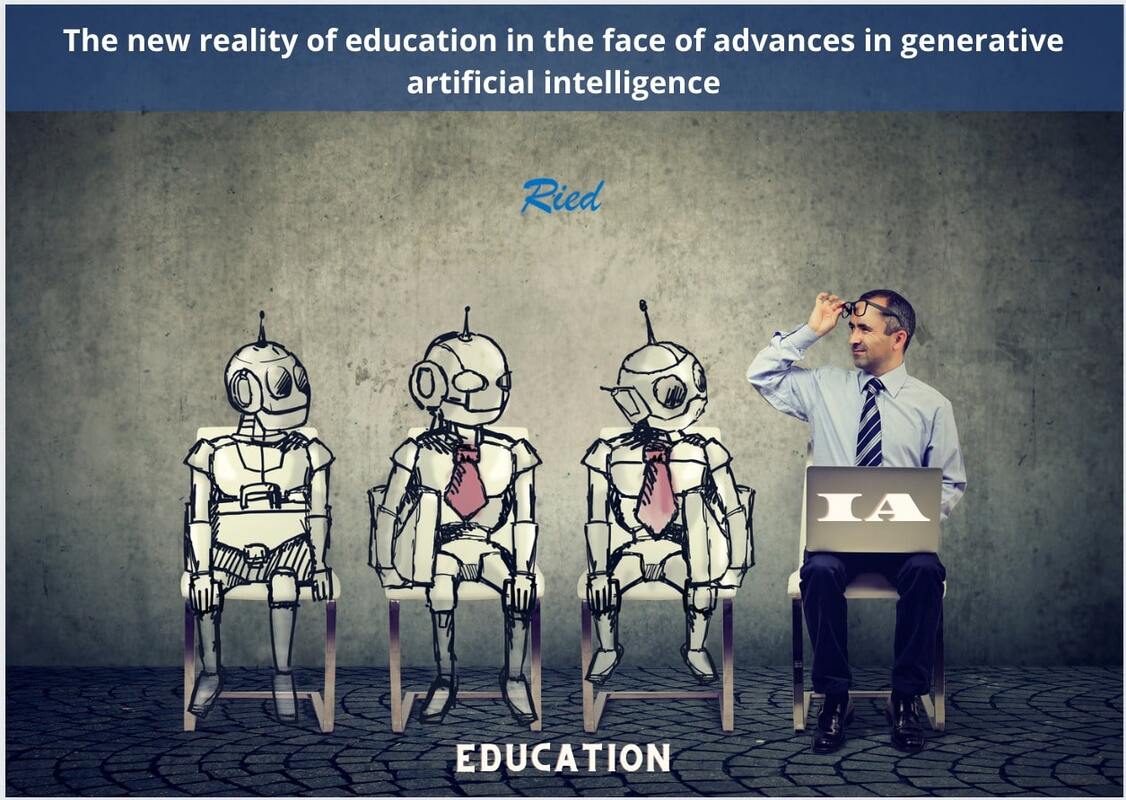
The new reality of education in the face of advances in generative artificial intelligence
DOI:
https://doi.org/10.5944/ried.27.1.37716Keywords:
artificial intelligence, generative artificial intelligence, ChatGPT, educationAbstract
It is increasingly common to interact with products that seem “intelligent”, although the label “artificial intelligence” may have been replaced by other euphemisms. Since November 2022, with the emergence of the ChatGPT tool, there has been an exponential increase in the use of artificial intelligence in all areas. Although ChatGPT is just one of many generative artificial intelligence technologies, its impact on teaching and learning processes has been significant. This article reflects on the advantages, disadvantages, potentials, limits, and challenges of generative artificial intelligence technologies in education to avoid the biases inherent in extremist positions. To this end, a systematic review has been carried out of both the tools and the scientific production that has emerged in the six months since the appearance of ChatGPT. Generative artificial intelligence is extremely powerful and improving at an accelerated pace, but it is based on large language models with a probabilistic basis, which means that they have no capacity for reasoning or comprehension and are therefore susceptible to containing errors that need to be contrasted. On the other hand, many of the problems associated with these technologies in educational contexts already existed before their appearance, but now, due to their power, we cannot ignore them, and we must assume what our speed of response will be to analyse and incorporate these tools into our teaching practice.
FULL ARTICLE:
https://revistas.uned.es/index.php/ried/article/view/37716/27914
Downloads
References
Adiwardana, D. (2020, January 28th). Towards a Conversational Agent that Can Chat About…Anything. Google. http://bit.ly/3YAYGpm
Agarwal, G. (2023). AI Tool Master List. https://doi.org/10.1007/s43681-022-00147-7
Ali, S., DiPaola, D., & Breazeal, C. (2021). What are GANs?: Introducing Generative Adversarial Networks to Middle School Students. In Proceedings of the 35th AAAI Conference on Artificial Intelligence, AAAI 2021 (pp. 15472-15479). https://doi.org/10.1609/aaai.v35i17.17821
Ali, S., DiPaola, D., Lee, I., Sindato, V., Kim, G., Blumofe, R., & Breazeal, C. (2021). Children as creators, thinkers and citizens in an AI-driven future. Computers and Education: Artificial Intelligence, 2, Article 100040. https://doi.org/10.1016/j.caeai.2021.100040
Alier-Forment, M., & Llorens-Largo, F. (2023). EP-31 Las Alucinaciones de ChatGPT con Faraón Llorens In Cabalga el Cometa. https://bit.ly/3ZCNBVT
Alonso, C. (2023, 19 de abril). ¡Ojo con ChatGPT, que es un charlatán mentirosillo! El futuro está por hackear. https://bit.ly/44dEbCk
Arora, A., & Arora, A. (2022). Generative adversarial networks and synthetic patient data: current challenges and future perspectives. Future Healthcare Journal, 9(2), 190-193. https://doi.org/10.7861/fhj.2022-0013
Bozkurt, A., Xiao, J., Lambert, S., Pazurek, A., Crompton, H., Koseoglu, S., Farrow, R., Bond, M., Nerantzi, C., Honeychurch, S., Bali, M., Dron, J., Mir, K., Stewart, B., Costello, E., Mason, J., Stracke, C. M., Romero-Hall, E., Koutropoulos, A., … Jandrić, P. (2023). Speculative futures on ChatGPT and generative artificial intelligence (AI): A collective reflection from the educational landscape. Asian Journal of Distance Education, 18(1), 53-130. https://doi.org/10.5281/zenodo.7636568
Brown, T. B., Mann, B., Ryder, N., Subbiah, M., Kaplan, J., Dhariwal, P., Neelakantan, A., Shyam, P., Sastry, G., Askell, A., Agarwal, S., Herbert-Voss, A., Krueger, G., Henighan, T., Child, R., Ramesh, A., Ziegler, D. M., Wu, J., Winter, C., … Amodei, D. (2020). Language Models are Few-Shot Learners. arXiv. https://doi.org/10.48550/arXiv.2005.14165
Chng, E., Tan, A. L., & Tan, S. C. (2023). Examining the Use of Emerging Technologies in Schools: a Review of Artificial Intelligence and Immersive Technologies in STEM Education. Journal for STEM Education Research, In Press. https://doi.org/10.1007/s41979-023-00092-y
Choi, E. P. H., Lee, J. J., Ho, M. H., Kwok, J. Y. Y., & Lok, K. Y. W. (2023). Chatting or cheating? The impacts of ChatGPT and other artificial intelligence language models on nurse education. Nurse Education Today, 125, Article 105796. https://doi.org/10.1016/j.nedt.2023.105796
Chomsky, N., Roberts, I., & Watumull, J. (2023, March 8th). The False Promise of ChatGPT. The New York Times. http://bit.ly/3GycXfx
Coeckelbergh, M. (2023). La filosofía política de la inteligencia artificial. Una introducción. Cátedra.
Collins, E., & Ghahramani, Z. (2021, May 18th). LaMDA: our breakthrough conversation technology. Google. http://bit.ly/3I5udIZ
Cooper, G. (2023). Examining Science Education in ChatGPT: An Exploratory Study of Generative Artificial Intelligence. Journal of Science Education and Technology, 32, 444-452. https://doi.org/10.1007/s10956-023-10039-y
Cotton, D. R. E., Cotton, P. A., & Shipway, J. R. (2023). Chatting and cheating: Ensuring academic integrity in the era of ChatGPT. Innovations in Education and Teaching International, In Press. https://doi.org/10.1080/14703297.2023.2190148
Crawford, J., Cowling, M., & Allen, K. A. (2023). Leadership is needed for ethical ChatGPT: Character, assessment, and learning using artifiicial intelligence (AI). Journal of University Teaching and Learning Practice, 20(3). https://doi.org/10.53761/1.20.3.02
Crespo Artiaga, D., Ruiz Martínez, P. M., Claver Iborra, J. M., Fernández Martínez, A., & Llorens Largo, F. (Eds.). (2023). UNIVERSITIC 2022. Análisis de la madurez digital de las universidades españolas en 2022. Crue Universidades Españolas. https://bit.ly/3n60tp3
Dennett, D. (2017). De las bacterias a Bach. La evolución de la mente. Pasado & Presente.
Devlin, J., & Chang, M.-W. (2018, November 2nd). Open Sourcing BERT: State-of-the-Art Pre-training for Natural Language Processing. Google. http://bit.ly/3Ebwrpi
Devlin, J., Chang, M.-W., Lee, K., & Toutanova, K. (2019). BERT: Pre-training of deep bidirectional transformers for language understanding. arXiv preprint, Article 1810.04805. https://doi.org/10.48550/arXiv.1810.04805
Dwivedi, Y. K., Kshetri, N., Hughes, L., Slade, E. L., Jeyaraj, A., Kar, A. K., Baabdullah, A. M., Koohang, A., Raghavan, V., Ahuja, M., Albanna, H., Albashrawi, M. A., Al-Busaidi, A. S., Balakrishnan, J., Barlette, Y., Basu, S., Bose, I., Brooks, L., Buhalis, D., … Wright, R. (2023). “So what if ChatGPT wrote it?” Multidisciplinary perspectives on opportunities, challenges and implications of generative conversational AI for research, practice and policy. International Journal of Information Management, 71, Article 102642. https://doi.org/10.1016/j.ijinfomgt.2023.102642
Ebrahimi, Y. (2023). 1000 AI collection tools. http://bit.ly/3YOjkSK
European University Association (2023). Artificial intelligence tools and their responsible use in higher education learning and teaching. European University Association. https://bit.ly/3Hq2ROf
Finnie-Ansley, J., Denny, P., Luxton-Reilly, A., Santos, E. A., Prather, J., & Becker, B. A. (2023). My AI Wants to Know if This Will Be on the Exam: Testing OpenAI's Codex on CS2 Programming Exercises. In ACE '23: Proceedings of the 25th Australasian Computing Education Conference (pp. 97-104). ACM. https://doi.org/10.1145/3576123.3576134
Flores-Vivar, J. M., & García-Peñalvo, F. J. (2023a). La vida algorítmica de la educación: Herramientas y sistemas de inteligencia artificial para el aprendizaje en línea. In G. Bonales Daimiel & J. Sierra Sánchez (Eds.), Desafíos y retos de las redes sociales en el ecosistema de la comunicación, (Vol. 1, pp. 109-121). McGraw-Hill.
Flores-Vivar, J. M., & García-Peñalvo, F. J. (2023b). Reflections on the ethics, potential, and challenges of artificial intelligence in the framework of quality education (SDG4). Comunicar, 31(74), 35-44. https://doi.org/10.3916/C74-2023-03
García-Peñalvo, F. J. (2022). Developing robust state-of-the-art reports: Systematic Literature Reviews. Education in the Knowledge Society, 23, Article e28600. https://doi.org/10.14201/eks.28600
García-Peñalvo, F. J. (2023). The perception of Artificial Intelligence in educational contexts after the launch of ChatGPT: Disruption or Panic? Education in the Knowledge Society, 24, Article e31279. https://doi.org/10.14201/eks.31279
García-Peñalvo, F. J., & Vázquez-Ingelmo, A. (2023). What do we mean by GenAI? A systematic mapping of the evolution, trends, and techniques involved in Generative AI. International Journal of Interactive Multimedia and Artificial Intelligence, In Press.
Gašević, D., Dawson, S., & Siemens, G. (2015). Let’s not forget: Learning analytics are about learning. TechTrends, 59(1), 64-71. https://doi.org/10.1007/s11528-014-0822-x
Gašević, D., Siemens, G., & Sadiq, S. (2023). Empowering learners for the age of artificial intelligence. Computers and Education: Artificial Intelligence, 4, Article 100130. https://doi.org/10.1016/j.caeai.2023.100130
Gates, B. (2023, March 21). The Age of AI has begun. GatesNotes. http://bit.ly/3nZjFF4
Gilson, A., Safranek, C. W., Huang, T., Socrates, V., Chi, L., Taylor, R. A., & Chartash, D. (2023). How Does ChatGPT Perform on the United States Medical Licensing Examination? The Implications of Large Language Models for Medical Education and Knowledge Assessment. JMIR Medical Education, 9, Article e45312. https://doi.org/10.2196/45312
Gobierno de España (2020). ENIA: Estrategia Nacional de Inteligencia Artificial. Ministerio de Asuntos Económicos y Transformación Digital. https://bit.ly/3oHHUb0
Goodfellow, I., Pouget-Abadie, J., Mirza, M., Xu, B., Warde-Farley, D., Ozair, S., Courville, A., & Bengio, Y. (2020). Generative adversarial networks. Commun. ACM, 63(11), 139-144. https://doi.org/10.1145/3422622
Grant, M. J., & Booth, A. (2009). A typology of reviews: an analysis of 14 review types and associated methodologies. Health Information and Libraries Journal, 26(2), 91-108. https://doi.org/10.1111/j.1471-1842.2009.00848.x
Gruetzemacher, R., & Paradice, D. (2022). Deep Transfer Learning & Beyond: Transformer Language Models in Information Systems Research. ACM Computing Surveys, 54(10s). https://doi.org/10.1145/3505245
Gubareva, R., & Lopes, R. P. (2020). Virtual Assistants for Learning: A Systematic Literature Review. In H. Chad Lane, S. Zvacek, & J. Uhomoibhi (Eds.), Proceedings of the 12th International Conference on Computer Supported Education (CSEDU 2020) (Online, May 2 - 4, 2020) (Vol. 1, pp. 97-103). SCITEPRESS. https://doi.org/10.5220/0009417600970103
Hazzan, O. (2023, January 23). ChatGPT in Computer Science Education. BLOG@ACM. http://bit.ly/3WYTxpv
Hoffmann, J., Borgeaud, S., Mensch, A., Buchatskaya, E., Cai, T., Rutherford, E., de las Casas, D., Hendricks, L. A., Welbl, J., Clark, A., Hennigan, T., Noland, E., Millican, K., Driessche, G. v. d., Damoc, B., Guy, A., Osindero, S., Simonyan, K., Elsen, E., … Sifre, L. (2022). Training Compute-Optimal Large Language Models. arXiv, Article arXiv:2203.15556v1. https://doi.org/10.48550/arXiv.2203.15556
Holmes, W., Porayska-Pomsta, K., Holstein, K., Sutherland, E., Baker, T., Shum, S. B., Santos, O. C., Rodrigo, M. T., Cukurova, M., Bittencourt, I. I., & Koedinger, K. R. (2022). Ethics of AI in Education: Towards a Community-Wide Framework. International Journal of Artificial Intelligence in Education, 32, 504-526. https://doi.org/10.1007/s40593-021-00239-1
Informatics Europe (2023). AI in Informatics Education (Position paper by Informatics Europe and the National Informatics Associations). Informatics Europe.
Iskender, A. (2023). Holy or Unholy? Interview with Open AI’s ChatGPT. European Journal of Tourism Research, 34, Article 3414. https://doi.org/10.54055/ejtr.v34i.3169
Johinke, R., Cummings, R., & Di Lauro, F. (2023). Reclaiming the technology of higher education for teaching digital writing in a post-pandemic world. Journal of University Teaching and Learning Practice, 20(2), Article 01. https://doi.org/10.53761/1.20.02.01
Karaali, G. (2023). Artificial Intelligence, Basic Skills, and Quantitative Literacy. Numeracy, 16(1), Article 9. https://doi.org/10.5038/1936-4660.16.1.1438
Karras, T., Laine, S., & Aila, T. (2021). A Style-Based Generator Architecture for Generative Adversarial Networks. IEEE Transactions on Pattern Analysis and Machine Intelligence, 43(12), 4217-4228. https://doi.org/10.1109/TPAMI.2020.2970919
Khan, R. A., Jawaid, M., Khan, A. R., & Sajjad, M. (2023). ChatGPT-Reshaping medical education and clinical management. Pakistan Journal of Medical Sciences, 39(2), 605-607. https://doi.org/10.12669/pjms.39.2.7653
Kingma, D. P., & Welling, M. (2022). Auto-Encoding Variational Bayes. arXiv, Article arXiv:1312.6114v11. https://doi.org/10.48550/arXiv.1312.6114
Kirchner, J. H., Ahmad, L., Aaronson, S., & Leike, J. (2023, January 31). New AI classifier for indicating AI-written text. https://bit.ly/3rbXJYI
Kung, T. H., Cheatham, M., Medenilla, A., Sillos, C., De Leon, L., Elepano, C., Madriaga, M., Aggabao, R., Diaz-Candido, G., Maningo, J., & Tseng, V. (2023). Performance of ChatGPT on USMLE: Potential for AI-assisted medical education using large language models. PLOS Digital Health, 2(2), Article e0000198. https://doi.org/10.1371/journal.pdig.0000198
Kurian, T. (2023, March 14th). The next generation of AI for developers and Google Workspace. The Keyword. http://bit.ly/3mUo0sx
Lee, H. (2023). The rise of ChatGPT: Exploring its potential in medical education. Anatomical sciences education, In Press. https://doi.org/10.1002/ase.2270
Lim, W. M., Gunasekara, A., Pallant, J. L., Pallant, J. I., & Pechenkina, E. (2023). Generative AI and the future of education: Ragnarök or reformation? A paradoxical perspective from management educators. International Journal of Management Education, 21(2), Article 100790. https://doi.org/10.1016/j.ijme.2023.100790
Liu, Y., Han, T., Ma, S., Zhang, J., Yang, Y., Tian, J., He, H., Li, A., He, M., Liu, Z., Wu, Z., Zhu, D., Li, X., Qiang, N., Shen, D., Tianming Liu, & Ge, B. (2023). Summary of ChatGPT/GPT-4 Research and Perspective Towards the Future of Large Language Models. arXiv, Article arXiv:2304.01852v3. https://doi.org/10.48550/arXiv.2304.01852
Llorens-Largo, F. (2019, 13/02/2019). Las tecnologías en la educación: características deseables, efectos perversos. Universídad. https://bit.ly/3SxO72D
Lyu, Z., Ali, S., & Breazeal, C. (2022). Introducing Variational Autoencoders to High School Students. In Proceedings of the 36th AAAI Conference on Artificial Intelligence, AAAI 2022 (pp. 12801-12809). https://doi.org/10.1609/aaai.v36i11.21559
Maslej, N., Fattorini, L., Brynjolfsson, E., Etchemendy, J., Ligett, K., Lyons, T., Manyika, J., Ngo, H., Niebles, J. C., Parli, V., Shoham, Y., Wald, R., Jack Clark, & Perrault, R. (2023). The AI Index 2023 Annual Report. http://bit.ly/3KBVCFa
Masters, K. (2023). Ethical use of artificial intelligence in health professions education: AMEE Guide No. 158. Medical Teacher, 45(6), 574-584. https://doi.org/10.1080/0142159X.2023.2186203
Mbakwe, A. B., Lourentzou, I., Celi, L. A., Mechanic, O. J., & Dagan, A. (2023). ChatGPT passing USMLE shines a spotlight on the flaws of medical education. PLOS digital health, 2(2), Article e0000205. https://doi.org/10.1371/journal.pdig.0000205
Meyer, B. (2022, December 23). What Do ChatGPT and AI-based Automatic Program Generation Mean for the Future of Software. BLOG@CACM. https://bit.ly/3LyAJLj
Muscanell, N., & Robert, J. (2023). EDUCAUSE QuickPoll Results: Did ChatGPT Write This Report? EDUCASE Review. https://bit.ly/44o0uWj
Nemorin, S., Vlachidis, A., Ayerakwa, H. M., & Andriotis, P. (2023). AI hyped? A horizon scan of discourse on artificial intelligence in education (AIED) and development. Learning, Media and Technology, 48(1), 38-51. https://doi.org/10.1080/17439884.2022.2095568
Neubauer, A. C. (2021). The future of intelligence research in the coming age of artificial intelligence – With a special consideration of the philosophical movements of trans- and posthumanism. Intelligence, 87, Article 101563. https://doi.org/10.1016/j.intell.2021.101563
Ng, D. T. K., Lee, M., Tan, R. J. Y., Hu, X., Downie, J. S., & Chu, S. K. W. (2022). A review of AI teaching and learning from 2000 to 2020. Education and Information Technologies, In Press. https://doi.org/10.1007/s10639-022-11491-w
OpenAI. (2023). GPT-4 Technical Report. arXiv, Article arXiv:2303.08774v3. https://doi.org/10.48550/arXiv.2303.08774
Page, M. J., McKenzie, J. E., Bossuyt, P. M., Boutron, I., Hoffmann, T. C., Mulrow, C. D., Shamseer, L., Tetzlaff, J. M., Akl, E. A., Brennan, S. E., Chou, R., Glanville, J., Grimshaw, J. M., Hróbjartsson, A., Lalu, M. M., Li, T., Loder, E. W., Mayo-Wilson, E., McDonald, S., … Moher, D. (2021). The PRISMA 2020 statement: an updated guideline for reporting systematic reviews. BMJ, 372, Article n71. https://doi.org/10.1136/bmj.n71
Pataranutaporn, P., Leong, J., Danry, V., Lawson, A. P., Maes, P., & Sra, M. (2022). AI-Generated Virtual Instructors Based on Liked or Admired People Can Improve Motivation and Foster Positive Emotions for Learning. In Proceedings of 2022 IEEE Frontiers in Education Conference (FIE) (Uppsala, Sweden, 08-11 October 2022). IEEE. https://doi.org/10.1109/FIE56618.2022.9962478
Pavlik, J. V. (2023). Collaborating With ChatGPT: Considering the Implications of Generative Artificial Intelligence for Journalism and Media Education. Journalism and Mass Communication Educator, 78(1), 84-93. https://doi.org/10.1177/10776958221149577
Perkins, M. (2023). Academic Integrity considerations of AI Large Language Models in the post-pandemic era: ChatGPT and beyond. Journal of University Teaching and Learning Practice, 20(2), Article 07. https://doi.org/10.53761/1.20.02.07
Pichai, S. (2023, February 6th). An important next step on our AI journey. Google. http://bit.ly/3YZj9E2
Raffel, C., Shazeer, N., Roberts, A., Lee, K., Narang, S., Matena, M., Zhou, Y., Li, W., & Liu, P. J. (2020). Exploring the limits of transfer learning with a unified text-to-text transformer. Journal of Machine Learning Research, 21(140), 1-67.
Rudolph, J., Tan, S., & Tan, S. (2023). ChatGPT: Bullshit spewer or the end of traditional assessments in higher education? Journal of Applied Learning and Teaching, 6(1), 1-22. https://doi.org/10.37074/jalt.2023.6.1.9
Sabzalieva, E., & Valentini, A. (2023). ChatGPT e inteligencia artificial en la educación superior: Guía de inicio rápido (ED/HE/IESALC/IP/2023/12). UNESCO e Instituto Internacional de la UNESCO para la Educación Superior en América Latina y el Caribe. https://bit.ly/3oeYm2f
Sadasivan, V. S., Kumar, A., Balasubramanian, S., Wang, W., & Feizi, S. (2023). Can AI-Generated Text be Reliably Detected? arXiv, Article arXiv:2303.11156v1. https://doi.org/10.48550/arXiv.2303.11156
Sallam, M. (2023). ChatGPT Utility in Healthcare Education, Research, and Practice: Systematic Review on the Promising Perspectives and Valid Concerns. Healthcare, 11(6), Article 887. https://doi.org/10.3390/healthcare11060887
Searle, J. R. (1980). Minds, brains, and programs. Behavioral and Brain Sciences, 3(3), 417-424. https://doi.org/10.1017/S0140525X00005756
Sivasubramanian, S. (2023, April 13th). Announcing New Tools for Building with Generative AI on AWS. AWS. https://bit.ly/3mziFXM
Šlapeta, J. (2023). Are ChatGPT and other pretrained language models good parasitologists? Trends in parasitology, 39(5), 314-316. https://doi.org/10.1016/j.pt.2023.02.006
Taori, R., Gulrajani, I., Zhang, T., Dubois, Y., Li, X., Guestrin, C., Liang, P., & Hashimoto, T. B. (2023). Alpaca: A Strong, Replicable Instruction-Following Model. Stanford University. https://bit.ly/444TrRx
Thatcher, J., Wright, R. T., Sun, H., Zagenczyk, T. J., & Klein, R. (2018). Mindfulness in Information Technology Use: Definitions, Distinctions, and a New Measure. MIS Quarterly, 42(3), 831-847. https://doi.org/10.25300/MISQ/2018/11881
Thoppilan, R., Freitas, D. D., Hall, J., Shazeer, N., Kulshreshtha, A., Cheng, H.-T., Jin, A., Bos, T., Baker, L., Du, Y., Li, Y., Lee, H., Zheng, H. S., Ghafouri, A., Menegali, M., Huang, Y., Krikun, M., Lepikhin, D., Qin, J., … Le, Q. (2022). LaMDA: Language Models for Dialog Applications. arXiv, Article arXiv:2201.08239v3. https://doi.org/10.48550/arXiv.2201.08239
Thorp, H. H. (2023). ChatGPT is fun, but not an author. Science, 379(6630), 313. https://doi.org/10.1126/science.adg7879
Thurzo, A., Strunga, M., Urban, R., Surovková, J., & Afrashtehfar, K. I. (2023). Impact of Artificial Intelligence on Dental Education: A Review and Guide for Curriculum Update. Education Sciences, 13(2), Article 150. https://doi.org/10.3390/educsci13020150
Tlili, A., Shehata, B., Adarkwah, M. A., Bozkurt, A., Hickey, D. T., Huang, R., & Agyemang, B. (2023). What if the devil is my guardian angel: ChatGPT as a case study of using chatbots in education. Smart Learning Environments, 10(1), Article 15. https://doi.org/10.1186/s40561-023-00237-x
Touvron, H., Lavril, T., Izacard, G., Martinet, X., Lachaux, M.-A., Lacroix, T., Rozière, B., Goyal, N., Hambro, E., Azhar, F., Rodriguez, A., Joulin, A., Grave, E., & Lample, G. (2023). LLaMA: Open and Efficient Foundation Language Models. arXiv, Article arXiv:2302.13971v1. https://doi.org/10.48550/arXiv.2302.13971
Turing, A. M. (1950). Computing machinery and intelligence. Mind, 59(236), 433-460. https://doi.org/10.1093/mind/LIX.236.433
UNESCO. (2019). Beijing Consensus on Artificial Intelligence and Education. International Conference on¬ Artificial Intelligence and Education, Planning Education in the AI Era: Lead the Leap, Beijing, China. ¬https://bit.ly/3n7wBIK
UNESCO. (2021). Inteligencia artificial y educación: Guía para las personas a cargo de formular políticas. UNESCO. https://bit.ly/3Hl93Hj
UNESCO. (2022). Recomendación sobre la ética de la inteligencia artificial. UNESCO. https://bit.ly/3nc3Yu1
van der Zant, T., Kouw, M., & Schomaker, L. (2013). Generative artificial intelligence. In V. C. Müller (Ed.), Philosophy and Theory of Artificial Intelligence (107-120). Springer-Verlag. https://doi.org/10.1007/978-3-642-31674-6_8
Vartiainen, H., & Tedre, M. (2023). Using artificial intelligence in craft education: crafting with text-to-image generative models. Digital Creativity, 34(1), 1-21. https://doi.org/10.1080/14626268.2023.2174557
Vaswani, A., Shazeer, N., Parmar, N., Uszkoreit, J., Jones, L., Gomez, A. N., Kaiser, L., & Polosukhin, I. (2017). Attention is all you need. In Advances in Neural Information Processing Systems 30: Annual Conference on Neural Information Processing Systems 2017, December 4-9, 2017, Long Beach, CA, USA (pp. 5998-6008).
Vázquez-Ingelmo, A., García-Peñalvo, F. J., & Therón, R. (2021). Towards a Technological Ecosystem to Provide Information Dashboards as a Service: A Dynamic Proposal for Supplying Dashboards Adapted to Specific Scenarios. Applied Sciences, 11(7), Article 3249. https://doi.org/10.3390/app11073249
Wang, T., & Cheng, E. C. K. (2021). An investigation of barriers to Hong Kong K-12 schools incorporating Artificial Intelligence in education. Computers and Education: Artificial Intelligence, 2, Article 100031. https://doi.org/10.1016/j.caeai.2021.100031
Yang, J., Jin, H., Tang, R., Han, X., Feng, Q., Jiang, H., Yin, B., & Hu, X. (2023). Harnessing the Power of LLMs in Practice: A Survey on ChatGPT and Beyond. arXiv, Article arXiv:2304.13712v2. https://doi.org/10.48550/arXiv.2304.13712
Yilmaz, R., Yurdugül, H., Karaoğlan Yilmaz, F. G., Şahi̇n, M., Sulak, S., Aydin, F., Tepgeç, M., Müftüoğlu, C. T., & Ömer, O. (2022). Smart MOOC integrated with intelligent tutoring: A system architecture and framework model proposal. Computers and Education: Artificial Intelligence, 3, Article 100092. https://doi.org/10.1016/j.caeai.2022.100092
Zhang, L., Basham, J. D., & Yang, S. (2020). Understanding the implementation of personalized learning: A research synthesis. Educational Research Review, 31, Article 100339. https://doi.org/10.1016/j.edurev.2020.100339
Zhang, R., Han, J., Liu, C., Gao, P., Zhou, A., Hu, X., Yan, S., Lu, P., Li, H., & Qiao, Y. (2023). LLaMA-Adapter: Efficient Fine-tuning of Language Models with Zero-init Attention. arXiv, Article arXiv:2303.16199v2. https://doi.org/10.48550/arXiv.2303.16199
Zhao, W. X., Zhou, K., Li, J., Tang, T., Wang, X., Hou, Y., Min, Y., Zhang, B., Zhang, J., Dong, Z., Du, Y., Yang, C., Chen, Y., Chen, Z., Jiang, J., Ren, R., Li, Y., Tang, X., Liu, Z., … Wen, J.-R. (2023). A Survey of Large Language Models. arXiv, Article arXiv:2303.18223v10. https://doi.org/10.48550/arXiv.2303.18223
Zhou, C., Liu, P., Xu, P., Iyer, S., Sun, J., Mao, Y., Ma, X., Efrat, A., Yu, P., Yu, L., Zhang, S., Ghosh, G., Lewis, M., Zettlemoyer, L., & Levy, O. (2023). LIMA: Less Is More for Alignment. arXiv, Article arXiv:2305.11206v1. https://doi.org/10.48550/arXiv.2305.11206
Downloads
Published
How to Cite
Issue
Section
License
Copyright (c) 2023 Francisco José García Peñalvo, Faraón Llorens-Largo, Javier Vidal

This work is licensed under a Creative Commons Attribution 4.0 International License.
The articles that are published in this journal are subject to the following terms:
1. The authors grant the exploitation rights of the work accepted for publication to RIED, guarantee to the journal the right to be the first publication of research understaken and permit the journal to distribute the work published under the license indicated in point 2.
2. The articles are published in the electronic edition of the journal under a Creative Commons Attribution 4.0 International (CC BY 4.0) license. You can copy and redistribute the material in any medium or format, adapt, remix, transform, and build upon the material for any purpose, even commercially. You must give appropriate credit, provide a link to the license, and indicate if changes were made. You may do so in any reasonable manner, but not in any way that suggests the licensor endorses you or your use.
3. Conditions for self-archiving. Authors are encouraged to disseminate electronically the OnlineFirst version (assessed version and accepted for publication) of its articles before publication, always with reference to its publication by RIED, favoring its circulation and dissemination earlier and with this a possible increase in its citation and reach among the academic community.