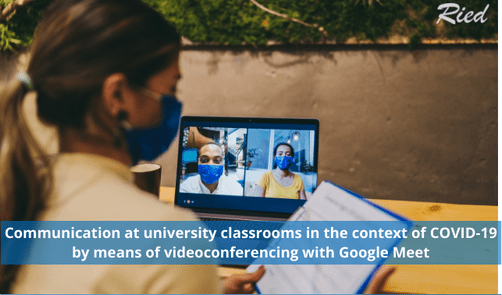
Communication at university classrooms in the context of COVID-19 by means of videoconferencing with Google Meet
DOI:
https://doi.org/10.5944/ried.24.1.27519Keywords:
Google Meet, university training, university students, COVID-19, virtual education, communicationAbstract
The new reality imposed by COVID-19 has meant one of the greatest challenges that face-to-face university teaching has had to confront, as these higher education centres were suddenly forced to change from a face-to-face format to a virtual, contingent kind of teaching. More precisely, face-to-face communication at classrooms now must rely on synchronous videoconferences which have digitally “occupied” the space that was previously regulated in ordinary lessons. It all required using a wide range of technological applications, amongst which Google Meet stood out as one of the most popular. Based on this, our study set itself two objectives: (1) identifying the communication needs that university students have felt throughout this period of virtual teaching; and (2) verifying the extent to which Google Meet succeeded in meeting those needs. Seeking to accomplish the aforesaid goals, we involved 52 students from the Degree in Primary Education Teacher Training imparted at the University of Alicante. A mixed methodological approach was adopted, the software programs utilized for data processing purposes being SPSS v. 25 and AQUAD 7, which enabled us to carry out a descriptive study and a content analysis, respectively. In view of the results, and although the teaching staff have used a synchronous type of audiovisual communication suited to the demands of students, the degree of satisfaction amongst the latter is remarkably low. Something similar happens when it comes to Google Meet because, despite recognizing that it has positive aspects such as a certain degree of usefulness and enjoyment, they claim to have had serious difficulties in using it. Such findings lead us to conclude that a compelling need exists to fine tune the technological response that universities are giving before the situation caused by COVID-19.
FULL ARTICLE:
https://revistas.uned.es/index.php/ried/article/view/27519/22043
Downloads
References
Barbosa, S., y Amariles, M. (2019). Learning styles and the use of ICT in university students within a competency-based training model. Journal of New Approaches in Educational Research, 8(1), 1-6. https://doi.org/10.7821/naer.2019.1.296
Budiana, K. M., y Yutanto H. (2020). Webinar: A strategy to enhance speaking skill of non-native English speaker. Journal of English Educators Society, 5(1), 31-37. https://doi.org/10.21070/jees.v5i1.354
Cabero, J., Barroso, J., y Llorente, Mª. C. (2016). Technology acceptance model & augmented reality: Study in progress. Revista Lasallista de Investigación, 13(2), 18-26. https://doi.org/10.22507/rli.v13n2a2
Carrick, F. R., Abdulrahman, M., Hankir, A., Zayaruzny, M., Najem, K., Lungchukiet, P., y Edwards, R. A. (2017). Randomized controlled study of a remote flipped classroom neuro-otology curriculum. Frontiers in Human Neuroscience, 8, 349. https://doi.org/10.3389/fneur.2017.00349
Cecilio-Fernandes, D., Parisi, M. C. R., Santos, T. M., y Sandars, J. (2020). The COVID-19 pandemic and the challenge of using technology for medical education in low and middle income countries. MedEdPublish. https://doi.org/10.15694/mep.2020.000074.1
Cendon, E. (2018). Lifelong learning at universities: Future perspectives for teaching and learning. Journal of New Approaches in Educational Research, 7(2), 81-87. http://dx.doi.org/10.7821/naer.2018.7.320
Chen, C. H., Liao, C. H., Chen, Y. C., y Lee, C. F. (2011). The integration of synchronous communication technology into service learning for pre-service teachers' online tutoring of middle school students. Internet and Higher Education, 14, 27-33. https://doi.org/10.1016/j.iheduc.2010.02.003
Chen, J., Dobinson, T., y Kent, S. (2020). Student’s perspectives on the impact of Blackboard Collaborate on Open University Australia (OUA) online learning. Journal of Educators Online, 17(1). https://bit.ly/3by9qM3. https://doi.org/10.1080/02680513.2019.1688654
Cornelius, S. (2014). Facilitating in a demanding environment: Experiences of teaching in virtual classrooms using web conferencing. British Journal of Educational Technology, 45(2), 260-271. https://doi.org/10.1111/bjet.12016
Creswell, J. W., y Creswell, J. D. (2018). Research design: Qualitative, quantitative, and mixed methods approaches. Sage.
Davis, F. D. (1989). Perceived usefulness, perceived ease of use, and user acceptance of information technology. MIS Quarterly, 13(3), 319-340. https://doi.org/10.2307/249008
Elo, S., y Kyngäs, H. (2008). The qualitative content analysis process. Journal of Advanced Nursing, 62(1), 107-115. https://doi.org/10.1111/j.1365-2648.2007.04569.x
Franchi, T. (2020). The impact of the COVID-19 pandemic on current anatomy education and future careers: A student’s perspective. Anatomical Sciences Education. https://doi.org/10.1002/ase.1966
Gegenfurtner, A., Zitt, A., y Ebner, C. (2020). Evaluating webinar-based training: A mixed methods study of trainee reactions toward digital web conferencing. International Journal of Training and Development, 24(1), 5-21. https://doi.org/10.1111/ijtd.12167
Hsieh, H. F., y Shannon, S. E. (2005). Three approaches to qualitative content analysis. Qualitative Health Research, 15(9), 1277-1288. https://doi.org/10.1177/1049732305276687
Huber, G. L., y Gürtler, L. (2013). AQUAD 7. Manual: The analysis of qualitative data. Ingeborg Huber Verlag.
Infante-Moro, A., Infante-Moro, J., y Gallardo-Pérez, J. (2019). The importance of ICTs for students as a competence for their future professional performance: The case of the faculty of business studies and tourism of the University of Huelva. Journal of New Approaches in Educational Research, 8(2), 201-213. http://dx.doi.org/10.7821/naer.2019.7.434
Kerres, M. (2020). Against all odds: Education in Germany coping with COVID-19. Postdigital Science and Education. https://doi.org/10.1007/s42438-020-00130-7
Morrison, K. A. (2011). Using web conferencing to teach constructivist, discussion-rich seminars: Can it work? The Quarterly Review on Distance Education, 12(4), 269-274.
Rao, P. (2019). Webinars and their effective use in English language teaching and learning. ELT Vibes: International E-Journal for Research in ELT, 5(1), 73-97.
Sandars, J., Correia, R., Dankbaar, M., de Jong, P., Goh, P. S., Hege, I. … Pusic, M. (2020). Twelve tips for rapidly migrating to online learning during the COVID-19 pandemic. MedEdPublish. https://doi.org/10.15694/mep.2020.000082.1
Sandhya, S., Koppad, S. H., Kumar, S. A., Dharani, A., Uma, B. V., y Subramanya, K. N. (2020). Adoption of Google Forms for enhancing collaborative stakeholder engagement in higher education. JEET Journal of Engineering Education Transformations, 33, 283-289. https://doi.org/10.16920/jeet/2020/v33i0/150161
So, S. (2016). Mobile instant messaging support for teaching and learning in higher education. Internet and Higher Education, 31, 32-42. https://doi.org/10.1016/j.iheduc.2016.06.001
Taha, M. H, Abdalla, M. E., Wadi, M., y Khalafalla, H. (2020). Curriculum delivery in medical education during an emergency: A guide based on the responses to the COVID-19 pandemic. MedEdPublish. https://doi.org/10.15694/mep.2020.000069.1
Trespalacios, J., y Uribe-Florez, L. (2020). Developing online sense of community: Graduate students’ experiences and perceptions. Turkish Online Journal of Distance Education, 21(1), 57-72. https://doi.org/10.17718/tojde.690340
UNESCO. (2020). Handbook on facilitating flexible learning during educational disruption: The Chinese experience in maintaining undisrupted learning in COVID-19 outbreak. https://bit.ly/3fQyeSJ
Villalón, R., Luna, Mª., y García-Barrera, A. (2019). Valoración y uso de la plataforma Blackboard Collaborate en una universidad a distancia: estudio de caso sobre las prácticas declaradas de docentes del Grado de Psicología. Digital Education Review, 35, 267-288.
Downloads
Published
How to Cite
Issue
Section
License
Copyright (c) 2020 RIED. Revista Iberoamericana de Educación a Distancia

This work is licensed under a Creative Commons Attribution 4.0 International License.
The articles that are published in this journal are subject to the following terms:
1. The authors grant the exploitation rights of the work accepted for publication to RIED, guarantee to the journal the right to be the first publication of research understaken and permit the journal to distribute the work published under the license indicated in point 2.
2. The articles are published in the electronic edition of the journal under a Creative Commons Attribution 4.0 International (CC BY 4.0) license. You can copy and redistribute the material in any medium or format, adapt, remix, transform, and build upon the material for any purpose, even commercially. You must give appropriate credit, provide a link to the license, and indicate if changes were made. You may do so in any reasonable manner, but not in any way that suggests the licensor endorses you or your use.
3. Conditions for self-archiving. Authors are encouraged to disseminate electronically the OnlineFirst version (assessed version and accepted for publication) of its articles before publication, always with reference to its publication by RIED, favoring its circulation and dissemination earlier and with this a possible increase in its citation and reach among the academic community.