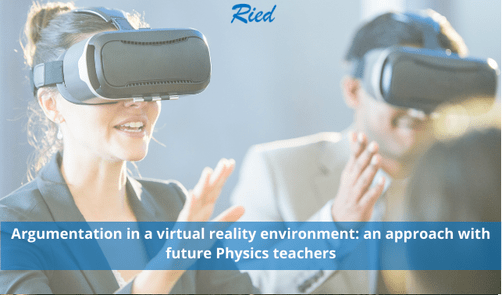
Argumentation in a virtual reality environment: an approach with future Physics teachers
DOI:
https://doi.org/10.5944/ried.24.1.27511Keywords:
digital technologies, pre-service teacher, physicsAbstract
In this work, we investigate the use of virtual reality for teaching Physics and its learning potential from an argumentative point of view. For this purpose, we created a simulation on the Sandbox platform concerning the Oblique Launch of Objects besides a problem question to be answered: There are two objects in the simulation environment, A and B. When making launches to hit them, which target is reached in the shortest flight time? This simulation was performed by 14 undergraduate students of Science courses at a Brazilian university, during a course about didactic materials. The students solved the problem by working in pairs on different computers, interacting with each order by a chat on the same program. The messages were recorded and were exported to sheets to be analyzed by the Rainbow Analytical Framework, which is configured as a tool for the analysis of argumentative discussions in Collaborative Learning environments. The results showed an assertive movement by the undergraduate students to solve the problem, with a predominance of actions focused on argumentative practice. Such results demonstrate the potential of virtual reality to the immersive learning of Physics concepts, as well as favoring the approach of future teachers to the demands placed by an increasingly computerized society, such as the Virtual World.
FULL ARTICLE:
https://revistas.uned.es/index.php/ried/article/view/27511/22041
Downloads
References
Backes, L., & Schlemmer, E. (2007). Processo de interação na formação de educadores para construção do mundo virtual. Revista de Ciências Humanas, 8(10), 29-50.
Baker, M., Andriessen, J., Lund, K., van Amelsvoort, M., & Quignard, M. (2007). Rainbow: A framework for analysing computer-mediated pedagogical debates. International Journal of Computer-Supported Collaborative Learning, 2(2-3), 315-357. https://doi.org/10.1007/s11412-007-9022-4
Bakri, H., Allison, C., Miller, A., & Oliver, I. (2016). Virtual Worlds and the 3D Web – Time for Convergence? In C. Allison, L. Morgado, J. Pirker, D. Beck, J. Richter, & C. Gütl (Orgs.), Immersive Learning Research Network (29-42). Springer International Publishing. https://doi.org/10.1007/978-3-319-41769-1_3
Biagini, M., Trotta, P., & Joy, B. (2013). Immersive Technology Supporting Individual and Collective Training. Proc. STO Modeling Simulation Group Conf., 1-16.
Boğar, Y. (2019). Synthesis Study on Argumentation in Science Education. International Education Studies, 12(9), 1. https://doi.org/10.5539/ies.v12n9p1
Burns, E., Easter, D., Chadwick, R., Smith, D. A., & Rosengrant, C. (2014). The Virtual World Framework: Collaborative virtual environments on the web. 2014 IEEE Virtual Reality (VR), 165-166. https://doi.org/10.1109/VR.2014.6802103
Corcini, L., Medeiros, L., & Moser, A. (2016). Changing Ways for a Better Education: A 3D Gamified Virtual Learning Environment (VLE). ATINER’s Conference Paper Series, EDU2016-1945, 1-16.
Falcade, A., Krassmann, A., Freitas, V., Kautzmann, T., & Medina, R. D. (2016). Design Instrucional: Um comparativo de metodologias para definição de abordagem em mundo virtual. Anais do XXVII Simpósio Brasileiro de Informática na Educação, 80-89. https://doi.org/10.5753/cbie.sbie.2016.80
Fettahlıoğlu, P., & Kaleci, D. (2018). Online Argumentation Implementation in the Development of Critical Thinking Disposition. Journal of Education and Training Studies, 6(3), 127. https://doi.org/10.11114/jets.v6i3.2904
França, C. R., & Silva, T. da. (2019). A Realidade Virtual e Aumentada e o Ensino de Ciências. Revista de Estudos e Pesquisas sobre Ensino Tecnológico (EDUCITEC), 5(10), Article 10. https://doi.org/10.31417/educitec.v5i10.414
Girvan, C. (2018). What is a virtual world? Definition and classification. Educational Technology Research and Development, 66(5), 1087-1100. https://doi.org/10.1007/s11423-018-9577-y
Hewitt, P. G. (2017). Conceptual Physics (12th edition). Pearson India.
Leitão, S. (2007). Processos de construção do conhecimento: A argumentação em foco. Pro-Posições, 18(3), 75-92.
Lourenço, A. B., Santos, A. R. dos, Gomes, G. E. A., & Queiroz, S. L. (2019). Construção de mapa conceitual e implicações na prática da argumentação. Caminhos da Educação Matemática em Revista, 9(4), 6–28.
McLoughlin, E., & Kampen, P. van (Orgs.). (2019). Concepts, Strategies and Models to Enhance Physics Teaching and Learning. Springer International Publishing. https://doi.org/10.1007/978-3-030-18137-6
Noroozi, O., & Hatami, J. (2019). The effects of online peer feedback and epistemic beliefs on students’ argumentation-based learning. Innovations in Education and Teaching International, 56(5), 548-557. https://doi.org/10.1080/14703297.2018.1431143
Rocha, S. S. D., Joye, C. R., & Moreira, M. M. (2020). A Educação a Distância na era digital: Tipologia, variações, uso e possibilidades da educação online. Research, Society and Development, 9(6), 10963390. https://doi.org/10.33448/rsd-v9i6.3390
Sá, L. P., Kasseboehmer, A. C., & Queiroz, S. L. (2014). Esquema de argumento de Toulmin como instrumento de ensino: Explorando possibilidades. Ensaio Pesquisa em Educação em Ciências (Belo Horizonte), 16(3), 147-170. https://doi.org/10.1590/1983-21172014160307
Silva, A. C. da, & Chiaro, S. D. (2018). O impacto da interface entre a aprendizagem baseada em problemas e a argumentação na construção do conhecimento científico. Investigações em Ensino de Ciências, 23(3), 82. https://doi.org/10.22600/1518-8795.ienci2018v23n3p82
Souza, N. S., Cabral, P. F. O., & Queiroz, S. L. (2015). Argumentação de Graduandos em Química sobre Questões Sociocientíficas em um Ambiente Virtual de Aprendizagem. Química Nova Na Escola, 37, 95-109. https://doi.org/10.5935/0104-8899.20150022
Toulmin, S. (2001). Os usos do argumento. Martins Fontes.
Wang, J., & Buck, G. A. (2018). Exploring the Use of Debate to Enhance Elementary Teacher Candidates’ Argumentation Skills. 30-47.
Downloads
Published
How to Cite
Issue
Section
License
Copyright (c) 2021 RIED. Revista Iberoamericana de Educación a Distancia

This work is licensed under a Creative Commons Attribution 4.0 International License.
The articles that are published in this journal are subject to the following terms:
1. The authors grant the exploitation rights of the work accepted for publication to RIED, guarantee to the journal the right to be the first publication of research understaken and permit the journal to distribute the work published under the license indicated in point 2.
2. The articles are published in the electronic edition of the journal under a Creative Commons Attribution 4.0 International (CC BY 4.0) license. You can copy and redistribute the material in any medium or format, adapt, remix, transform, and build upon the material for any purpose, even commercially. You must give appropriate credit, provide a link to the license, and indicate if changes were made. You may do so in any reasonable manner, but not in any way that suggests the licensor endorses you or your use.
3. Conditions for self-archiving. Authors are encouraged to disseminate electronically the OnlineFirst version (assessed version and accepted for publication) of its articles before publication, always with reference to its publication by RIED, favoring its circulation and dissemination earlier and with this a possible increase in its citation and reach among the academic community.