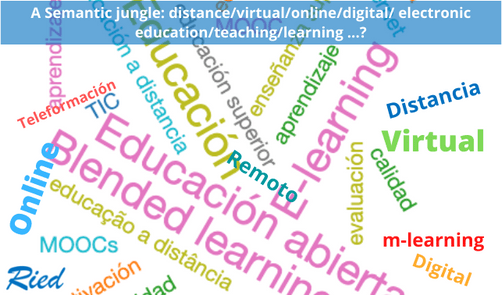
A Semantic jungle: distance/virtual/online/digital/electronic education, teaching, learning ...?
DOI:
https://doi.org/10.5944/ried.23.1.25495Keywords:
distance education, virtual, online, digital, eLearning, semantic jungle, definition, denominations.Abstract
Since its inception, distance education has had underlying theoretical weaknesses. This problem grew with the integration of advanced technologies in the educational processes. Since then, a “semantic jungle” has emerged in a way that has increasingly entangled the entire theoretical framework of this educational modality. During the last decade of the previous century, denominations have proliferated around the concept of distance education, growing even more with the arrival of digital technologies. In our task of reviewing these multiple denominations of the non-face-to-face educational phenomenon, we begin by selecting what seems to be the most appropriate to us, “distance education”. We analyze the two terms that make up that the concept, "education" versus teaching, learning or instruction, and "distance" versus electronic, online, virtual or digital, arguing in each case its total validity in today's society. Finally, we try to offer a definition of this concept that we intend to integrate with other current ways of educating via digital support, highlighting the ideas of dialogue (educational communication and interaction), didactic (pedagogical vision of the acquisition of valuable learning) and mediated (necessary technological component when there is a physical separation during the educational act). Finally, we define distance education as a mediated educational dialogue between teachers of an institution and students who, located in a different space from those, can learn independently or in groups.
Downloads
References
Anderson, T. y Dron, J. (2011). Thre Generations of Distance Education Pedagogy. The International Review of Research in Open and Distance Learning, 12(3).
Annand, D. (2007). Re-organizing universities for the information age. The International Review of Research in Open and Distance Learning. Vol. 8 (3).
Bartolomé, A. (2008). Entornos de aprendizaje mixto en educación superior. RIED. Revista Iberoamericana de Educación a Distancia, 11(1), 15-51. doi:https://doi.org/10.5944/ried.1.11.955
Blackburn, G. (2018). e-Learning Or eLearning? Confusion: It's All In A Word. eLearning Industry. Recuperado de: https://elearningindustry.com/e-Learning-or-elearning-confusion-all-word
Deimann, M. (2019). Openness. En Jung, I. (ed.) (2019). Open and Distance Education Theory Revisited. Implications for the Digital Era. Singapore: Springer.
Dillenbourg, P., Schneider, D. y Synteta. P. (2002). Virtual Learning Environments. 3rd Hellenic Conference ”Information Communication Technologies in Education”, pp.3-18. Kastaniotis: Rhodes.
Edwards, R. (1995). Different discourses, discourses of difference: Globalisation, distance education, and open learning. Distance Education, 16(2), 241–255.
García Aretio, L. (1986). Educación superior a distancia. Análisis de su eficacia. Badajoz: UNED-Mérida.
García Aretio, L. (1989). La educación: teorías y conceptos. Perspectiva integradora. Madrid: Paraninfo.
García Aretio, L. (1994). Educación a distancia hoy. Madrid: UNED
García Aretio, L. (2001). La educación a distancia. De la teoría a la práctica. Barcelona: Ariel, 328 pp.
García Aretio, L. (2004). Viejos y nuevos modelos de educación a distancia. Bordón, 56(3-4).
García Aretio, L. (2009). ¿Por qué va ganando la educación a distancia? Madrid: UNED.
García Aretio, L. (2014). Bases, mediaciones y futuro de la educación a distancia en la sociedad digital. Madrid: Síntesis.
García Aretio, L. y Marín Ibáñez, R. (Coords.) (1998). Aprendizaje abierto y a distancia. Perspectivas y consideraciones políticas..Madrid: UNESCO-UNED
García Peñalvo, F. (2005). Estado actual de los sistemas e-Learning. Teoría de la Educación. Educación y Cultura en la Sociedad de la Información, 6 (2)
García-Peñalvo, F., y Seoane, A. (2015). Una revisión actualizada del concepto de eLearning. Décimo Aniversario. Education In The Knowledge Society (EKS), 16(1), 119-144. doi:10.14201/eks2015161119144
Garrison, D.R. (1989). Understanding distance education. A framework for the future. London: Routledge.
Garrison, D.R. (2016). E-Learning en el siglo XXI. Un marco comunitario de investigación para la investigación y la práctica. New York: Routledge.
Garrison, D.R. y Shale, D. (1987). Mapping the boundaries of distance education: Problems in defining the field. American Journal Distance Education, 1, 3.
Garrison, D.R. y Baynton, M. (1987). Beyond independence in distance education: The concept of control. American Journal Distance Educatio, 1, 3.
Harasim, L. (2000). Shift happens: Online education as a new paradigm in learning. Internet and Higher Education. Vol. 3 (1-2), pp. 41-61.
Henri, F. (1992). Computer conferencing and content analysis. En Kaye, A.R. (ed.), Collaborative learning through computer conferencing: The Najaden papers, Berlin: Springer-Verlag, pp. 117-136.
Holmberg, B. (1995). The evolution of the character and practice of distance education. Open Learning 10 (2): 47-53.
Holmberg, B. (2003). A theory of distance education based on empathy. En Moore, M. y Anderson, W.G. (eds.) Handbook of distance education. New Jersey: Lawrence Erlbaum Associates, pp. 79-86.
Guri-Rosenblit, S. (2005). Distance education and e-learning: Not the same thing. Higher Education. Vol. 49, pp. 467-493.
Guri-Rosenblit, S. (2009). Digital technologies in higher education: Sweeping expectations and actual effects. New York: Nova Science.
Guri-Rosenblit, S. y Gros, B. (2011). E-Learning: Confusing Terminology, Research Gaps and Inherent Challenges. The Journal of Distance Education. Vol. 25 (1).
Jonassen, D. y Driscol, M. (2013). Handbook of Research on Educational Communications and Technology. Routledge: New York.
Jung, I. (ed.) (2019). Open and Distance Education Theory Revisited. Implications for the Digital Era. Singapore: Springer.
Kanuka , H. y Conrad, D. (2003). The Name of the Game: Why “Distance Education” Says It All. An Official Journal of the Association for Educational Communications and Technology, 4(4).
Keegan, D. (1983). Six distance education Theorists. Hagen: ZIFF
Keegan, D. (1996). Foundations of distance education. Routledge: Londres.
Larreamendy-Joerns, J. y Leinhardt, G. (2006). Going the distance with online education. Review of Educational Research. Vol. 76 (4), pp. 567-605.
Lin, M. H., Chen, H. C., y Liu, K. S., (2017). A Study of the Effects of Digital Learning on Learning Motivation and Learning Outcome. Eurasia Journal of Mathematics, Science and Technology Education, 13(7), 3553-3564.
Marín, R. (1985): Pedagogía Universitaria de la creatividad. Revista Española de Pedagogía, 169-170.
Moore, M.G. (1972). Learner autonomy: The second dimension of independent learning. Collection of Conference Pa¬pers. Warrenton (Vir¬ginia), II.
Moore, M.G. (1977). On a theory of independent study. Epis¬tolodidaktika.
Moore, M. (2007). The Theory of Transactional Distance. En Moore, M. G. (ed.) The Handbook of Distance Education. Mahwah, N. J.: Lawrence Erlbaum Associates, pp. 89-108
Moore, J.L., Dickson-Deane, C. y Galyen, K. (2011). e-Learning, online learning, and distance learning environments: Are they the same?. Internet and Higher Education, 14(2), 129-135.
Moore, M.G. y Kearsley, G. (2011). Distance Education: A Systems View of Online Learning (What's New in Education). CENGAGE Learning Custom Publishing.
Peters, O. (1971). Theoretical aspects of correspondence instruction. En McKenzie y Christensen. The changing world of correspondence study. Pensylvania State University Presss.
Peters, O. (1993). Distance education in a post-industrial society. En Keegan (ed) Teoretical principles of distance education. London & New York: Routledge.
Saltzberg, S., y Polyson, S. (1995). Distributed learning on the World Wide Web. Syllabus, 9(1), 10–12.
Sangrá, A., Vlachopoulos, D. y Cabrera, N. (2012). Building an inclusive definition of e-learning: An approach to the conceptual framework. The International Review of Research in Open and Distance Learning. Vol. 13 (2).
Seels, B.B. and Richey, R.C. (1994) Instructional technology: The definition and domains of the field. AECT, Washington DC.
Siemens, G. (2004). Connectivism: A Learning Theory for the Digital Age Recuperado: http://citeseerx.ist.psu.edu/viewdoc/download?doi=10.1.1.87.3793&rep=rep1&type=pdf
Simonson, M.; Schlosser, C y Hanson, D. (1999). Theory and distance education: A new discussion. American Journal of Distance Education, 13(1), https://doi.org/10.1080/08923649909527014
Simonson, M.; Smaldino, S. y Zvacek, S.M. (2011). Teaching and Learning at a Distance: Foundations of Distance Education. Prentice Hall: NJ.
Slavin, R. (1995). Cooperative learning: Theory, research and practice. Boston: Allyn and Bacon.
Thompson, M.M. (2019). Are we re-marginalizing distance education students and teachers? Online Learning, 11 doi: 10.24059/olj.v11i1.1740.
Twigg, C. (2001). Innovations in online learning: Moving beyond the no significant difference. Troy, NY: Pew Learning & Technology Program.
Wedemeyer, C.A. (1971). Independent study. En Deighton, L.C. (ed) The Encyclopedia of Education, 4. New York: Macmillan.
Wedemeyer, C. A. (1981). Learning at the back door. Reflections on non-traditional learning in the lifespan. Madison: The Univer¬sity of Wisconsin Press.
Downloads
Published
How to Cite
Issue
Section
License
Copyright (c) 2019 RIED. Revista Iberoamericana de Educación a Distancia

This work is licensed under a Creative Commons Attribution 4.0 International License.
The articles that are published in this journal are subject to the following terms:
1. The authors grant the exploitation rights of the work accepted for publication to RIED, guarantee to the journal the right to be the first publication of research understaken and permit the journal to distribute the work published under the license indicated in point 2.
2. The articles are published in the electronic edition of the journal under a Creative Commons Attribution 4.0 International (CC BY 4.0) license. You can copy and redistribute the material in any medium or format, adapt, remix, transform, and build upon the material for any purpose, even commercially. You must give appropriate credit, provide a link to the license, and indicate if changes were made. You may do so in any reasonable manner, but not in any way that suggests the licensor endorses you or your use.
3. Conditions for self-archiving. Authors are encouraged to disseminate electronically the OnlineFirst version (assessed version and accepted for publication) of its articles before publication, always with reference to its publication by RIED, favoring its circulation and dissemination earlier and with this a possible increase in its citation and reach among the academic community.