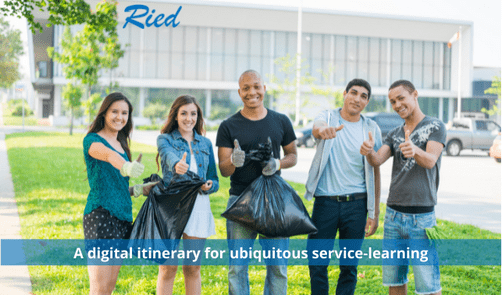
A digital itinerary for ubiquitous service-learning
DOI:
https://doi.org/10.5944/ried.23.1.25389Keywords:
information and communication technologies, ubiquitous service-learning, innovational projects, digital itinerary, secondary educationAbstract
This work reflects on the inclusion of digital technologies in solidarity service-learning (SL) projects with a Latin-American perspective, based on research carried out to analyze the use of information and communication technologies (ICT) in the development of SL projects in public secondary schools in Argentina. The research analyzes a series of projects in which ICTs were integrated in the different disciplines to "expand" the students' experience and help them connect the "distributed" knowledge to solve specific problems in their community. The research starts from the case study as a methodological option since we are interested in deepening and understanding how ICTs enter the selected projects. Among the results, we found that ICTs came in to better organize and represent the available information, develop critical thinking tools and better instruments to evaluate practices. In sum, ICTs give visibility to the invisible learning that occurs in solidarity projects. The young people recreated the disciplinary contents incorporating various multimedia languages and resources to improve their learning, express their ideas and reflections and communicate their initiatives. There emerged new spaces and formats for personal and group reflection and for communication between different actors to contribute new knowledge, accompany solidarity initiatives or access the service they provided, extending the scope of ApS projects to promote the development of a global citizenship.
Downloads
References
Bradshaw, A. (2017). Critical Pedagogy and Educational Technology. In Benson, A., Joseph, R. y Moore, J. (2017) Culture, Learning, and Technology. New York, USA: Routledge.
Buckingham, D. (2008). Más allá de la tecnología. Aprendizaje infantil en la era de la cultura digital. Buenos Aires, Argentina: Ediciones Manantial.
Burbules, N. (2008). Riesgos y promesas de las TIC en educación. ¿Qué hemos aprendido en estos últimos diez años? en UNICEF ARGENTINA – IIPE-UNESCO Buenos Aires. Las TIC. Del aula a la agenda política. Ponencias del Seminario Internacional Cómo las TIC transforman las escuelas. Buenos Aire, Argentina: IIPE UNESCO.
CLAYSS - Centro Latinoamericano de Aprendizaje y Servicio Solidario y Scholas Occurrentes (2017). Escuelas para el Encuentro. Cómo desarrollar proyectos de aprendizaje-servicio solidario. Recuperado de: http://www.clayss.org/04_publicaciones/Manual_CLAYSS_Scholas.pdf
Cobo Romaní, C.; Movarec, J. (2011). Aprendizaje invisible. Hacia una nueva ecología de la educación. Col.lecció Transmedia XXI. Laboratori de Mitjans Interactius / Publicacions i Edicions de la Barcelona: Universitat de Barcelona.
De Pablos Pons, J. (2003). La Tecnología Educativa hoy no es como ayer: Nuevos enfoques, nuevas miradas. Tecnología y Comunicación Educativa, 37, 4 – 21.
Deely, Susan (2016). El Aprendizaje-Servicio en educación superior. Madrid: Narcea.
Díaz De Salas, S. A.; Mendoza Martínez, V. M., y Porras Morales, C. M. (2011). Una guía para la elaboración de estudios de caso. Razón y palabra, 75, 1-23.
Furco, A. (1996). Service-Learning: A Balanced Approach to Experiential Education. Service Learning, General, 128. Recuperado de: https://digitalcommons.unomaha.edu/slceslgen/128
Furco, A. (2016). La comunidad como recurso para el aprendizaje: Un análisis del aprendizaje-servicio académico en la educación primaria y secundaria. En OCDE, OIE-UNESCO, UNICEF LACRO. La naturaleza del aprendizaje: Usando la investigación para inspirar la práctica. Recuperado de: http://panorama.oei.org.ar/_dev/wp-content/uploads/2017/09/UNICEF_UNESCO_OECD_Naturaleza_Aprendizaje_.pdf
Gardner, H. (2003). Inteligencias múltiples: la teoría en la práctica. Barcelona: Paidós.
Gardner, H. (2005). Las cinco mentes del futuro. Barcelona: Paidós.
Gardner, H. (2005). Service-learning and Good Work. En National Youth Leadership Conference. Growing to Greatness 2005. St. Paul, MN, USA.
GoodWork Project® Team (2006). The GoodWork Project®: An Overview. Recuperado de: www.goodworkproject.org
Jacquinot, G. (1996). La escuela frente a las pantallas. Buenos Aires, Argetina: Aique Grupo Editor.
Litwin, E. (2008). El oficio de enseñar. Condiciones y contextos. Buenos Aires, Argentina: Paidós.
Maggio, M. (2018). Reinventar la clase en la universidad. Buenos Aires: Paidós.
Mayer, R. (2016). Aprendizaje con tecnología. En OCDE, OIE-UNESCO, UNICEF LACRO. La naturaleza del aprendizaje: Usando la investigación para inspirar la práctica. Recuperado de: http://panorama.oei.org.ar/_dev/wp-content/uploads/2017/09/UNICEF_UNESCO_OECD_Naturaleza_Aprendizaje_.pdf
Ministerio de Educación. Unidad de Programas Especiales. Programa Nacional Educación Solidaria. (2008). Antología 1997-2007. Seminarios Internacionales “Aprendizaje y Servicio Solidario”. Buenos Aires, Argentina: Ministerio de Educación.
Morrissey, J. (2008). El uso de TIC en la enseñanza y el aprendizaje. Cuestiones y desafíos. En UNICEF ARGENTINA – IIPE-UNESCO Buenos Aires. Las TIC. Del aula a la agenda política. Ponencias del Seminario Internacional Cómo las TIC transforman las escuelas. Buenos Aires, Argentina: IIPE UNESCO.
OCDE, OIE-UNESCO, UNICEF LACRO (2016). La naturaleza del aprendizaje: Usando la investigación para inspirar la práctica. Recuperado de: http://panorama.oei.org.ar/_dev/wp-content/uploads/2017/09/UNICEF_UNESCO_OECD_Naturaleza_Aprendizaje_.pdf
Salomon, G. (1993). Cogniciones distribuidas. Consideraciones psicológicas y educativas. Madrid: Amorrortu.
Sancho Gil, Juana Ma. (Coord.) (2006). Tecnologías para transformar la educación. Madrid: Ediciones Akal.
Simons, H. (2011). El estudio de caso: teoría y práctica. Madrid: Morata.
Stake, Robert E. (2007). Investigación con estudio de casos. 4ª ed., Madrid: Morata.
Tapia, María Nieves (2006). Aprendizaje y servicio solidario en el sistema educativo y las organizaciones juveniles. Buenos Aires, Argentina: Editorial Ciudad Nueva.
Downloads
Published
How to Cite
Issue
Section
License
Copyright (c) 2019 RIED. Revista Iberoamericana de Educación a Distancia

This work is licensed under a Creative Commons Attribution 4.0 International License.
The articles that are published in this journal are subject to the following terms:
1. The authors grant the exploitation rights of the work accepted for publication to RIED, guarantee to the journal the right to be the first publication of research understaken and permit the journal to distribute the work published under the license indicated in point 2.
2. The articles are published in the electronic edition of the journal under a Creative Commons Attribution 4.0 International (CC BY 4.0) license. You can copy and redistribute the material in any medium or format, adapt, remix, transform, and build upon the material for any purpose, even commercially. You must give appropriate credit, provide a link to the license, and indicate if changes were made. You may do so in any reasonable manner, but not in any way that suggests the licensor endorses you or your use.
3. Conditions for self-archiving. Authors are encouraged to disseminate electronically the OnlineFirst version (assessed version and accepted for publication) of its articles before publication, always with reference to its publication by RIED, favoring its circulation and dissemination earlier and with this a possible increase in its citation and reach among the academic community.