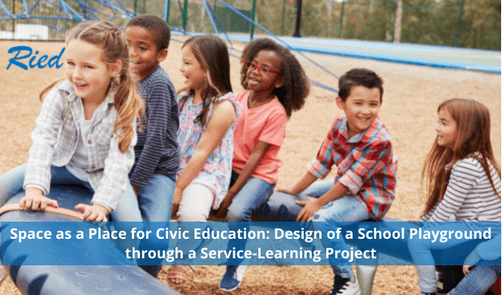
Space as a Place for Civic Education: Design of a School Playground through a Service-Learning Project
DOI:
https://doi.org/10.5944/ried.23.1.24496Keywords:
educación cívica, tecnologías de la información y de la comunicación, relación escuela-comunidad, participación, patio de recreo, distribución del espacio, aprendizaje-servicioAbstract
This article presents the results of a Service-Learning project in which physical and virtual spaces have a central and interrelated role. The project was developed by the Universidad Complutense and a geographically distant school with the objective of transforming a playground, from a pedagogical perspective. Future teachers worked together with pupils from the school for the reconditioning of that space, taking into account the contents of the course Theory of Education, such as citizenship and communitarian participation in education, teacher commitment, ethical and civic education, inclusion, environmental education, outdoor games, among others. Method used was qualitative, through content analysis of different documents, paying special attention to the role that technology plays in the process of communication between these two institutions and in the visibility and vindication of an educational need. Results show the critical reflection of participants because of their collaboration in the project, a relevant personal and civic commitment with socio-educational needs, the comprehension of the role of technologies in the contemporaneous citizenship and in Service-Learning projects, the impact in the consideration of teacher identity and the reinforcement of connections between university, school and community.Downloads
References
Barbour, A. C. (1999). The Impact of Playground Design on the Play Behaviors of Children with Differing Levels of Physical Competence. Early Childhood Research Quarterly, 14 (1), 75-98. Doi: https://doi.org/10.1016/S0885-2006(99)80007-6
Beresaluce, R. (2009). Las escuelas reggianas como modelo de calidad en la etapa de educación infantil. Aula abierta, 37 (2), 123-130.
Bollnow, O. F. (1969). Hombre y espacio. Barcelona: Labor.
Bruchner, P. (2017). Bosquescuela. Guía para la educación infantil al aire libre. Rodeno: Valencia.
Burbules, N. C. (2006). Rethinking Dialogue in Networked Spaces. Cultural Studies – Critical Methodologies, 6 (1), 107-122. Doi: https://doi.org/10.1177/1532708605282817
Burbules, N. C. (2012). Ubiquitous Learning and the Future of Teaching. Encounters in Theory and History of Education, 13, 3-14. Doi: https://doi.org/10.24908/eoe-ese-rse.v13i0.4472
Carr, D. (2002). Making Sense of Education: An Introduction to the Philosophy and Theory of Education and Teaching. Hoboken: Routledge.
Castells, M. (2012). Redes de indignación y esperanza. Madrid: Alianza.
Chancellor, B. y Cevher-Kalburan, N. (2014). Comparing and Contrasting Primary School Playgrounds in Turkey and Australia. International Education Journal: Comparative Perspectives, 13 (2), 1-19.
Conde, S., García Prieto, F. J. y Delgado-García, M. (2019). Diseño y validación de un instrumento para analizar el trabajo por rincones en las aulas de Educación Infantil. Estudios sobre educación, 36, 53-83. Doi: DOI: https://doi.org/10.15581/004.36.53-83
Czalczynska-Podolska, M. (2014). The Impact of Playground Spatial Features on Children's Play and Activity Forms: An Evaluation of Contemporary Playgrounds' Play and Social Value. Journal of Environmental Psychology, 38, 132-142. Doi: https://doi.org/10.1016/j.jenvp.2014.01.006
Dewey, J. (1915). The Schools of Tomorrow. New York: Dutton & Company.
Erdem, D. (2018). Kindergarten Teachers’ Views About Outdoor Activities. Journal of Education and Learning, 7 (3), 203-217. Doi: https://doi.org/10.5539/jel.v7n3p159
Fuentes, J. L., Esteban, F. y Caro, C. (2015). Vivir en Internet. Madrid: Síntesis.
Furco, A. y Root, S. (2010). Research Demonstrates the Value of Service Learning. Phi Delta Kappan, 91 (5), 16-20. Doi: https://doi.org/10.1177/003172171009100504
García Amilburu, M. y García Gutiérrez, J. (2012). Filosofía de la Educación. Cuestiones de hoy y de siempre. Madrid: Narcea.
García, A. (2017). Otra educación es posible. Albuixech: Litera Libros.
Ibáñez-Martín, J. A. (2017). Horizontes para los educadores. Madrid: Dykinson.
Igelmo-Zaldívar, J., & Quiroga Uceda, P. (2018). La pedagogía ligera en tiempos hipermodernos: el homeschooling, las escuelas Waldorf y la nueva pedagogía ignaciana. Teoría de la educación. Revista Interuniversitaria, 30 (1), 75-94. Doi: http://dx.doi.org/10.14201/teoredu3017594
Jongeneel, D., Withagen, R. y Zaal, F. (2015). Do Children Create Standardized Playgrounds? A Study on the Gap-Crossing Affordances of Jumping Stones. Journal of Environmental Psychology, 44, 45-52. Doi: https://doi.org/10.1016/j.jenvp.2015.09.003
Malaguzzi, L. (2011). La educación infantil en Reggio Emilia. Barcelona: Octaedro.
Mayor, D. y Rodríguez, D. (2017). Aprendizaje-Servicio: una práctica pedagógica que promueve la participación del estudiantado para la mejora escolar y social. Revista Complutense de Educación, 28 (2), 555-571. Doi: https://doi.org/10.5209/rev_RCED.2017.v28.n2.49623
Miranda, N., Larrea, I., Muela, A. Martínez de Lagos, A. y Barandiaran, A. (2015). Mejora del espacio exterior escolar desde la participación comunitaria. Participación educativa, 4 (7), 160-167.
Montessori, M. (2014). El método de la pedagogía científica: aplicado a la educación de la infancia. Madrid: Biblioteca Nueva.
Puig, J. M., Gijón, M., Martín, X. y Rubio. L. (2011). Aprendizaje-Servicio y Educación para la Ciudadanía. Revista de Educación, nº extraordinario, 45-67.
Ramos, S. (2016). Un método educativo para la infancia: el de Fröbel. En C. Sanchidrián y J. Ruiz Berrio (Coords.), Historia y perspectiva actual de la educación infantil (pp. 113-132). Barcelona: Graó.
Romañá, T. (2004). Arquitectura y educación: perspectivas y dimensiones. Revista Española de Pedagogía, 67 (228), 199-220.
Saldaña, D., Goula, J., Cardona, H. y Amat, C. (2018). El pati de l’escola en igualtat. Guia de diagnosi i d’intervenció amb perspectiva de gènere. Barcelona: Equal Saree.
Sanchidrián, C. (2014). Introducción. En Montessori, M. El método de la Pedagogía científica. Madrid: Biblioteca Nueva.
Subirats, M. y Tomé, A. (2010). Balones fuera: reconstruir los espacios desde la coeducación. Madrid: Octaedro.
Uceira, E. (2009). El patio escolar como espacio de integración social. Quaderns digitals: Revista de Nuevas Tecnologías y Sociedad, 60, 1-8.
Unesco (2015). Replantear la educación: ¿Hacia un bien común mundial? Paris: UNESCO.
Vázquez, S., Liesa, M. & Lozano, A. (2017). Recreos Cooperativos e Inclusivos a través de la metodología de Aprendizaje‐Servicio. Revista Electrónica Interuniversitaria de Formación del Profesorado, 20 (1), 173-185 .Doi: http://dx.doi.org/10.6018/reifop.20.1.213181
Waters, J. y Maynard, T. (2010). What's So Interesting Outside? A Study of Child‐Initiated Interaction With Teachers in the Natural Outdoor Environment. European Early Childhood Education Research Journal, 18 (4), 473-483. Doi: https://doi.org/10.1080/1350293X.2010.525939
Downloads
Published
How to Cite
Issue
Section
License
Copyright (c) 2019 RIED. Revista Iberoamericana de Educación a Distancia

This work is licensed under a Creative Commons Attribution 4.0 International License.
The articles that are published in this journal are subject to the following terms:
1. The authors grant the exploitation rights of the work accepted for publication to RIED, guarantee to the journal the right to be the first publication of research understaken and permit the journal to distribute the work published under the license indicated in point 2.
2. The articles are published in the electronic edition of the journal under a Creative Commons Attribution 4.0 International (CC BY 4.0) license. You can copy and redistribute the material in any medium or format, adapt, remix, transform, and build upon the material for any purpose, even commercially. You must give appropriate credit, provide a link to the license, and indicate if changes were made. You may do so in any reasonable manner, but not in any way that suggests the licensor endorses you or your use.
3. Conditions for self-archiving. Authors are encouraged to disseminate electronically the OnlineFirst version (assessed version and accepted for publication) of its articles before publication, always with reference to its publication by RIED, favoring its circulation and dissemination earlier and with this a possible increase in its citation and reach among the academic community.