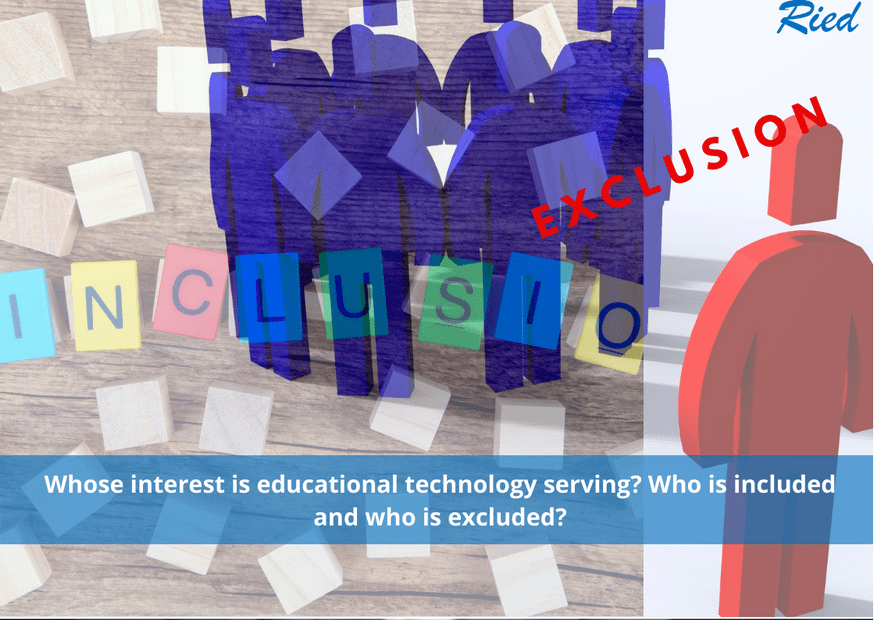
Whose interest is educational technology serving? Who is included and who is excluded?
DOI:
https://doi.org/10.5944/ried.22.1.22293Keywords:
digital practice, technological determinism, critical realism, realist social theory, educational technologyAbstract
This article gives an account of what is happening nowadays in the intersection of education and technology. It aims to offer an overview that starts not in the present but in the past so that we become aware of how more often than not we are trapped in political rhetoric and capitalistic discourses. Headings in newspapers from 1963 read, “Crowded schools. Overworked teachers. In today’s education turmoil, can your child obtain the personalized teaching that every child, average or advanced, need?” and for that problem the solution proposed was technological, hence, little has changed in relation to the crowded schools and overworked teachers. I then scrutinise the present through the invasion of platforms and the accompanying Silicon Valley discourse about universal solutions to education concluding that the situation does not look very different than at the beginning of the 20th century. The future is illustrated using my own research giving an account of my sociological oriented approach to educational research in the field. Critical realism and realist social theory are described briefly and proposed as a theoretical framework to think about these issues in a less deterministic way, giving its due importance to the local. It offers a theory-driven approach to a methodology that thinks about how to capture the daily entanglements of students with open and participatory digital tools in the context of their studies looking at uncovering the invisible thus hidden structures that operate as constraints for students’ agency in their digital practice.Downloads
References
Archer, Margaret. 1995. “Realist Social Theory: The Morphogenetic Approach Thus Not Only Rejects.” : 370. http://books.google.co.uk/books?id=SMbNRp5EseMC.
—. 2000. Being Human: The Problem of Agency. Cambridge: Cambridge University Press.
—. 2003. Structure, Agency and the Internal Conversation. Cambridge: Cambridge University Press.
Archer, Margaret S. 1995. Realist Social Theory: The Morphogenetic Approach. Cambridge: Cambridge University Press.
Attwell, Graham. 2007. “Personal Learning Environments - the Future of ELearning.” In ELearning Papers, 8.
Bhaskar, Roy. 1989. The Possibility of Naturalism: A Philosophical Critique of the Contemporary Human Sciences. 2nd ed. Harvester, Wheatsheaf.
—. 2008. A Realist Theory of Science A Realist Theory of Science. Routledge. http://www.jstor.org/stable/2184170?origin=crossref.
Case, Jennifer M. 2013. Researching Students Learning in Higher Education: A Social Realist Approach. London and New York: Routledge.
Castañeda, Linda, and Jordi Adell. 2013. “La Anatomía de Los PLEs.” Entornos Personales de Aprendizaje: Claves para el ecosistema educativo en red: 11–27. https://digitum.um.es/jspui/handle/10201/30408.
Castañeda, Linda, and Neil Selwyn. 2018. “More than Tools? Making Sense of the Ongoing Digitizations of Higher Education.” International Journal of Educational Technology in Higher Education 15(22). https://educationaltechnologyjournal.springeropen.com/track/pdf/10.1186/s41239-018-0109-y (May 21, 2018).
Coleman, John. 2008. The Educational and Social Impact of New Technologies on Young People in Britain. Oxford, UK.
Cronin, Catherine. 2017. “Openness and Praxis: Exploring the Use of Open Educational Practices in Higher Education.” The International Review of Research in Open and Distributed Learning 18(5). http://www.irrodl.org/index.php/irrodl/article/view/3096 (July 4, 2018).
Cuban, Larry. 1986. Teachers and Machines: The Classroom Use of Technology since 1920. New York: Teachers college Press.
Danermark, Berth, Mats Ekström, Liselotte Jacobson, and Karlsson Jan Ch. 2002. Explaining Society: Critical Realism in the Social Science.
Hamilton, Edward. 2008. “The Atomatic Student and the Robot Professor: Online Education and the Politics of University Reform.”
Hamilton, F., and Norm Friesen. 2013. “Online Education: A Science and Technology Studies Perspective.” Canadian Journal of Learning and Technology 39(2): 1–21.
Herepath, Andrea. 2014. “In the Loop: A Realist Approach to Structure and Agency in the Practice Strategy.” Organization Studies 35(6): 857–79.
Hooks, Bell. 1989. “Choosing the Margin as a Space of Radical Openness.” Framework: The Journal of Cinema and Media (36): 15–23. http://www.jstor.org/stable/44111660.
—. 1994. Teaching to Transgress. Education as the Practice of Freedom Teaching to Transgress. Education as the Practice of Freedom. New York, London.
Kühn, Caroline. 2014. “Personal Learning Environment and the Learning of Mathematics -Possibility or Reality?” In Sinteza 2014 - Impact of the Internet on Business Activities in Serbia and Worldwide., 55–61. http://portal.sinteza.singidunum.ac.rs/paper/114.
—. 2017. “Are Students Ready to (Re)-Design Their Personal Learning Environment? The Case of the E-Dynamic.Space.” NAER Journal of New Approaches in Educational Research JOURNAL OF NEW APPROACHES IN EDUCATIONAL RESEARCH 6(1): 11–19. http://naerjournal.ua.es.
Martins, Nuno. 2006. “Capabilities as Causal Powers.” Cambridge Journal of Economics 30(5): 671–85.
Matthewmann, Steve. 2011. Ttechnology and Social Order. ed. Palgrave.
Morris, Sean. 2017. “Reading the LMS against the Backdrop of Digital
Oliver, Carolyn. 2011. “Critical Realist Grounded Theory: A New Approach for Social Work Research.” British Journal of Social Work.
Popper, Karl. 1978. Three Worlds. Michigan.
Porlán, Isabel Gutiérrez et al. 2016. “Análisis Del PLE de Estudiantes Universitarios Españoles: Proyecto CAPPLE.” In In-Red, http://dx.doi.org/10.4995/INRED2016.2016.4388 (September 17, 2016).
Selwyn, Neil. 2010. “Looking beyond Learning: Notes towards the Critical Study of Educational Technology.” Journal of Computing Assisted Learning 26: 65–73.
Selwyn, Neil, and Keri Facer. 2013. “Recognizing the Politics of ‘Learning’ and Technology.” In The Politics of Education and Technology, New York: Palgrave Macmillan.
Sen, Amartya. 1995. “The Perspective of Freedom.” In Development as Freedom,.
Skinner, B.F. 1968. The Technology of Teaching. New York: Meredith Corporation.
Stommel, Jesse. 2017. “If Bell Hooks Made an LMS: Grades, Radical Opennes and Domain of One’s Own.” Higher Jesse Stommel. Education Pedagogy, Critical edtech. https://www.jessestommel.com/ (July 4, 2018).
Watters, Audrey. 2012. “The Plaforming of Education.” Top Ed-Tech Trends of 2012 series. http://2012trends.hackeducation.com/platforms.html (July 4, 2018).
—. 2015. “The History of the Future of Education.” Hack Education: The history of the future of education technology.
Winner, Langdon. 1980. “Do Artifacts Have Politics?” Daedalus 109(1): 121–36. http://www.jstor.org/stable/20024652.
Downloads
Published
How to Cite
Issue
Section
License
Copyright (c) 2018 RIED. Revista Iberoamericana de Educación a Distancia

This work is licensed under a Creative Commons Attribution 4.0 International License.
The articles that are published in this journal are subject to the following terms:
1. The authors grant the exploitation rights of the work accepted for publication to RIED, guarantee to the journal the right to be the first publication of research understaken and permit the journal to distribute the work published under the license indicated in point 2.
2. The articles are published in the electronic edition of the journal under a Creative Commons Attribution 4.0 International (CC BY 4.0) license. You can copy and redistribute the material in any medium or format, adapt, remix, transform, and build upon the material for any purpose, even commercially. You must give appropriate credit, provide a link to the license, and indicate if changes were made. You may do so in any reasonable manner, but not in any way that suggests the licensor endorses you or your use.
3. Conditions for self-archiving. Authors are encouraged to disseminate electronically the OnlineFirst version (assessed version and accepted for publication) of its articles before publication, always with reference to its publication by RIED, favoring its circulation and dissemination earlier and with this a possible increase in its citation and reach among the academic community.