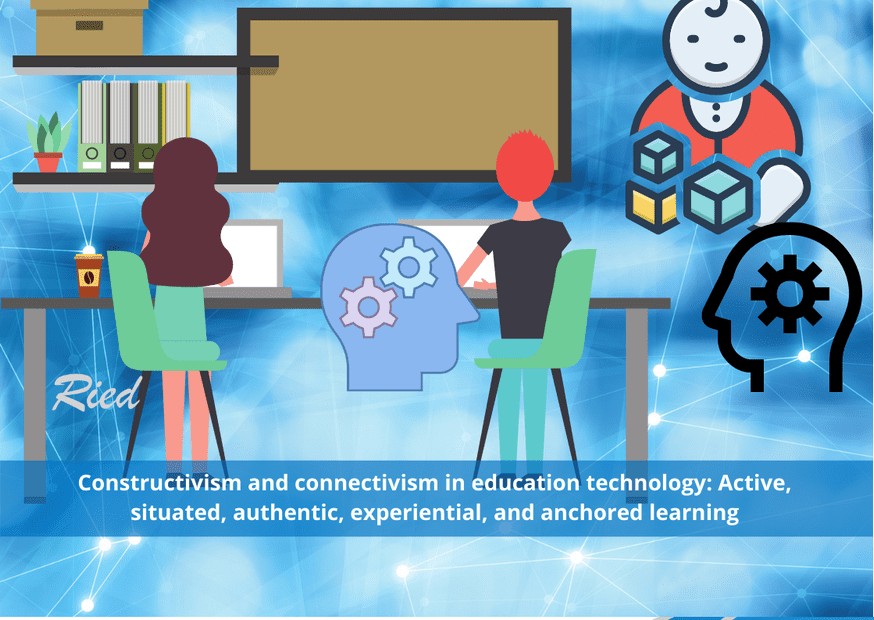
Constructivism and connectivism in education technology: Active, situated, authentic, experiential, and anchored learning
DOI:
https://doi.org/10.5944/ried.21.2.20055Keywords:
learning, cognition, educational technology, distance education.Abstract
The main objectives of this theoretical paper are to compare some constructivist-related learning theories and explore how they can be adequately used in educational technology and distance education. After a brief introduction, constructivism is defined as a general philosophy of education encompassing several different learning theories. The article then presents and discusses the following theories: situated cognition, activity theory, experiential learning, anchored instruction, and authentic learning. Connectivism or distributed learning is also presented as a new and important theory, including its pedagogical view and practice in massive open online courses (MOOCs). These theories are then organized in a coherent way, classified under the constructivist umbrella, pointing their common and distinctive features. Connectivism is positioned as a new philosophy of education for the digital age, making Vygotsky’s concept of zone of proximal development (ZPD) more flexible and stretching it to include learning that lies outside the learner, in social networks and technological tools. The text finally proposes further work on how these theories can be properly combined and used as frameworks for constructivist projects and activities in the fields of educational technology and distance education. The article is based on the search and review of peer-reviewed articles on constructivism, connectivism, the other aforementioned theories, and education technology and distance education.
Downloads
References
Anderson, T. (2016). Theories for learning with emerging technologies. In G. Veletsianos (Ed.), Emergence and innovation in digital learning: Foundations and applications (pp. 35-64). Edmonton: Athabasca University Press.
Anderson, T., & Dron, J. (2011). Three generations of distance education pedagogy. The International Review of Research in Open and Distributed Learning, 12(3), 80-97.
Anderson, T., & Dron, J. (2012). Learning technology through three generations of technology enhanced distance education pedagogy. European Journal of Open, Distance and e-learning, 15(2).
Bardin, L. (2013). L’analyse de contenu. Paris: Presses Universitaires de France.
Beckem, J. M., & Watkins, M. (2012). Bringing life to learning: Immersive experiential learning simulations for online and blended courses. Journal of Asynchronous Learning Networks, 16(5), 61-70.
Bedwell, W. L., Pavlas, D., Heyne, K., Lazzara, E. H., & Salas, E. (2012). Toward a taxonomy linking game attributes to learning: An empirical study. Simulation & Gaming, 43(6), 729-760.
Bell, F. (2011). Connectivism: Its place in theory-informed research and innovation in technology-enabled learning. The International Review of Research in Open and Distributed Learning, 12(3), 98-118.
Bender, W. N. (2012). Project-based learning: Differentiating instruction for the 21st century. Corwin Press.
Bergmann, J., & Sams, A. (2012). Flip your classroom: Reach every student in every class every day. International Society for Technology in Education.
Brown, J. S., Collins, A., & Duguid, P. (1989, January/February). Situated cognition and the culture of learning. Educational Researcher, 18(1), 32-42. Retrieved from http://www.exploratorium.edu/ifi/resources/museumeducation/situated.html
Clancey, W. J. (1994). Situated cognition: How representations are created and given meaning. In Lewis, R. & Mendelsohn P. (Eds.), Lessons from learning (pp. 231-242). Amsterdam: North-Holland. Retrieved from http://cogprints.org/661/1/133.htm
Clarà, M., & Barberà, E. (2014). Three problems with the connectivist conception of learning. Journal of Computer Assisted Learning, 30(3), 197-206.
Crouch, C. H., & Mazur, E. (2001). Peer instruction: Ten years of experience and results. American Journal of Physics, 69(9), 970-977.
Dewey, J. (1933). How we think: a restatement of the relation of reflective thinking to the educative process. Boston: D.C. Heath and company.
Dewey, J. (1938). Experience and Education. New York: Simon & Schuster.
Dron, J., & Anderson, T. (2014). Teaching crowds: Learning and social media. Athabasca University Press.
Greeno, J. D. (1989, February). A perspective on thinking. American Psychologist, 44(2), 134-141. Retrieved from http://inkido.indiana.edu/syllabi/p500/greeno.pdf
Hansen, R. E. (2000, Spring). The role of experience in learning: Giving meaning and authenticity to the learning process in schools. Journal of Technology Education, 11(2), 23-32. Retrieved from http://citeseerx.ist.psu.edu/viewdoc/download?doi=10.1.1.4.6974&rep=rep1&type=pdf
Horn, M. B., & Staker, H. (2014). Blended: Using disruptive innovation to improve schools. John Wiley & Sons.
Hung, D., Looi, C.-K., & Koh, T.-S. (2004). Situated cognition and communities of practice: First-person “lived experiences” vs. third-person perspectives. Educational Technology & Society, 7(4), 193-200.
Jonassen, D. H. (2000). Revisiting activity theory as a framework for designing student-centered learning environments. In Jonassen, D. H., & Land, S. M. (Eds.), Theoretical foundations of learning environments (pp. 89-121). Mahwah, NJ: Lawrence Erlbaum.
Kanuka, H., & Anderson, T. (1999). Using constructivism in technology-mediated learning: Constructing order out of the chaos in the literature. Radical Pedagogy, 1(2). Retrieved from http://radicalpedagogy.icaap.org/content/issue1_2/02kanuka1_2.html
Karagiorgi, Y., & Symeou, L. (2005, January). Translating constructivism into instructional design: Potential and limitations. Journal of Educational Technology & Society, 8(1), 17-27. Retrieved from http://citeseerx.ist.psu.edu/viewdoc/download?doi=10.1.1.117.357&rep=rep1&type=pdf#page=22
Kasloff, P. (2011). Active Online Learning: Implementing the Case Study/Personal Portfolio Method. In K. D. Kirstein, J. M. Hinrichs, & S. G. Olswang (Eds.), Authentic Instruction and Online Delivery: Proven Practices in Higher Education (pp. 283-304). CreateSpace.
Kerr, B. (2007, February). A Challenge to Connectivism. Transcript of Keynote Speech, Online Connectivism Conference. University of Manitboa. Retrieved from http://ltc.umanitoba.ca/wiki/index.php?title=Kerr_Presentation
Koh, J. H. L., Chai, C. S., Benjamin, W., & Hong, H. Y. (2015). Technological Pedagogical Content Knowledge (TPACK) and design thinking: A framework to support ICT lesson design for 21st century learning. The Asia-Pacific Education Researcher, 24(3), 535-543.
Kolb, D. A. (1984). Experiential learning: Experience as the source of learning and development. Englewood Cliffs: Prentice Hall.
Kolb, D. A. (1993). The process of experiential learning. In M. Thorpe, R. Edwards, & A. Hanson (Eds.), Culture and processes of adult learning. New York: Routledge.
Kop, R. (2011). The challenges to connectivist learning on open online networks: Learning experiences during a massive open online course. The International Review of Research in Open and Distributed Learning, 12(3), 19-38.
Kop, R., & Hill, A. (2008). Connectivism: Learning theory of the future or vestige of the past? The International Review of Research in Open and Distance Learning, 9(3). Retrieved from http://www.irrodl.org/index.php/irrodl/article/view/523/1137
Landers, R. N. (2014). Developing a theory of gamified learning: Linking
serious games and gamification of learning. Simulation & Gaming, 45(6), 752-768.
Lave, J. (1988). Cognition in practice: Mind, mathematics and culture in everyday life. Cambridge: Cambridge University Press.
Lave, J., & Wenger, E. (1991). Situated learning: Legitimate peripheral participation. Cambridge: Cambridge University Press.
Mackness, J., & Bell, F. (2015). Rhizo14: A rhizomatic learning cMOOC in sunlight and in shade. Open Praxis, 7(1), 25-38.
Maina, F. W. (2004). Authentic learning: Perspectives from contemporary educators [Editorial]. Journal of Authentic Learning, 1(1), 1-8. Retrieved from http://www.oswego.edu/academics/colleges_and_departments/education/jal/vol1no1/maina.pdf
Okoli, C. (2015). A Guide to Conducting a Standalone Systematic Literature Review. Communications of the Association for Information Systems, 37(43), 879-910.
Reeves, T.C., Herrington, J. and Oliver, R. (2002) Authentic activities and online learning. In: HERDSA 2002 Quality Conversations, 7 - 10 July 2002, Perth, Western Australia pp. 562-567.
Scheer, A., Noweski, C., & Meinel, C. (2012). Transforming constructivist learning into action: Design thinking in education. Design and Technology Education: An International Journal, 17(3), 8-19.
Siemens, G. (2004, December). Connectivism: A theory for the digital age. Retrieved from http://www.elearnspace.org/Articles/connectivism.htm
Siemens, G. (2008). Learning and knowing in networks: Changing roles for educators and designers. Paper 105: University of Georgia IT Forum. Retrieved from http://it.coe.uga.edu/itforum/Paper105/Siemens.pdf
Siemens, G. (2012, July 25). MOOCs are really a platform. Elearnspace. Retrieved from http://www.elearnspace.org/blog/2012/07/25/moocs-are-really-a-platform/
Siemens, G. (2011, May 1st). Moving beyond self-directed learning: Network-directed learning. Connectivism. Retrieved from http://archive.is/tVRLa
Tam, M. (2000). Constructivism, instructional design, and technology: Implications for transforming distance learning. Educational Technology & Society, 3(2), 50-60. Retrieved from http://www.ifets.info/journals/3_2/tam.html
The Cognition and Technology Group at Vanderbilt. (1990, August). Anchored instruction and its relationship to situated cognition. Educational Researcher, 19(6), 2-10. doi: 10.3102/0013189X019006002
The Cognition and Technology Group at Vanderbilt. (1993). Anchored instruction and situated cognition revisited. Educational Technology, 33(3), 52-70.
The Cognition and Technology Group at Vanderbilt. (1997). The Jasper Project: Lessons in curriculum, instruction, assessment, and professional development.
Vygotsky, L. S. (1978). Mind in Society: The Development of Higher Psychological Processes. Cambridge: Harvard University Press.
Wenger, E. (1998). Communities of Practice: Learning, Meaning, and Identity. Cambridge: Cambridge University Press.
Whitehead, A. N. (1929). The aims of education and other essays. New York: The Macmillan company.
Wilson, B. G., & Myers, K. M. (2000). Situated cognition in theoretical and practical context. In Jonassen, D. H., & Land, S. M. (Eds.), Theoretical foundations of learning environments (pp. 57-88). Mahwah, NJ: Lawrence Erlbaum.
Young, M. F. & Kulikowich, J. M. (1992, April 22). Anchored instruction and anchored assessment: An ecological approach to measuring situated learning. Paper presented at the Annual Meeting of the American Educational Research Association, San Francisco, CA, 1-21. Retrieved from http://eric.ed.gov/PDFS/ED354269.pdf
Downloads
Published
How to Cite
Issue
Section
License

This work is licensed under a Creative Commons Attribution 4.0 International License.
The articles that are published in this journal are subject to the following terms:
1. The authors grant the exploitation rights of the work accepted for publication to RIED, guarantee to the journal the right to be the first publication of research understaken and permit the journal to distribute the work published under the license indicated in point 2.
2. The articles are published in the electronic edition of the journal under a Creative Commons Attribution 4.0 International (CC BY 4.0) license. You can copy and redistribute the material in any medium or format, adapt, remix, transform, and build upon the material for any purpose, even commercially. You must give appropriate credit, provide a link to the license, and indicate if changes were made. You may do so in any reasonable manner, but not in any way that suggests the licensor endorses you or your use.
3. Conditions for self-archiving. Authors are encouraged to disseminate electronically the OnlineFirst version (assessed version and accepted for publication) of its articles before publication, always with reference to its publication by RIED, favoring its circulation and dissemination earlier and with this a possible increase in its citation and reach among the academic community.