Estudios e Investigaciones
Gamification-Education: the power of data. Teachers in social networks
Gamificación-educación: el poder del dato. El profesorado en las redes sociales
 Carlos Barroso Moreno
Mª Rosario Mendoza Carretero
Belén Sáenz-Rico de Santiago
Laura Rayón Rumayor
Carlos Barroso Moreno
Mª Rosario Mendoza Carretero
Belén Sáenz-Rico de Santiago
Laura Rayón Rumayor
Gamification-Education: the power of data. Teachers in social networks
RIED-Revista Iberoamericana de Educación a Distancia, vol. 27, núm. 1, 2024
Asociación Iberoamericana de Educación Superior a Distancia

Esta obra está bajo una Licencia Creative Commons Atribución-NoComercial 4.0 Internacional.
How to cite: Barroso Moreno, C., Mendoza Carretero, M. R., Sáenz-Rico de Santiago, B., & Rayón Rumayor, L. (2024). Gamification-Education: the power of data. Teachers in social networks. [Gamificación-educación:
el poder del dato. El profesorado en las redes sociales].
RIED-Revista Iberoamericana de Educación a Distancia, 27(1) 373-396. https://doi.org/10.5944/ried.27.1.37648
Abstract: Social networks are spaces for teachers to exchange content on new methodological approaches to gamification, raising questions about the integration of gamification in current and future digital trends. The present research aims to determine the behaviour of posts with gamification content on the social networks Twitter, Instagram and TikTok. Web scraping techniques for Instagram and TikTok, together with the Twitter API, collect 189,414 posts with the keywords gamification and education in Spanish and English during the year 2022. These large volumes of data are made available to stakeholders through Microsoft Power Business Intelligence. Using deliberative sampling, an in-depth analysis of the 100 most viral posts on each social network was conducted to respond to the research objective. The results highlight the presence of teachers on social networks, predominantly on Instagram for the Primary Education stage, and the influence of gender on the posts. The male gender has a greater number of followers and posts, but the female gender has followers with a greater number of likes. Commercial interests in the gamification theme are accentuated in digital trends, although they are lower in comparison to sharing non-profit resources. It is concluded that teaching staff who use social networks become emerging agents in the design of materials and, therefore, mediators between the curriculum and practice.
Keywords: social network, education, teaching staff, big data, gamification.
Resumen: Las redes sociales son espacios de intercambio de contenido para el profesorado sobre nuevos planteamientos metodológicos en torno a la gamificación. Nos preguntamos sobre la integración de la gamificación en las tendencias digitales presentes y futuras. La presente investigación tiene como objetivo determinar comportamientos de las publicaciones con contenido de gamificación en las redes sociales de Twitter, Instagram y TikTok. Las técnicas de «Web scraping» para Instagram y TikTok, junto con la API de Twitter, recopilan 189.414 publicaciones con las palabras clave de gamificación y educación en español e inglés, durante el año 2022. Estos grandes volúmenes de datos se ponen a disposición de los interesados mediante Power Business Intelligence de Microsoft. Mediante un muestreo deliberativo profundizamos en el análisis sobre las 100 publicaciones más virales de cada red social para responder al objetivo de investigación. Los resultados destacan la presencia del profesorado en las redes sociales, predominante en Instagram para la etapa de Educación Primaria, y la influencia del género en las publicaciones. El género masculino dispone de un número mayor de seguidores y publicaciones, pero el femenino tiene seguidores con mayor apoyo en «like». Los intereses mercantiles en la temática gamificación se ven acentuados en las tendencias digitales, aunque son menores en comparación con compartir recursos sin fines lucrativos. Se concluye que los docentes usuarios de las redes sociales se convierten en agentes emergentes de diseño de materiales y, por tanto, en mediadores entre el Curriculum y la práctica.
Palabras clave: redes sociales, educación, personal docente, big data, gamificación.
INTRODUCTION
Gamification is an emerging methodology that uses games or game mechanics to facilitate learning in non-game contexts. It is associated with additional learner motivation (Kim et al., 2018; Sailer & Homner, 2020) that is linked to positive effects on engagement in learning, socialisation and teamwork (Uz-Bilgin & Gul, 2020) for the enhancement of face-to-face and distance education (Mahmud et al., 2020). Furthermore, it can lead to the enrichment of visual skills and creativity in the educational community (Wai-yee, 2021), as well as to technological literacy and the development of digital competences (Almeida & Simoes, 2019).
In line with the above, authors such as Buckley and Doyle (2016) investigated more than 100 university students studying online for gamified learning. They showed a practical interest for teachers, which can be extrapolated to various educational contexts with an increase in intrinsic and extrinsic motivation. Sánchez-Rivas et al. (2019) carried out an intra-group comparison between Primary Education teachers using traditional exams (control group) and those using a gamified exam-based model (experimental group). The results showed that this group obtained the best results due to the high motivation and learning ability of the students. Nolan and McBride (2014) applied digital game-based learning in the Early Childhood Education stage, obtaining relevant results for inclusive and equitable integration, although they criticise the idealism within the curriculum of educational institutions.
However, there are critical currents that identify negative effects, such as a decrease in academic performance (Toda et al., 2018), lack of understanding, ethical problems in the game, curricular irrelevance, as well as excessive competitiveness and impulsivity (Almeida et al., 2023), even if it is indicated that gamification has positive effects if applied correctly in the classroom. Online educational gamification has also attracted interest from the business world, although it can become a business due to the sales interests and advertising embedded in the games (Terlutter & Capella, 2013).
Nowadays, digital platforms employ gamification elements to attract and retain users, so understanding social networks is crucial and requires data analysis skills. Klašnja et al. (2017) discuss the importance of data science, and expose the significance of Big Data and Learning Analytics techniques in education for educational achievement through the promotion of research. Other studies, by Bourkoukou and El-Bachari (2022) and Hu et al. (2020), determine the feasibility of applying Big Data technologies in education, given the large amount of data generated with Learning Management Systems (LMS), Massive Open Online Courses (MOOC), Learning Object Repository (LOR), OpenCourseWare (OCW), Open Educational Resources (OER), and Social Media, among others. The real feasibility is demonstrated by multiple authors such as Calvera-Isabal et al. (2023), who automate the extraction and analysis of information from web pages for educational purposes, and Barroso-Moreno et al. (2023), who, using Business Intelligence (BI) techniques, detect hidden behavioural patterns in social networks to promote critical digital citizenship.
Digital trends in education are a present and future reality, although it is currently unknown which technologies will succeed and what educational value they will have. Ezquerra et al. (2022) apply Artificial Intelligence (AI) techniques to determine emotions and behaviours in physics learning through facial expressions. Nespor (2019) applies blockhain techniques for the certification of students in an American school. Salas-Rueda (2021) uses machine learning to detect classroom perceptions during the use of Geogebra in Mathematics. However, these trends are not exclusive to the field of education; in other contexts they are of interest, as is the case of using Big Data to establish management strategies in the tourism sector (González-Serrano et al., 2021), sentiment analysis of Twitter content to determine the potential impact of political campaigns (Rodríguez-Ibáñez et al., 2021), or the use of Machine Learning techniques in the medical field to predict the probability of vitamin D deficiency and risk of cardiovascular disease (García-Carretero et al., 2021). The progressive and rapid momentum of technological development is setting digital trends for various applications in different fields and for different purposes. The manner in which these trends are realised in education leaves us with an open panorama that is not without ethical concerns that make a public debate necessary in the light of scientific research clarifying the contributions to education.
Recent studies analyse the functioning of digital platforms to detect behavioural patterns and transfer them to the classroom. In this regard, Marín et al. (2021) identify several current trends around digital competence in teaching and digital tools of social networks in education. Lozano-Blasco et al. (2023) determine that social networks are new relationship ecosystems among young people because they generate a critical analysis of information and define spaces in which to share values and ideology. Along the same lines, Samad et al. (2019) establish a positive relationship between social network presence, social well-being and students' academic performance, although Zimmer (2022) identifies the need for self-control in students so that they do not develop inappropriate habits on social networks.
In relation to the topic at hand, Ladislav et al. (2019) examine the hashtag #gamification on Instagram with 17,994 posts, identifying five communities from highest to lowest modularity: education, entrepreneurship, general gamification, social and fun. Hristova and Lieberoth (2021) examine the educational social interactions of gamification on Snapchat, Facebook, Twitter and Instagram through a manual analysis. The study concludes that these interactions can be beneficial in education, but they also criticise the underlying business practices for supporting gamified offerings, and question the sustainability of these types of educational interactions. Roig-Vila and Álvarez-Herrero (2019) analyse the presence of active methodologies on Twitter, with gamification being one of the most prevalent. Studies of TikTok for educational gamification are scarce, although Deng and Yu (2023) detect a model of short videos to increase hedonic motivation in a university in China. They conclude that this model strikes a balance between curiosity and boredom as a meaningful experience. The present research is far from unconnected with the diverse and even disparate outcomes of digital trends and social media.
Therefore, the purpose of this research is to investigate the behaviour of the most viral posts with gamification and education content on Twitter, Instagram and TikTok, which guides the following hypotheses:
- H1. The profile of teachers is the most active on social networks in terms of publishing educational and gamification content.
- H2. The "influencers" concentrate the virality of the social networks and advertising provides evidence of the commercial interests in the subject of gamification.
- H3. Posts on gamification in education address Digital Education trends to promote adaptive and personalised learning.
METHODOLOGY
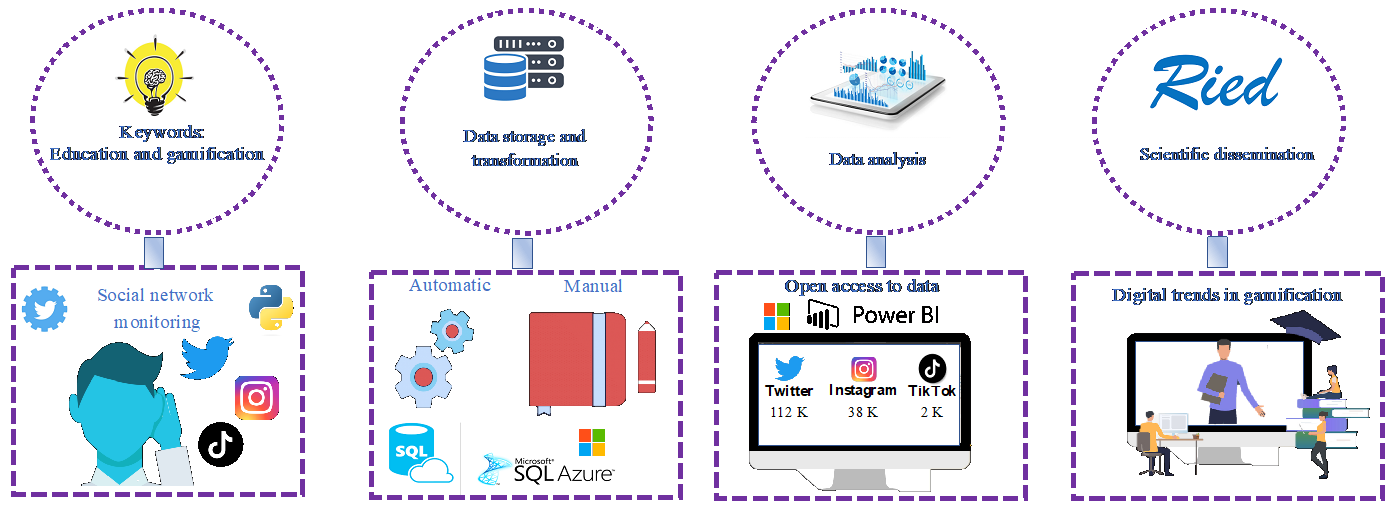
This research analyses gamification on Twitter, Instagram and TikTok to identify correlations between post properties and post content. Figure 1 represents the data flow diagram during the research; the first three blocks correspond to the three stages of the mixed methodology developed. The first stage performs an exploratory analysis to determine the descriptors that the posts should contain through the keywords gamification and education. The posts must contain these words, as the audiovisual content is not analysed. Social network monitoring uses the SocialNetworkTool software, owned by the DETECESE research group, which runs on Microsoft Azure to optimise workloads and have the necessary computational elasticity at times of high postings. The software collects posts in real time and stores them with an unambiguous identifier if they contain the keywords; otherwise they are discarded. After seven days, the identifier is retrieved to search the network and compile the properties of the publication. This methodology has two significant direct consequences: it is not possible to collect posts retroactively to the activation of the software, and the publication properties are not updated periodically. This last consequence is acceptable in terms of bias in data collection, as posts that do not go viral on the day of publication do not change their trend afterwards; even so, a margin of one week is used.
The second stage stores the posts collected in the first stage and applies data transformation through automatic processes, executed on a daily basis, and a manual process, which is performed on an ad hoc basis. The database administration is carried out with the SQL language that allows queries to be made on the relational data systems and access control to them (Gorman et al., 2020). Among the automatic processes, sentiment analysis is performed with the Azure Cognitive Service for Language software, which determines the associated sentiment quantitatively through the content of each publication. This software integrates a collection of machine learning and AI algorithms in the cloud for the analysis of written language.
The third stage analyses the data using the Power BI tool to provide interactive visualisations with business intelligence capabilities (Knight et al., 2018), but with a heuristic strategic view. The connection to the second-stage database is made with Azure Analysis, a connector integrated into the Power BI platform. The loaded data allows different graphs to be generated according to the needs of the researcher. Initially, graphs are generated to extract mathematical statistics and perform the relevant data analysis to find behavioural patterns. This novel way of presenting the data allows the research to be disseminated in a visual and intuitive way that is freely accessible.
The process is simple to implement as it is a common technique for enterprise data management. For the research environment it is inexpensive: most readers with Office 365 packages can use Azure Service (Microsoft) with a free 100$ credit and Power BI Desktop (Microsoft) free of charge. Interested parties can check the veracity of the data and graphs presented for free at the following Power BI link: https://bit.ly/3MoI67j. The manual analysis corresponds to the 100 most viral posts on each social network, totaling 300 posts, which can be downloaded in full via FigShare (m9.figshare.22991627), the contents of which include an Excel file with pivot tables used for the percentages shown.
Data flow diagram of gamification data in research
Source: own elaboration.
In the second phase of the methodology, automated and manual techniques are applied to gamification and education posts. The automated variables are used on the complete database, and common variables are objectively collected by properties of the publication: identifier, content, number of likes, visualisations and geolocation. In addition, informational value is generated by applying algorithms on the content variable: post title, sentiment, word frequency and hashtags. This last variable is collected in Instagram directly; however, in Twitter and TikTok it is not a property of the post and requires a division of the content by the # character. Similarly, there are variables available in each social network that provide information in the general analysis, but do not allow for objective comparisons: retweet 100% concentrated in Twitter, hashtag 82.7% in Instagram or 93.1% reproductions in TikTok. Therefore, the number of likes is determined as a comparative element of virality as it is common to the three networks and there is no uniform criterion (Zamora et al., 2021).
Virality in the networks marks the consumption trends of users and the acceptance of a content or topic that advise a deliberative, non-probabilistic sampling of the posts that clearly represent their influence in the networks, visibility and popularity. Consequently, the categorisation of the manual variables is applied to the 100 most viral posts on each social network, the range of which meets the selection criteria indicated. Table 1 shows the variables analysed, their categories and subcategories, which are completed through the digital trace generated in the social networks, whose authors are regular users who publish their information in blogs or similar easily accessible social networks.
| Identification |
Person Company Educational event Digital platform Other |
If educational, it is... |
Generalist Therapeutic Pedagogy Hearing and Language Physical Education English Spanish Language Early Childhood Other/Unspecified |
|
What for (type of post) |
Sharing educational resources Educational experience Dissemination Reflection Other |
Educational content creator |
Yes No Not known |
| Gender |
Masculine Feminine Unknown |
Economic remuneration for content creation |
Yes No Not known |
| Work profile |
Company Entrepreneur Organization Teacher Other |
Context in which they are used |
Formal Non-formal |
| Content creator for other areas |
Yes No Not known |
||
| Educational stage |
Early childhood educ. Primary education Secondary Educ. and Baccalaureate University |
Mentioning others |
Yes No |
| Profile of those mentioned |
Teachers Company Other |
RESULTS
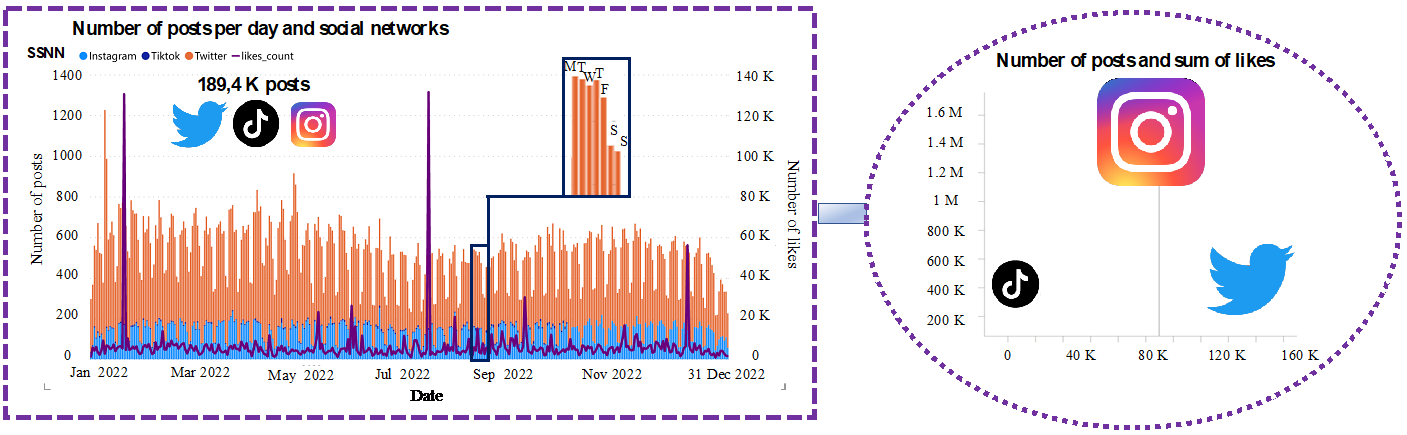
The database consists of a total of 189,414 posts: Twitter with 137,726 (72.71% of the total); Instagram with 49,937 (26.36%); TikTok with 1,751 (0.92%). In relation to the positive and negative sentiment associated with the social network posts, Twitter has 30.75% that are positive (n=42,344) and 5.62% negative (n=7,738); Instagram has 43.88% that are positive (n=21,911) and 1.51% negative ( n=755); TikTok has 31.30% that are positive (n=548) and 2.91% negative (n=51). The rest of the posts correspond to neutral messages, whose sentiment load per word is not remarkable. Figure 2 (left) represents the aforementioned volumetries by social network, highlighting the presence of Twitter. In addition, a pattern of behaviour is detected for all networks over time, with five days of high and two days of low posts corresponding to weekdays and holidays, respectively.
Another notable aspect of Figure 2 (right) is the number of likes per post ratio. Instagram stands out with a ratio of 29.4 likes/post, although TikTok is much higher with 201.50 likes/post, but due to its low number of posts the total impact is lower. Twitter is in the opposite situation: with its high number of posts, the ratio drops to 3.03 likes/post. If we look at the 100 posts on each social network with the greatest impact (virality), they account for 23.5% of the likes and barely 0.1% of the posts, and due to their importance, the posts are analysed manually.
Timeline for counting posts per social network and likes ratio
Source: own elaboration.
In summary, the following results become evident in a macro view of gamification: (i) Twitter is the social network with the highest number of posts and polarisation. (ii) Instagram has a lower number of posts than Twitter, but has a higher total of likes and a predominance of positive sentiment. (iii) TikTok is the network with the lowest number of posts, but its virality is extreme, occupying the ranking with the highest virality. (iv) The top 100 most viral posts capture the attention of users, relegating the rest of the disseminations to second place. (v) On weekdays, educational gamification is very active compared to holidays. The conclusions drawn from the volume and sentiment of each social network are confirmed by previous studies. However, it is worth investigating the reason for the concentration of likes on Instagram and the pattern of gamification activity on weekdays, the latter of which could be motivated by teaching or business breaks. The current results on this point are indicative of the research line, but do not confirm any hypotheses.
The role of teaching staff in the dissemination of resources
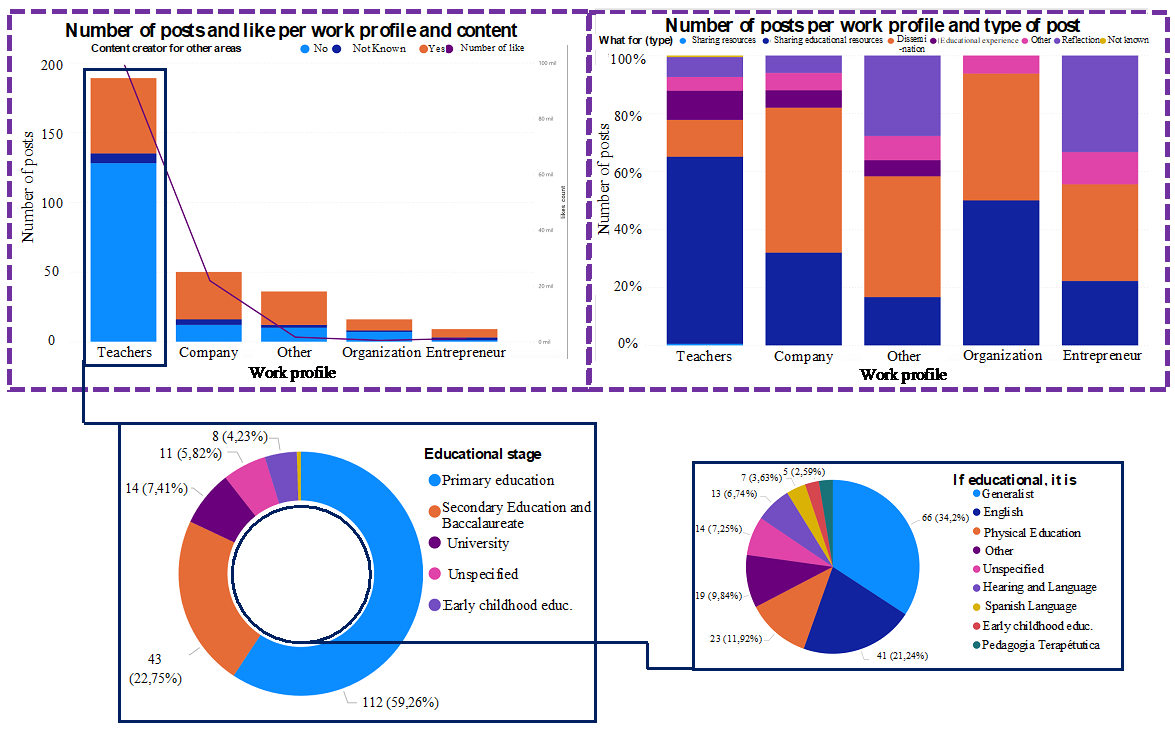
The most viral posts with gamification and education content on Twitter, Instagram and TikTok are mostly made by individuals (76.7%; n=230), followed by companies (11.3%, n=34), digital platforms (6%, n=18. and organisers of educational events (3%, n=9). Most are used to share educational resources (51.7%, n=155) and to disseminate activities of various kinds (24.7%, n=74).
The posts made by teachers (63%, n=189) stand out in the three social networks (Twitter: 12%, n=35; Instagram: 29%, n=86; TikTok: 23%, n=68), and belong in greater numbers to Primary Education teachers (59%, n=112), followed by Secondary Education and Baccalaureate teachers (23%, n=43), university teachers (7%, n=14) and, lastly, Pre-school teachers (4%, n=8). With regard to Primary Education teachers, it is evident that the profiles that publish the most are generalist teachers (34%, n=66), followed by those with curricular specialisations in a specific area of education: Physical Education (12%, n=23), Hearing and Language (7%, n=13), English (21.24%, n=41) and Therapeutic Pedagogy (3%, n=5). With regard to Secondary Education and Baccalaureate teachers (23%, n=43), it was found that posts by teachers specialising in English (63%, n=27), Language and Literature (16%, n=7) and Physical Education (2%, n=1) prevailed.
Histogram of job profiles according to the content and purpose of the publication, and pie charts classifying educational stage and curricular subjects
Source: own elaboration.
In this sense, teachers at all educational stages tend to publish content that is developed for pedagogical purposes, with the aim of sharing resources (41%, n=123) in order, for example, to introduce the metaverse in education [P01]. They also tend to disseminate diverse content (8%, n=23): Escape Room games, tutorials on Canva or tools that allow them to work on reasoning [P02], among other contents. They also share educational experiences (6%, n=19) that can be useful for the networked community; posts that contribute to reflection (4%, n=13) and other actions related in some way to education (3%, n=9), such as nominations for teacher awards, magic tricks with cards, etc. (Figure 3, right).
The data shown confirm that (i) almost two thirds of the posts correspond to teachers, (ii) of which more than half create content exclusively for education with the aim of sharing educational resources, (iii) teachers mostly use gamification in the educational stages of Primary and Secondary (6-16 years) with preferences in English and Physical Education, (iv) although the companies do not specialise, they create content of various kinds whose purpose is to give visibility to the product or service they offer.
H1 is confirmed, as the profile that stands out on the social networks is that of teachers, especially those who teach in the Primary Education stage, with a greater prominence on Instagram.
Instagram: the gamified teaching staff’s preference
The content of the posts published to share educational resources is found on Instagram (26%, n=78), followed by Tik-Tok (9%, n=27) and Twitter (6%, n=18). The prominence of Instagram is in line with one of the main uses of this network, which is to bring together and share resources in different formats (text, images, sound and videos). In this sense, the 10 most viral posts (range of likes: 1389-3512) belong to Primary Education teachers (Table 2). The publication with the highest number of likes is the one by a Therapeutic Pedagogy teacher who, on this occasion, uses games such as Dobble, Lince or Pictureka to work on processing speed, attention and hand-eye coordination [ID01]. However, generalist teachers [IG02, IG05, IG07, IG08] and teachers of Hearing and Language [IG03, IG06, IG10] have more posts in this list of outstanding teachers. Of these four posts, generalist teachers share material with the intention of promoting audio-visual literacy through the use of films (Encanto, Holly Moon, etc.) and short films (El puente, El puercoespín, etc.) [IG05], reviewing the contents worked on in different subjects using Halloween [IG08] with the support of a Escape Room, among others. If we look at the three posts by teachers specialising in Hearing and Language, they publish, among other aspects, content which contributes to improving reading comprehension through the menus of a restaurant [IG06]. The publication of an English teacher who shares resources for working on regular and irregular verbs through Monopoly with the Genially Game tool [IG09] is particularly noteworthy.
| ID | Link | ID | Link |
| IG01 | https://bit.ly/43iQVqd | IG06 | https://bit.ly/3Mmb8V9 |
| IG02 | https://bit.ly/45lFVdi | IG07 | https://bit.ly/3MJA6iJ |
| IG03 | https://bit.ly/3IvDZFs | IG08 | https://bit.ly/3BHcbdm |
| IG04 | https://bit.ly/3IuxDGb | IG09 | https://bit.ly/3MJoMDb |
| IG05 | https://bit.ly/3ItjwRB | IG10 | https://bit.ly/3BLmiOu |
The posts by Early Childhood Education teachers (4%, n=8), despite being fewer in number compared to those of Secondary Education and Baccalaureate (23%, n=43), receive more likes (range: 18-1290), and deal with different aspects such as virtual bookmarks (likes=127) or the preparation of details to give to children at their graduation (likes=1,274). Occasionally, there are posts about projects, such as El Universo, coinciding with the type of methodology used at this educational stage (likes=1,290). As for the posts by Secondary and Baccalaureate teachers that receive fewer likes (range: 12-971), the most notable are Sintaximinó [P03] (likes=836), which allows students to review simple syntax while playing dominoes, and Genomia [P04] (likes=798), a game based on basic concepts of human genetics. University teaching staff do not post on Instagram.
In reference to TikTok (9%, n=27), the impact for sharing educational resources is moderate and concentrated in Primary Education teachers (8%, n=25) with a generalist profile (8%, n=23) and only in Secondary and Baccalaureate teachers (1%, n=2) do they publish anything. Particularly noteworthy is the publication related to the capture of Pokémon [P8], whose activity involves solving questions in teams to work on curricular content (likes=7,747). Pre-school and university teachers do not share educational resources on this network.
With regard to Twitter, teaching staff from all educational stages publish content for the purpose of sharing educational resources. The presence of Primary Education teachers (2%, n=6) decreases, but they stand out on Instagram and TikTok. The situation is similar for Secondary Education and Pre-university Education teachers (0%, n=1). However, it is on Twitter where university teachers are present (2%, n=6. with posts of scientific content such as, for example, an article [P05] (likes=68), or the dissemination of a conference [P06] (likes=16). This presence does not arouse the interest of the networked community if we evaluate the number of likes. It is clear that the most viral posts are grouped around teachers of compulsory education stages, focused on exchanging materials that can be reused in their classes.
In view of the data presented, three ideas can be synthesised: (i) a differentiated behaviour of the educational stage of the teaching staff depending on the social network; (ii) Instagram is the preferred medium for Primary Education teachers due to the audiovisual appeal of the materials that support specific activities; (iii) Twitter is the preferred medium for university teachers, who are oriented towards sharing scientific materials that do not arouse the interest of the networked community.
H2 is partially confirmed; the most viral profiles in terms of number of likes are found on Instagram with multimodal content
Gender matters in social networks
Of the total number of most viral posts on the three social networks, 40.3% (n=121) belong to the female gender, 38.3% (n=115) to the male gender and 21.3% (n=64) are unknown. This predominance coincides with what is reported on the Instagram social network, with the female gender (21%, n=64) posting more posts than the male gender (8%, n=25). However, this pattern changes in the posts on the social networks Twitter and TikTok, where the male gender predominates (14%, n=43 and 16%, n=47, respectively) compared to the female gender (5%, n=16; 14%, n=41). The differences between the two genders on the Twitter social network are evident.
However, if we focus on the posts made by teachers (63%, n=189) on the three social networks, we find that the female gender predominates (35%, n=105) compared to the male gender (28%, n=83). Female teachers prefer Instagram (21%, n=63) and male teachers prefer TikTok (12%, n=36). Both genders excel in the number of posts aimed at sharing educational resources (F: 27%, n=81; M: 14%, n=42), although, as can be seen, they are lower in the latter. Teachers use social networks to share educational resources and take on the role of content creators, with a prominent use of Instagram by the female gender.
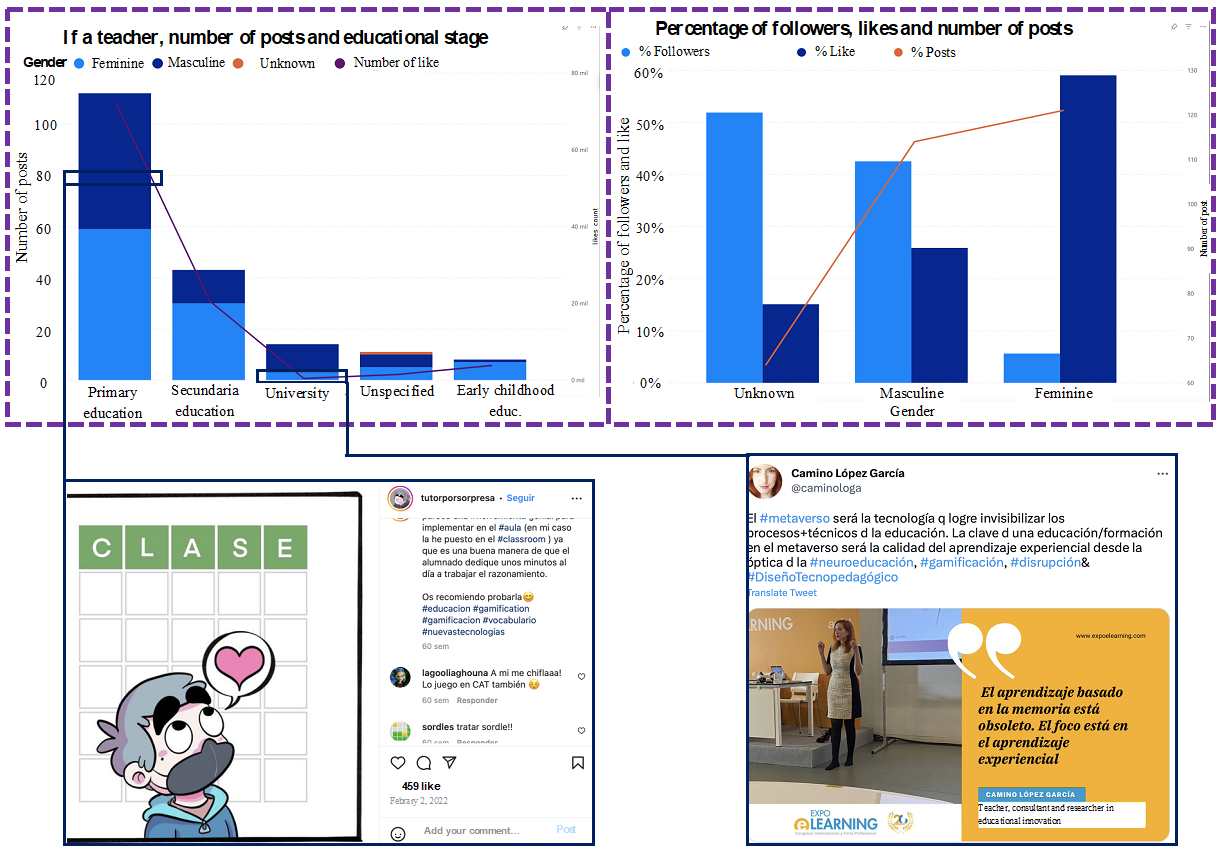
In relation to the educational stages, Figure 4 (left), the teachers publish more posts associated with Early Childhood Education (F: 2%, n=7; M: 0%, n=1), Primary Education (F: 20%, n=60; M: 18%, n=53), Secondary Education and Baccalaureate (F: 10%, n=30; M: 4%, n=13) and university teachers (F: 1%, n=3; M: 4%, n=11). The topics vary depending on the educational stage: in Early Childhood Education, educational proposals that complement space missions are collected [P10] (likes=1290); in Primary Education, Pokémon video game resources are shared (likes=4,887); in Secondary and Baccalaureate, web pages for creating comics are disseminated [P07] (likes=971); and in University, thought-provoking questions are posed, such as, for example, whether it is possible to educate with video games [P09] (likes=44).
The data analysed show that female teachers (29%, n=87) disseminate more educational content than male teachers (11%, n=34) in the educational stages characterised by a feminisation of teaching, i.e. early childhood education and primary education.
Figure 4 (right) shows the notable differences for the gender variable. The male gender has a large number of followers, 42.51%, but its percentage of likes decreases to 25.90% of the total number of likes (n=115). The female gender has a small number of followers with 5.62%, but captures the highest number of likes, 59.02% of the total (n=121). Finally, the unknown gender groups companies or organisations, with 51.87% of followers due to their advertising campaigns, such as "follow us and get a 5% discount", but only account for 15.08% of the likes. They publish 64 posts with a majority of content that is not specialised in education, which may not be very attractive for the educational profiles analysed.
Histogram of teaching staff according to educational stage and gender associated with the sum of likes and two examples of publication
Source: own elaboration.
*Post(left): implement in the #class (in my case I've put it in the #classroom) as it is a good way for students to spend a few minutes a day working on reasoning. I recommend you to try it :) #educacion #gamification #gamificacion #vocabulario #nuevastecnologias #newastecnologias
**Post (right): The #metaverso will be the technology that manages to make the technical+processes of education invisible. The key to education/training in the metaverse will be the quality of experiential learning from the perspective of #neuroeducación , #gamificación , #disrupción & #DiseñoTecnopedagógico
In summary, social networks are a reflection of today's society. (i) The female gender is in the majority at the early childhood stage and the male gender at university, with a balance in the intermediate educational stages. (ii) The male gender has more users, followers and posting activity than the female gender, but with followers who are less inclined to like. At the other end of the spectrum, (iii) the female gender has a smaller number of followers, but with loyal support for each post as measured by like ratios. (iv) The unknown gender, mostly from companies and organisations, has the largest number of followers, but lacks virality in terms of number of likes, which would show little educational harmony with the online community.
Given these results, H2 adds two new dimensions: virality is influenced by gender and educational stage. Bearing in mind that Primary and Compulsory Secondary teachers account for most posts on Instagram and TikTok and university teachers on Twitter, further research is needed to answer H2.
Social network merchandising for gamification and educational content
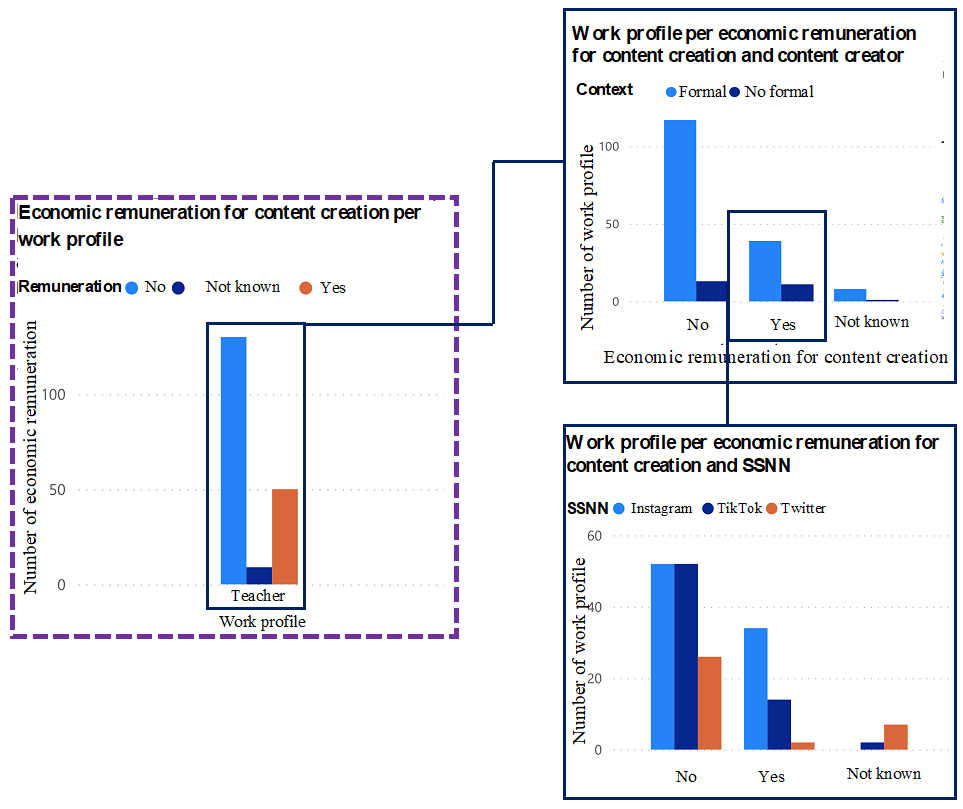
Of all the educational content created, 17% (n=50) of teachers use the designed materials for commercial purposes, and it is the generalist teachers (9%, n=26) who show the greatest preference for commercialisation. Materials are made available to users at a price ranging from €1 to €5. For example, the "Psicoeducando" account, developed by a teacher of Therapeutic Pedagogy, hosts various materials including the "Juego de atención" ("attention game") for €1.5, whose purpose is to practice processing speed and verbal fluency. The account "Paula's Slate" is an educational materials shop that hosts materials such as "the verbal suitcase" [P27] (€1), which contains the morphological description of verbs. Most of the profiles that market the materials are active in formal teaching contexts (13%, n=39) and create them to be used in these contexts, compared to those profiles that create materials for non-formal contexts (4%, n=11). The "deporteeducacion" account, held by a PE teacher, hosts didactic resources for the speciality, such as detectiveEF [P11] or acrosport cards [P28] (€3).
In addition, 5% (n=15) of teachers who create educational content in formal contexts and market it, also create content for other areas, generally focused on video games or books. One such material is "En clase sí se juega" ("In the classroom you do play") [P29], a practical guide for creating games in the classroom, or "Aprender lenguaje: sin papel ni lápiz" ("Learning language: without paper and pencil") [P30] comprising various activities to do at home and at school.
Histogram of teaching staff according to financial remuneration and context, as well as focusing the social network on market posts
Source: own elaboration.
The global database has digital trends such as: artificial intelligence [P12], computational thinking [P14], chatbots [P15], virtual assistants [P16], machine learning [P17], blockchain [P18], intelligent tutoring, metaverse [P19], virtual reality [P20], immersive environments [P22], adaptive and personalised learning [P25] and Big Data [P26]. The profiles associated with these trends are various: teachers sharing videos where they represent activities linked to programming with game activities, or companies showing the advantages of their products or services in teaching. The value of these trends in education will have to go beyond the flow of fads that promulgate their innovative nature in order to sustain transformative actions that combine quality and equity. However, these technologies could mark a new path in education without being linked to commercial interests. This situation of private interest is clearly reflected in the posts related to remote and virtual laboratories [P24], augmented reality products [P21], extended reality training plans [P23] and robotics workshops [P13].
H3 confirms (i) the presence in social networks of digital educational trends for promoting motivation in learning and adaptation to the interests of students in online and face-to-face environments. Additionally, (ii) a commoditisation of the network in digital trends derived from the need for specialised products and services is detected.
The data presented above provide a partial answer to H2. (i) There are commercial interests in the subject of gamification and education that are increasing in digital trends, (ii) but these are minor in comparison with those teachers who create traditional materials and share them for non-profit purposes. In summary, the answers to H2 allow us to affirm the virality of Primary and Secondary Education teachers on Instagram. Two thirds of the posts are aimed at sharing resources for altruistic purposes, and one third of them, together with companies, seek economic returns through advertising on the network.
DISCUSSION AND CONCLUSION
Teachers play a relevant role as creators of educational content in the three networks analysed, compared to companies in the education and technology industry. However, their behaviour is differentiated on the three digital platforms. It can be seen that the male gender has more followers and publication activity than the female gender, but the number of followers does not correspond to the number of likes that would be expected. These are interesting results considering it is the female gender that attracts loyal support if we look at the ratios of likes per publication, even though their profiles do not show the same loyalty in the number of followers. Female profiles are recognised for their shared content, a paradoxical behaviour for the visibility of gamification-education content. This is a relevant behaviour that deserves to be explored if we take into account that the greater the number of followers, the greater the possibility of visualisation-viralisation. The posts recognised on the networks are unequal depending on the gender of a profile. Once again, the same pattern of behaviour already evidenced for other educational content appears (Barroso-Moreno et al., 2023).
In this research, Instagram is shown to be a favourite space in which to show and share educational materials and projects. Teachers' preference for this social network and for these purposes modulates it as a space for professional exchange. This is confirmed by the concentration of likes on this social network and the pattern of activity on weekdays, a time frame in which educational gamification is very active compared to holidays. In other words, the use of this network appears to be a part of the professional concerns and occupations of those teachers who are network users. Instagram is the social network with the greatest dissemination of educational gamification, in line with Ladislav et al. (2019) and in response to H1. Posts aimed at questioning and reflecting on the value of gamification to improve learning are relegated to the background. In this sense, it is on Twitter where we identify posts that are more likely to question the value of gamification from scientific interests, associated with university faculty, but do not attract the attention of the online community. This problematisation of gamification could explain the polarisation and negative feelings of the posts analysed. These results are relevant for two reasons. The first is that research on the value of gamification is scarce and inconclusive regarding the positive effects on motivation, engagement and learning enhancement, as understood by Toda et al. (2018), Nolan and McBride (2014) and Almeida et al. (2023). The other reason is that this questioning is alien to Primary and Secondary teachers, as evidenced by the type of material they are willing to share, mainly worksheets to support learning on Instagram; on Twitter their presence is scarce.
Other results obtained allow us to conclude that Instagram is a network with a certain influence on the professional development of teachers, albeit of the opposite sign. On the one hand, it is a space for meeting and altruistic professional exchange. On the other hand, they offer a decontextualization and a vision of gamification as a set of detailed tasks, which could point towards a clear trend, the preference for prescriptive materials. Teachers, in relation to gamification, would assume a role as emerging agents for the distribution of materials and, therefore, as mediators between the curriculum and practice based on visually attractive cards. This type of material is very similar in its aesthetics to the materials for Early Childhood and Primary Education marketed by publishers. A question for further research is the didactic rationality that informs the design of materials that guides the teachers' mediating action between the Curriculum and practice. The multimodal nature of communication on Instagram might legitimise the content exchanged. It should be noted that the most viral posts do not include problematising discourses on gamification on this social network. What is published on this social network are activities that, in themselves, seemingly justify gamification in education. This lack of pedagogical and didactic references would naturalise gamification as an innovation that is reduced to applying aesthetically and visually attractive cards (Wai-yee, 2021) that highlight their playful and motivating nature (Kim et al., 2018; Sailer & Hommer, 2020) for specific curricular topics, especially in the curricular area of English and Physical Education.
Mention should be made of another relevant function from which teachers are not exempt, a mercantile use of the networks analysed, thus playing the role of content creators with financial interests. The danger lies in the mercantile logic, which is alien to educational interests, spreading among teachers and defining the creation of materials in favour of products that, although aesthetically appealing, are lacking in solvent didactic references. Economic interests become visible for gamification in the category of sharing resources associated with technological products, in which there may be corporate business interests. This relevant trend has been identified by Terlutter and Capella (2013), who consider that companies can draw attention to their products and make them attractive by associating their products with online educational gamification.
In the same vein, another set of relevant results shows the association of gamification with novel digital trends, these being undiscovered scenarios that require clear and quality pedagogical frameworks and approaches. Note that H3 in this study is confirmed. Computational thinking or virtual reality in the classroom are promising for the future, but require a sustained and shared effort from different actors to discuss what educational model and teacher training are needed to make use of the potential of these digital trends, in line with Bourkoukou and El-Bachari (2022), Hu et al. (2020) and Calvera-Isabal et al. (2023). This is a complex and multidimensional issue on which shared critical vigilance needs to be developed. The value of AI or computational thinking will be a reality in classrooms (Ezquerra et al., 2022), more because of political decisions and rigorous institutional commitments than because of advances in technological development. However, the social networks analysed function as spaces that generate new semantics and languages through the inclusion of hashtags that relate the game to the products of technological development. The hashtags define an association between educational gamification and technologies that serve as unquestionable and a priori legitimate descriptors which could function as an advertising claim without a clear pedagogical basis. H2 is confirmed by the commercial interests in the most viral posts that fail to provide an educational vision, along the lines we have been discussing.
The results obtained show the complexity of the behaviour of the networks analysed for gamification and educational content, and point to two paths for further exploration. The first is to delve deeper into the content of the most viral posts, as advocated by Calvera-Isabal et al. (2023). The materials analysis approach, a relevant line of research in the field of Curriculum, could be a good alternative to develop in social networks. Determining what conceptions of learning and teaching underlie the shared materials and what values are associated with gamification (competitiveness or cooperation) will clarify the didactic implications of what has clearly become established as a clear trend;the relevance of social networks as spaces for sharing materials. The second is to analyse in depth the most viral posts aimed at sharing company products in order to identify the influencing actions of business agents who do not have an educational profile, but who target their products at teachers.
This research is a future digital trend, big data in education-themed social media. The questions of what social networks are used for, who has the most influence and to what extent they transform learning and teaching mark a roadmap in the study of the power of networks to either generate or not generate educational change.
Acknowledgments
This action has been financed by the Community of Madrid through the Multiannual Agreement with the Complutense University of Madrid in its Excellence Programme for university teaching staff, within the framework of the V PRICIT (Regional Plan for Scientific Research and Technological Innovation).
REFERENCES
Almeida, F., & Simoes, J. (2019). The role of serious games, gamification and industry 4.0 tools in the education 4.0 paradigm. Contemporary Educational Technology, 10(2), 120-136. https://doi.org/10.30935/cet.554469
Almeida, C., Kalinowski, M., Uchôa, A., & Feijó, B. (2023). Negative effects of gamification in education software: Systematic mapping and practitioner perceptions. Information and Software Technology, 156, 107142. https://doi.org/10.1016/j.infsof.2022.107142
Barroso-Moreno, C., Rayon-Rumayor, L., & Bautista García-Vera, A. (2023). Big Data and Business Intelligence on Twitter and Instagram for digital inclusion. Comunicar, 74, 49-60. https://doi.org/10.3916/C74-2023-04
Bourkoukou, O., & El-Bachari, E. (2022). A big data-oriented recommendation method in E-Learning environment. International Journal of Emerging Technologies in Learning, 17(10). https://doi.org/10.3991/ijet.v17i10.27861
Buckley, P., & Doyle E. (2016). Gamification and student motivation. Interactive Learning Environments, 24(6), 1162-1175. https://doi.org/10.1080/10494820.2014.964263
Calvera-Isabal, M., Santos, P., Hoppe, H., & Schulten, C. (2023). How to automate the extraction and analysis of information for educational purposes. Comunicar, 74, 23-35. https://doi.org/10.3916/C74-2023-02
Deng, X., & Yu, Z. (2023). An extended hedonic motivation adoption model of TikTok in higher education. Education and Infoormation Technologies. https://doi.org/10.1007/s10639-023-11749-x
Ezquerra, A., Agen, F., Rodríguez-Arteche, I., & Ezquerra-Romano, I. (2022). Integrating artificial intelligence into research on emotions and behaviors in science education. Eurasia Journal of Mathematics, Science and Technology Education, 18(4), em2099. https://doi.org/10.29333/ejmste/11927
García-Carretero, R., Vigil-Medina, L., Barquero-Perez, O., Mora-Jimenez, I., Soguero-Ruiz, C., & Ramos-Lopez, J. (2021). Machine learning approaches to constructing predictive models of vitamin D deficiency in a hypertensive population: a comparative study. Informatics for Health and Social Care, 46(4), 355-369. https://doi.org/10.1080/17538157.2021.1896524
González-Serrano, L., Talón-Ballestero, P., Muñoz-Romero, S., Soguero-Ruiz, C., & Rojo-Álvarez, J. L. (2021). A big data approach to customer relationship management strategy in hospitality using multiple correspondence domain description. Applied Sciences, 11(1), 256. https://doi.org/10.3390/app11010256
Gorman, K., Hirt, A., Noderer, D., Pearson, M., Rowland-Jones, J., Ryan, D., Sirpal, A., & Woody, B. (2020). Introducing Microsoft SQL Server 2019: Reliability, scalability, and security both on premises and in the cloud. Packt Publishing Ltd.
Hristova, D., & Lieberoth, A. (2021). How socially sustainable is social media gamification? A look into Snapchat, Facebook, Twitter and Instagram. In A. Spanellis & J. T. Harviainen (Eds.), Transforming Society and Organizations through Gamification (pp. 225-245). Palgrave Macmillan. https://doi.org/10.1007/978-3-030-68207-1_12
Hu, H., Zhang, G., Gao, W., & Wang, M. (2020). Big data analytics for MOOC video watching behavior based on Spark. Neural Computing and Applications, 32, 6481-6489. https://doi.org/10.1007/s00521-018-03983-z
Kim, S., Song, K., Lockee, B., & Burton, J. (2018). What is gamification in learning and education? En S. Kim, K. Song, B. Lockee y J. Burton (Coords.), Gamification in learning and education. Advances in Game-Based Learning (pp. 25-38). Springer. https://doi.org/10.1007/978-3-319-47283-6_4
Klašnja, A., Ivanović, M., & Budimac, Z. (2017). Data science in education: Big data and learning analytics. Computer Applications in Engineering Education, 25, 1066-1078. https://doi.org/10.1002/cae.21844
Knight, D., Knight, B., Pearson, M., Quintana, M., & Powell, B. (2018). Microsoft Power BI Complete Reference: Bring your data to life with the powerful features of Microsoft Power BI. Packt Publishing Ltd.
Ladislav, O., Pavel, M., Pitrová, J., Bouda, P., Gresham, G., Balcarová, T., & Rojík, S. (2019). Education and Business as a key topics at the Instagram posts in the area of Gamification. Journal on Efficiency and Responsibility in Education and Science, 12(1), 26-33. https://doi.org/10.7160/eriesj.2019.120103
Lozano-Blasco, R., Mira-Aladrén, M., & Gil-Lamata, M. (2023). Social media influence on young people and children: Analysis on Instagram, Twitter and YouTube. Comunicar, 74, 125-137. https://doi.org/10.3916/C74-2023-10
Mahmud, S., Husnin, H., & Tuan Soh, T. (2020). Teaching presence in online gamified education for sustainability learning. Sustainability, 12, 3801. https://doi.org/10.3390/su12093801
Marín, D., Cuevas, N., & Gabarda, V. (2021). Competencia digital ciudadana: análisis de tendencias en el ámbito educativo. RIED-Revista Iberoamericana De Educación a Distancia, 24(2), 329-349. https://doi.org/10.5944/ried.24.2.30006
Nespor, J. (2019). Cyber schooling and the accumulation of school time. Pedagogy, Culture & Society, 27(3), 325-341. https://doi.org/10.1080/14681366.2018.1489888
Nolan, J., & McBride, M. (2014). Beyond gamification: reconceptualizing game-based learning in early childhood environments. Information, Communication & Society, 17(5), 594-608. https://doi.org/10.1080/1369118X.2013.808365
Rodríguez-Ibáñez, M., Gimeno-Blanes, F. J., Cuenca-Jiménez, P. M., Soguero-Ruiz, C., & Rojo-Álvarez, J. L. (2021). Sentiment analysis of political tweets from the 2019 Spanish elections. IEEE Access, 9, 101847-101862. https://doi.org/10.1109/ACCESS.2021.3097492
Roig-Vila, R., & Álvarez Herrero, J. F. (2019). Repercusión en Twitter de las metodologías activas ABP, Flipped Classroom y Gamificación. RIED-Revista Iberoamericana de Educación a Distancia, 22(2), pp. 79-96. https://doi.org/10.5944/ried.22.2.23272
Sailer, M., & Homner, L. (2020). The gamification of learning: a meta-analysis. Educational Psychology Review, 32, 77-112. https://doi.org/10.1007/s10648-019-09498-w
Salas-Rueda, R. A. (2021). Students’ perceptions of the use of the flipped classroom during the educational process of linear functions. Culture and Education, 33(3), 431-454. https://doi.org/10.1080/11356405.2021.1949109
Samad, S., Nilashi, M., & Ibrahim, O. (2019). The impact of social networking sites on students’ social wellbeing and academic performance. Education and Information Technologies, 24, 2081-2094. https://doi.org/10.1007/s10639-019-09867-6
Sánchez-Rivas, E., Ruiz-Palmero, J., & Sánchez-Rodríguez, J. (2019). Gamification of assessments in the natural sciences subject of primary education. Educational Sciences: Theory & Practice, 19(1), 95-111. https://doi.org/10.12738/estp.2019.1.0296
Terlutter, R., & Capella, M. (2013). The gamification of advertising: Analysis and research directions of in-game advertising, advergames, and advertising in social network games. Journal of Advertising, 42(2-3), 95-112. https://doi.org/10.1080/00913367.2013.774610
Toda, A. M., Valle, P. H., & Isotani, S. (2018). The dark side of gamification: An overview of negative effects of gamification in education. In A. I. Cristea, I. I. Bittencourt, & F. Lima (Eds.), Communications in Computer and Information Science (pp. 143-156). Springer. https://doi.org/10.1007/978-3-319-97934-2_9
Uz-Bilgin, C., & Gul, A. (2020). Investigating the effectiveness of gamification on group cohesion, attitude, and academic achievement in collaborative learning environments. TechTrends 64, 124–136. https://doi.org/10.1007/s11528-019-00442-x
Wai-yee, M. (2021). Fostering musical creativity of students with intellectual disabilities: Strategies, gamification and re-framing creativity. Music Education Research, 23(1), 1-13. https://doi.org/10.1080/14613808.2020.1862777
Zamora, R., Gómez-García, S., & Martínez-Martínez, H. (2021). Los memes políticos como recurso per- suasivo online. Análisis de su impacto durante los debates electorales de 2019 en España. Opinión pública, 27, 681-704. https://doi.org/10.1590/1807-01912021272681
Zimmer, J. C. (2022). Problematic social network use: Its antecedents and impact upon classroom performance. Computers & Education, 177, 104368. https://doi.org/10.1016/j.compedu.2021.104368
ANNEX
| ID | Word in the text | Link | ID | Word in the text | Link | ID | Word in the text | Link |
| P01 | Metaverse in education | https://bit.ly/45hrVBq | P11 | detectivEF | https://bit.ly/3pWwctZ | P21 | And augmented reality | https://bit.ly/3Iuc09f |
| P02 | Working on reasoning | https://bit.ly/3MqBiWT | P12 | Artificial Intelligence | https://bit.ly/3WqkKTl | P22 | Immersive environments | https://bit.ly/3WlcnIC |
| P03 | Sintaximinó | https://bit.ly/43bv1oH | P13 | Robotics | https://bit.ly/3MMGWnK | P23 | Extended reality | https://bit.ly/3MmdJyn |
| P04 | Genomia | https://bit.ly/3BGLo0K | P14 | Computa-tional thinking | https://bit.ly/3Ism8iy | P24 | Extended and virtual laboratories | https://bit.ly/3BLmdKq |
| P05 | Article | https://bit.ly/45jW8zJ | P15 | Chatbots | https://bit.ly/43f4QNT | P25 | Adaptive and personalised learning. | https://bit.ly/3BJOzVq |
| P06 | Congress | https://bit.ly/3q2iSnW | P16 | Virtual assistants | https://bit.ly/41UnIRh | P26 | Big data | https://bit.ly/3omEZoA |
| P07 | Comic | https://bit.ly/3MBwvC5 | P17 | Machine learning | https://bit.ly/43baq3Q | P27 | The verbal case | https://bit.ly/41UZWo7 |
| P08 | Pokémon | https://bit.ly/45DTkgU | P18 | Blockchain | https://bit.ly/3MFVXaF | P28 | Acrosport | https://bit.ly/438ODJW |
| P09 | Educating with videogames | https://bit.ly/3C3zi1Q | P19 | Metaverse | https://bit.ly/3MuKM3w | P29 | In class you can play | https://bit.ly/3odEpcL |
| P10 | Space missions | https://bit.ly/3C2wzG3 | P20 | Virtual reality | https://bit.ly/45lIc8k | P30 | Learning language: without pen and paper | https://bit.ly/3OAVk3o |
Date of reception: 01 June 2023
Date of acceptance: 21 August 2023
Date of publication in OnlineFirst: 06 October 2023
Date of publication: 01 January 2024