Monográfico
Digital Cognitive Maps for Scientific Knowledge Construction in Initial Teacher Education
Los mapas cognitivos digitales para la construcción de conocimiento científico en la formación inicial del profesorado
 Alba Guiral
Manoli Pifarré
Alba Guiral
Manoli Pifarré
Digital Cognitive Maps for Scientific Knowledge Construction in Initial Teacher Education
RIED. Revista Iberoamericana de Educación a Distancia, vol. 26, núm. 2, 2023
Asociación Iberoamericana de Educación Superior a Distancia

Esta obra está bajo una Licencia Creative Commons Atribución 4.0 Internacional.
How to cite: Guiral, A., & Pifarré, M. (2023). Digital Cognitive Maps
for Scientific Knowledge Construction in Initial Teacher Education. RIED-Revista
Iberoamericana de Educación a Distancia, 26(2), 89-109. https://doi.org/10.5944/ried.26.2.36067
Abstract: Interactive technology offers new opportunities to design dialogic learning spaces and scaffolds with the aid of visual icons. These technological environments can support the construction of open-ended visual cognitive digital maps, which portray an external representation of scientific knowledge that could foster the meaningful resolution of socio-scientific challenges. In this context, this research aims to study the impact of digital cognitive maps on: a) meaningful learning of scientific concepts and b) complex representation of scientific concepts in teacher education. A case study with multi-method analysis was designed. The cognitive maps of 47 teacher education students are analysed, both quantitatively and qualitatively, and before-after their participation in an educational experience that enhances the collaborative construction of digital cognitive maps in order to solve a socio-scientific challenge. The results show that the overall educational experience and, specifically, the scientific inquiry visual scaffolds embedded into the technological environment have a positive impact on learning scientific knowledge and inquiry skills. Furthermore, outcomes also indicate that the experience enriches the students’ representation strategies of complex scientific knowledge and that the construction of cognitive maps with a network architecture increases after the educational experience. Finally, educational implications on the use of interactive technology and cognitive maps for promoting significant learning of content knowledge in pre-service teachers are discussed.
Keywords: educational technology, visual learning, transfer of learning, teacher education.
Resumen: La tecnología interactiva ofrece nuevas oportunidades para el diseño de espacios de aprendizaje dialógico y ayudas al aprendizaje con el uso de iconos visuales. Estos entornos virtuales pueden facilitar la construcción de mapas cognitivos visuales abiertos, que posibilitan la representación externa del conocimiento científico y a su vez pueden favorecer la resolución significativa de retos socio-científicos. En este contexto, en la presente investigación se pretende estudiar el impacto de los mapas cognitivos sobre: a) el aprendizaje significativo de conceptos científicos y b) la representación compleja de conceptos científicos en la formación del profesorado. Se ha diseñado un caso de estudio con análisis multimétodo. Se analizan 47 mapas cognitivos de estudiantes de educación, ambos cuantitativa y cualitativamente, y antes y después de su participación en una experiencia educativa que promueve la construcción colaborativa de mapas cognitivos digitales para resolver un reto socio-científico. Los resultados muestran que la experiencia educativa globalmente y, concretamente, las ayudas visuales al aprendizaje de las ciencias por indagación incluidas en el entorno tecnológico tienen un impacto positivo en el aprendizaje de conocimientos científicos y habilidades de indagación. Además, los resultados también indican que la experiencia enriquece las estrategias de representación del alumnado con respecto al conocimiento científico complejo y la construcción de mapas cognitivos con arquitectura de red incrementa después de participar en la experiencia educativa. Finalmente, se discuten las implicaciones educativas sobre el uso de la tecnología interactiva y los mapas cognitivos para promover el aprendizaje significativo de contenidos científicos en la formación inicial de profesorado.
Palabras clave: tecnología para la educación, aprendizaje visual, transferencia del aprendizaje, formación del profesorado.
INTRODUCTION
Interactive technologies have increased the opportunities to design educational contexts that promote student-centred learning, flexible access to multimedia information, social interaction, multimodal communication, and multiple possibilities to represent and outsource learning (Mercer et al., 2019). However, it has been argued that it is not easy for students to start effective cognitive processes when interacting with technology because the content is diverse, the tasks are complex and they need to be solved collaboratively (Wang & Wegerif, 2019). In this line, Isohätälä et al. (2021) claim the need to use technologies that support collective learning and include the concept of social sensitivity, i.e., the individual and collective ability to collaborate constructively, respectfully, and cohesively. This claim is also crucial in pre-service teacher education programs because teachers must develop a Technological and Pedagogical Content Knowledge (henceforth TPACK) capable to integrate the use of technology in their classes to promote students’ development of the 21st century learning competences (Huang et al., 2022).
Educational research has already stated some challenges, in pre-service and in-service training programs, to formulate and develop what teachers should know and be able to do professionally. Many recent studies have focused on formulating the concept of Pedagogical Content knowledge (henceforth PCK) and its extension with the integration of technology (TPACK) (Chai, 2019; Huang et al., 2022; Kind & Chan, 2019). From this research we can extrapolate five key outcomes. Firstly, PCK is formed through the teacher’s ability to integrate pedagogical knowledge and content knowledge in such a way that the content knowledge becomes accessible to students. Secondly, the different components of the PCK concept and its intersections are important types of teacher knowledge and all of them are relevant to understand teacher practices and their impact on students’ learning. Thirdly, PCK development occurs over time and with the integration between knowledge types. Fourthly, there is a wide variety in how researchers interpret content knowledge, PCK and TPACK. Fifthly, the widespread use of interactive and smart technologies in our daily lives, in learning and in work, suggests technology as also an important and essential type of teacher’s knowledge (Chai, 2019; Kind & Chan, 2019).
The different compounds included in the PCK concept need the emergence of different strategies to develop it in preservice and in-service teacher training. Huang et al. (2022), in a literature review about trends of teacher professional development, highlight that PCK can be promoted by focusing on a single type of knowledge or on multiple types of knowledge. Additionally, previous research claims that teachers need to construct a comprehensive and high-quality content knowledge to develop pedagogical content knowledge (Şen et al., 2022). Hence, content knowledge is a “necessary precursor” (Pitjeng-Mosabala & Rollnick, 2018) to PCK. In these studies, content knowledge (henceforth CK) is defined as knowledge about concepts, facts and learning strategies to build meaningful understanding.
Extending this argument, Pitjeng-Mosabala and Rollnick (2018) claim that teachers’ prior knowledge experiences as learners persist on their in-service practice. Further backing this claim is the fact that teacher knowledge is directly related to the quality of instruction in the classroom (Bayram-Jacobs et al., 2019), an extensively accepted link within the educational researchers. Therefore, pre-service teacher programs should also include authentic technology-mediated collaborative learning experiences to build meaningful knowledge on a specific subject context and it will surely be the seed for the PCK development (Huang et al., 2022).
In the context of integrating interactive technologies to boost, enrich and orchestrate key collaborative learning processes, there is an increasing interest in the mediating role that technologies can play in shaping learning processes and dialogue. Interactive technologies offer affordances for fostering new and rich multimodal forms of dialogue and knowledge representation (Ley, 2020). In this line, Hennessy (2011) coined the concept of “digital knowledge artefacts” as the external representation of the evolving knowledge and ideas negotiated and cumulatively co-constructed over time for a group of learners. Digital cognitive maps are one example of the digital knowledge artefacts that can be collaboratively constructed with technology. Digital maps provide physical records that externalise and embody the group thinking and learning processes that can remain visible during time for subsequent activity.
Despite the learning potential of together creating and manipulating digital knowledge artefacts, in the context of teacher training, there is still very few research that promotes content knowledge using the co-construction of a digital cognitive map. However, it has been proven that this technique can serve as a powerful tool to externally represent a co-inquiry process to solve an authentic socio-scientific problem (Brugha & Hennessy, 2022). Our study aims to fill this gap with the design of specific visual icons scaffolds that support the externalization, co-construction and collective reflection of scientific learning processes and scientific inquiry skills. These visual icons are embedded in an interactive technology, allowing multi-user interaction in the same workspace to learn and collaboratively solve a socio-scientific challenge. These collective learning processes result in digital cognitive maps that incorporate and show in a holistic and integrated way inquiry processes and scientific reasoning as well as relevant scientific concepts to solve a scientific challenge.
Our working hypothesis is that the visual representation of specific scientific knowledge and inquiry processes in collaborative digital cognitive maps will have a positive impact on individual pre-service teachers’ CK development. More specifically, we presume that the impact will be the most relevant on: a) the meaningful learning of scientific concepts and b) the complex representation of scientific concepts.
Digital cognitive maps to promote Science Content Knowledge
The use of externalization and representation of scientific concepts and scientific inquiry for promoting meaningful learning in science has been widely studied (e.g., Chen et al., 2021), as well as for the development of scientific inquiry skills (e.g. de Ries et al., 2021). Such research postulates that the representation of cognitive structures and processes in visual formats extend and amplify human cognitive functions. In our study, we emphasize students’ co-construction of cognitive maps because they can include representations of the knowledge construction process epistemology and highlights the essential cognitive aspects for solving complex problems, Cognitive maps represent a level of complexity higher than the mere representation of concepts; hence, we infer that the construction of cognitive maps to externalize knowledge and its construction process should favour the development of high-level thinking skills and meaningful learning.
The construction of open-ended digital cognitive maps has been explored as a learning and pedagogical tool to develop pre-service teachers’ CK in understanding particulate level of nature matter (Derman & Ebenezer, 2020). In this context, among the digital cognitive maps affordances to develop science CK, the following three are of paramount importance:
a. Giving visibility to cognitive processes and scientific thinking
The cognitive process of knowledge construction consists in: 1) acquiring and identifying inter-related concepts, and 2) connecting these concepts. We need to select relevant information, organize information in a coherent representation and integrate information with prior knowledge (Wang et al., 2018). In this line, recent research suggests that digital cognitive maps can be valuable tools to give visibility to thinking (Wang et al., 2016; Wang et al., 2017).
b. Representing and enriching the complex process of scientific inquiry
Various types of maps are found in the literature, some of the most noteworthy are, namely: the conceptual map, the causal map (Yang, 2022) and the evidence map that connects the evidence with hypotheses (Suthers et al., 2008).
Various technological environments have provided specific visual scaffolds to enrich scientific inquiry processes representation (de Ries et al., 2021; Pifarré et al., 2014). The technology support for the externalization of complex cognitive processes in diagrams, graphs or pictorial representations emphasizes the following three objectives: a) reduction of the cognitive load, given that our brain is capable of processing visual images more quickly; b) help and promote thinking and reflection about relationships between ideas and key concepts and c) improving inquiry learning (Sun et al., 2022; Wu et al., 2016).
Despite the evidence that building digital cognitive maps in science enriches students’ skills to represent complex scientific concepts, little is known about whether these skills are internalised and transferred when building cognitive maps without technology. Our study pretends to contribute in this knowledge gap.
c. Dialogical learning
Research on collaborative learning claims that the characteristics of communications among students and the dialogue are essential to understanding learning outcomes. Wegerif et al. (2020) found two essential functions of dialogue that promote learning: firstly, it is a tool that allows for the generation of both meaning and knowledge, and secondly, it can transform the individual and reality. Consequently, dialogue is a relevant tool for collective thinking and learning; hence, designing optimal educational environments, using dialogue as a pivotal element, may be crucial aspect in enhancing and enriching interactions between students. In this context, technology can play a prominent role in creating new opportunities for interaction that, in turn, enable new opportunities to share, justify and reformulate ideas through dialogue (Major et al., 2018). Our research uses digital cognitive maps from this perspective and designs pedagogical scaffolds that can promote high quality scientific dialogue and learning skills among students.
THE PRESENT STUDY
The objective of this research is to study if the participation of pre-service primary teachers in an authentic technology-mediated collaborative learning experience, which uses the co-construction of digital cognitive maps as a learning tool to solve a socio-scientific challenge, has a positive impact on pre-service teachers’ CK development. To this end, individual learning and individual complex representation of scientific concepts are evaluated by comparing an initial and final individual cognitive map (henceforth IC-map) which is built individually and without using technology (paper and pencil format).
RESEARCH QUESTIONS
This research study aims to provide answers to the following two research questions:
RQ1. Does the use of digital collaborative cognitive maps promote individual meaningful learning of scientific concepts in pre-service teachers?
RQ2. How does the use of digital collaborative cognitive maps enhance and enrich students’ complex representation strategies for scientific concepts?
METHODOLOGY
To give answer to the research questions, a case study based on a multi-method analysis was designed. The participants were 47 students from the primary teacher education degree at the University of Lleida (Spain), in the subject “Experimental Sciences Learning II”. Students were grouped into 12 working groups of 3-4 members each. Participants took part in a long-term, collaborative and technological-based science learning experience. Students’ knowledge and learning before and after the experience was assessed. This assessment consisted in individually building a cognitive map (henceforth IC-map) without using technology (paper and pencil format).
Characteristics of the authentic technology-mediated collaborative learning experience
The experience consisted in solving within 25 teaching hours a socio-scientific open-ended challenge in the field of Earth Sciences called “drink or not drink?”. To solve this challenge students had to learn the contents of fluvial geodynamics, the water cycle, and the management of this resource through the development of scientific inquiry skills. Challenge solution was divided into three phases, which were outlined by giving the participants the next three questions: 1st- Knowledge phase, “Is the water from the Segre River drinkable?”; 2nd- Proactive phase, “what could we do to keep the river water from being so polluted?”; 3rd- Informative phase, “what actions would you take to disseminate your conclusions?”
Students were encouraged to solve this scientific challenge collaboratively in a synchronic, interactive, and multi-user technological environment. This was designed to support learning understood as a process of shared inquiry (Wegerif & Yang, 2011) by providing visual icons that represent the main inquiry processes and skills. The set of visual icons provided to the participants during the study are gathered in Figure 1; the icons represent the main inquiry processes and skills (in green) unpacked by the main inquiry stages (in blue). Students dragged and dropped these visual icons into a shared workspace and were able to plan, organize, reflect and display the resolution process of the scientific challenge by constructing a digital collaborative cognitive map (henceforth DCC-map). Therefore, the DCC-map allowed the group of students to visually represent the different stages of the inquiry process to solve the challenge and the relationships between them. Such visual representation of group inquiry can facilitate group thinking and intensive discussions that could lead to high quality and complex ideas. DCC-map acted as a shared and tangible knowledge artefact allowing group members to communicate and manipulate ideas, co-construct understanding, elaborate on differences and reach collective solutions.
Representation of scientific inquiry cycle that includes visual language icons of inquiry stages and processes provided as scaffolds in the technological environment (Adapted from Pifarré et al., 2014, p. 164)
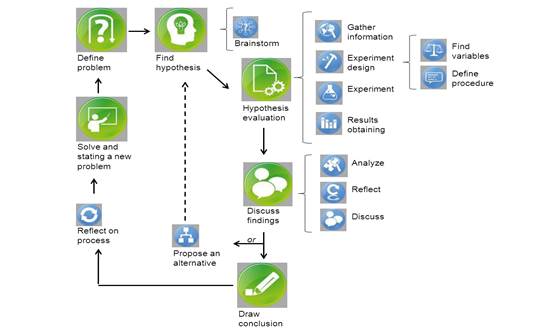
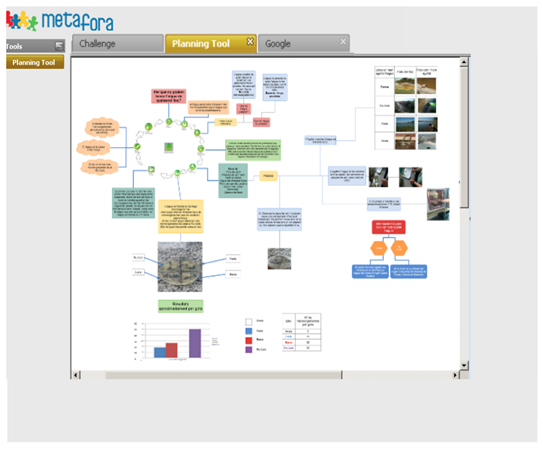
Figure 2 shows an example of a DCC-map constructed in the technological environment by a group of students. Students use the visual icons in an open, flexible and drag-and-drop mode. The DCC-maps had net architecture (see Table 1) and visual icons were the key elements to organize and represent the scientific inquiry process and the main science concepts. Besides, as it can be seen in Figure 2, students create complex explanations around the visual icons that reflects collective reasoning and unpacking inquiry processes. It includes both the planning and the report about how the group is approaching the whole inquiry processes. Furthermore, the technological environment allows students to report visually (pictures, graphics, tables…) about the experimental and data analyses processes. Group discussion round each inquiry phase were also synthetized and registered in the DCC-map for subsequent revision and reflection.
Technological environment and an example of one group DCC-map
Materials
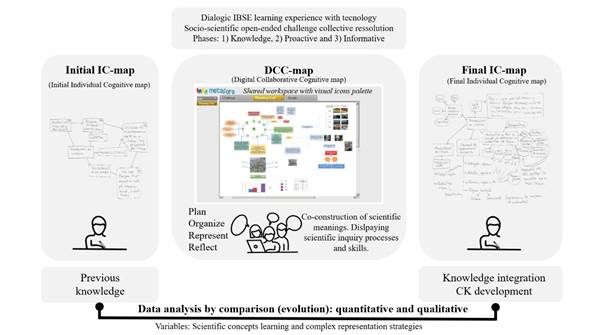
In order to assess the students’ knowledge learning before and after the technological-based learning experience, students were asked to individually make a cognitive map without using technology (in a paper-pencil format). In both moments, students were requested to build a cognitive map around the central concept of "the potability of drinking water ". The paper-pencil and individual cognitive map was used as an assessment tool similarly to the methods described by de Ries et al. (2021). Henceforth we will call this the Initial or the Final IC-map (Individual Cognitive map). Figure 3 shows a synthesis of this research methodology.
Research methodology diagram: materials, variables and data analyses
Data analysis procedure
To study the impact of the technological learning experience on students’ individual knowledge, initial and final IC-maps were compared and analysed at two levels: quantitative and qualitative. For the quantitative analysis, a category system was established with a scalar numerical logic. For the data analysis, normal data distribution with a Shapiro-Wilk test and t-test was used to compare initial-final IC-maps. This analysis was carried out with the aim of answering the first research question and finding out the level of significant learning of scientific concepts (RQ1). To this end, we adapted the categories proposed by Hakkarainen (2003) for evaluating scientific concepts construction level of explanations. Four categories were established that incorporate the explanation levels and the quality of meaning construction for four key scientific concepts in relation to “the potability of drinking water”: 0) No answer; 1) Unorganized and/or organized facts; 2) Partial explanation; and 3) Explanation. Two researchers evaluated the cognitive maps with substantial reliability (Cohen's Kappa test, K = 0.702).
Turning now to the qualitative analysis of the IC-map, to delve into the study of scientific meaning generation (RQ1) and the complex representation of scientific concepts (RQ2) the following three qualitative variables were considered:
a. IC-map Architecture: This variable analyses how ideas are connected, grouped, hierarchized and organized in space and between them. We reproduced the three main concept maps structures proposed by Kinchin et al. (2000) namely, spoke, chain and net structures. The description of these variables is presented in Table 1.
b. Number of ideas the IC-map incorporates: simple or complex (Table 1).
c. Scientific content construction: we analysed the meaning and quality of key concepts relates with “the potability of water”. We also studied the evolution of the meaning of concepts between the initial and the final IC-maps. Finally, we analysed whether scientific inquiry processes had been taken into account.
| Qualitative variables | Type | Description |
| a) IC-map Architecture | Spoke | All ideas are related to the central concept, but not to each other. No hierarchy of concepts. Shows little understanding and/or integration of ideas. |
| Chain | Linear sequence of ideas that reflects the understanding of a consecution between them. A consecutive linear hierarchy is established, in terms of importance, between concepts. Shows understanding of concepts, although they are not related to each other at different levels. | |
| Net | Ideas are interconnected and highly integrated in a framework of complex relationships. They are organized and packaged by related sets and in a hierarchical manner. Demonstrates a deep understanding of the core concept. | |
| b) Number of ideas | Simple | Incorporates few ideas. They are often not the most relevant. |
| Complex | Incorporates many ideas that are generally the main ones related to the central concept. |
RESULTS
Individual meaningful learning of scientific concepts. Quantitative study of IC-map evolution (RQ1)
The results confirm the normal distribution of the data (Initial K= 0.56; Final K=0,44). The results for the t test comparison between the initial and final IC-maps show significant differences in the level of explanation of scientific concepts (x̄ = 1, σ = 0.51, p <0.001).
On the one hand, descriptive statistical analysis, collected in Table 2, shows that in initial IC-map most of the students show a low level of scientific knowledge about the potability of drinking water (with an average value of 1 point out of 3; low dispersion, 0.21). On the other hand, in the final IC-map, scientific knowledge increases an average of 1 point and is placed at level 2 of partial explanation of scientific concepts. In addition, a greater dispersion is observed in the final results. This indicates that the 47 students internalized scientific knowledge in different ways after participating in the educational experience.
| N | Min. | Max. | x̄ | σ2 | σ | |
| Initial Test | 47 | 0 | 2 | 1 | 0.04 | 0.21 |
| Final Test | 47 | 1 | 3 | 2.04 | 0.26 | 0.5 |
To show the individual evolution pattern, Table 3 presents the frequencies obtained in the 4 levels or categories of explanation for scientific knowledge in the initial and final IC-maps.
| Initial IC-map | Final IC-map | |||
| Qualification | Frequency | % | Frequency | % |
| 0 | 1 | 2.1 | 0 | 0 |
| 1 | 45 | 95.8 | 5 | 10.6 |
| 2 | 1 | 2.1 | 35 | 74.5 |
| 3 | 0 | 0 | 7 | 14.9 |
| Total | 47 | 100 | 47 | 100 |
Table 3 shows that before the technological-based science experience, 95.8% of students presents a low learning level of key scientific concepts about potability of drinking water and were only capable of explain random disorganized facts. After participating in the mentioned collaborative and technological learning experience, about 90% of students were able to name, describe and meaningfully integrate at least two of the four key concepts. From the results obtained at quantitative level we infer that the building of DCC-maps during the learning experience had a positive impact on the individual learning of scientific concepts.
Complex representation of scientific concepts and meaningful learning. Qualitative study of IC-map evolution (RQ2)
Results of IC-map quantitative analysis, specifically the results synthesized in Table 3, allowed us to establish 6 patterns of evolution between the initial and final IC-maps. By order of frequency, these patterns were: a) evolution pattern [1-2]; 72.3% of the students were rated in the initial IC-map under category 1 and the final IC-map under category 2; b) evolution pattern [1-3]; this pattern is shown in 13% of the students; c) evolution pattern [1-1]; this pattern represents 10.6% of the students; d) evolution pattern [2-3] represents 2% of the students; and patterns [0-2] and [2-3] have only been obtained by 1 student respectively.
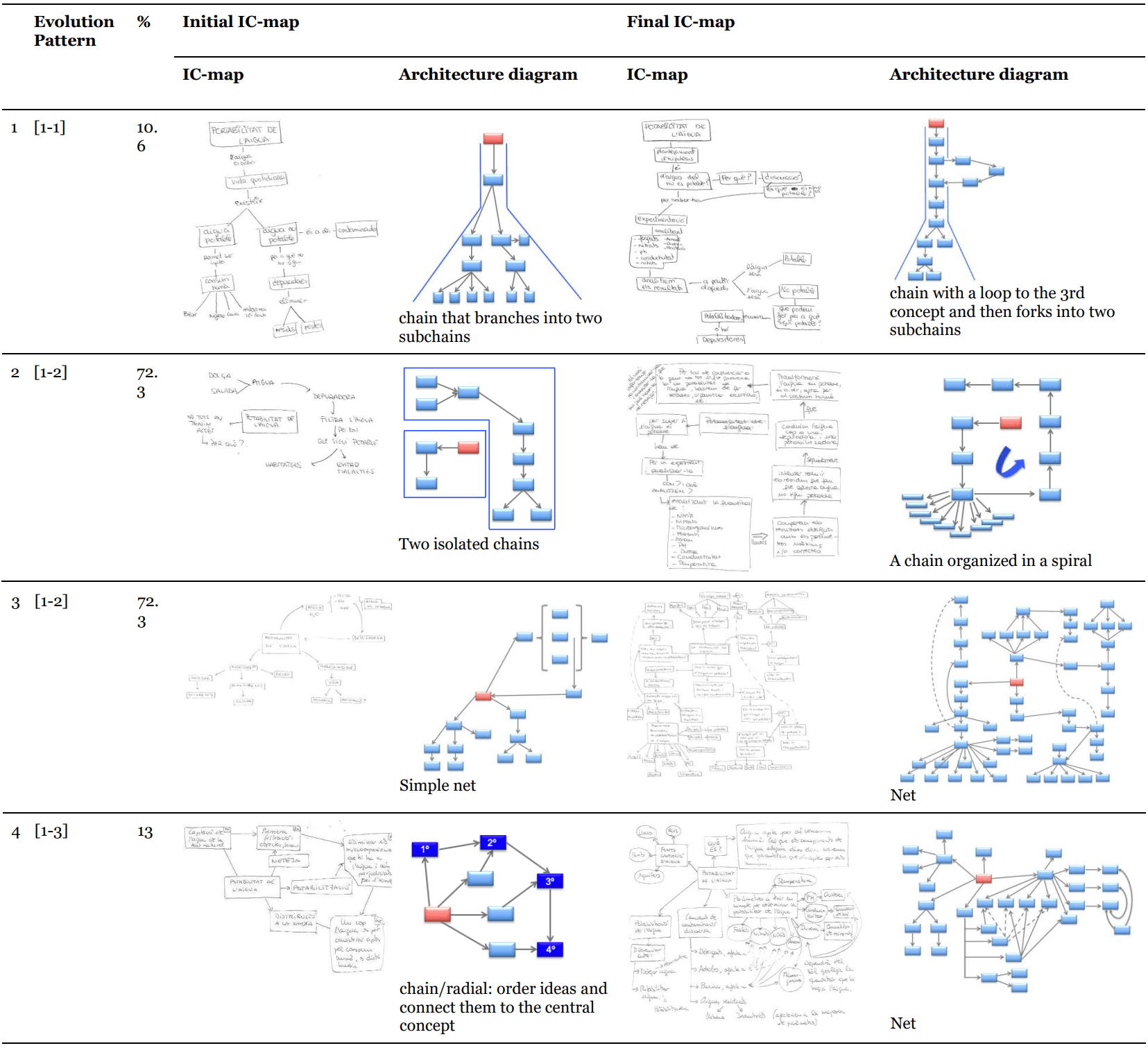
These evolution patterns are used to present qualitative analysis of IC-map and to answer RQ2, i.e., how the use of DCC-map enhance and enrich individual pre-service teachers’ complex representation strategies for scientific concepts. Table 4 shows 4 examples of IC-maps evolution and illustrates the main results obtained in our study.
First, the qualitative analysis of the initial IC-maps highlights the low level of knowledge of the scientific content. Initial IC-maps show that ideas presented are shallow and quite disconnected and, the key scientific concepts are not clearly identified.
Second, and regarding the architecture of the maps, the initial IC-maps are diverse and we identified the three types of architecture –i.e. spoke, chain and net–, including mixed forms. By contrast, in the final IC-maps, a larger number of students constructed maps with a net structure. This type of structure allows organising ideas into hierarchies and packaging between related ideas and, ultimately, representing a framework of complex relationships between concepts. Student 4 in Table 4 illustrates this result. This student was categorized with an evolution pattern [1-3] whereby she built an initial IC-map mixing chain and spoke structures, since only four out of the seven ideas included related directly to the central concept. These ideas corresponded to the path that water follows from its catchment to our homes, by avoiding the use of specific language. In addition, she lists orderly, four ideas with which she represents an interconnected outer chain. By so doing, she manifests a second layer of depth and establishes a linear ordered sequence. In the case of final IC-map, she clearly establishes a network in which demonstrates deep and complex knowledge with integration and packaging of ideas. She details key concepts. Moreover, she highlights the high degree of ideas integration, since they are correctly packaged, hierarchized and connected by related sets. In this way, she establishes up to four levels of hierarchical packaging and the last one links it to level two. This evidences the potential of a net structure to enable multiple interconnections between ideas and contribute to express a concept with depth and complexity. Finally, it is worth mentioning the attainment of a wide range of representation strategies associated with work in the technological environment.
Third, in the final IC-map an enrichment of the representation strategies was observed, since even in cases where a simple radial or chain type architecture dominates, some type of free approach to packaging and hierarchizing ideas was included. Thanks to the learning scaffolds included in the technological environment, representation strategies have been incorporated that allow representing complex scientific concepts.
Student 2 in Table 4 illustrates this result. This student has been categorized with an evolution pattern of [1-2]. Although she constructs two chain-structured IC-maps, they are substantially different. In the initial IC-map she builds two isolated chains with very simple concepts and without a specific language. One of the chains, which also includes the central concept, only consists of 3 ideas and the other fails to connect with the central concept. That is why we highlight the disconnection and confusion shown on the previous ideas related to the central concept. By contrast, chain build in final IC-map is organized in a spiral shape with "potability of drinking water" concept in the centre. This figure attributes a hierarchy from lesser to greater complexity as well as a connection between the layers of ideas. The ideas constructed are more elaborated and include specific language as well as some packaging when listing what the potability parameters are. In the final IC-map, this student enriched the chain representation by adding elements of spatial representation that allowed her to express the change in understanding and representing complex knowledge about the “potability of drinking water”.
DISCUSSION AND CONCLUSIONS
Our study tackled the need to develop scientific content knowledge in pre-service teachers by designing a technology-mediated collaborative learning experience that explicitly uses the co-construction of digital cognitive maps as a pedagogical tool to promote scientific learning processes and scientific inquiry skills. On a first note, the results of this research, firstly, confirms that pre-service teachers show, at the beginning of the study, a low level of specific scientific content knowledge. Thus, these results acknowledge that pre-service training programs need to include the design of evidence-based learning experiences capable to develop high-level learning processes and meaningful knowledge in specific domains (i. e. Derman & Ebenezer, 2020; Derman & Eilks, 2016).
Secondly, results indicated that the technological-based science experience and, specifically, the visual scaffolds to guide and externally represent a co-inquiry process to solve an authentic socio-scientific issue have positively contributed to learning scientific knowledge by pre-service teachers (RQ1). Previous educational research claims about the positive impact of inquiry approaches on students’ scientific learning (e.g. Kamarudin et al., 2022; Lin et al., 2021; Murphy et al., 2021). In addition, our study includes the analysis of level explanation of scientific concepts (Hakkarainen, 2003) in the evaluation categories and, therefore, we can also state that students developed socio-scientific reasoning (Romine et al., 2017).
Regarding the study about how the use of digital collaborative cognitive maps (DCC-maps) help students to represent the complexity of scientific concepts and enrich their representation strategies (RQ2); firstly, we provided experimental evidence that in the initial IC-maps the representation of the scientific ideas are not interconnected or grouped, and they are represented intuitively in spoke or chain structures. This result is in line with previous studies (de Ries et al., 2021; Kinchin et al., 2000).
Secondly, in the final IC-map, students who used spoke or chain structures enriched their answers with representation strategies that contributed to both representing complexity and overcoming limitations of these two architectures. From our point of view, students learnt that the process of solving the socio-scientific challenge with technology is not a linear sequence of processes or a simple hierarchy of concepts.
Thirdly, in the final IC-map, students perceived net representation strategy as the structure that offered better possibilities to organize, interconnect ideas and ultimately express their knowledge in depth that spoke or chain structure. Net representation makes it possible to group together sets of ideas, establish codes of representation, such as arrows of continuous and discontinuous lines to express different types of relationships with the same idea being repeated, qualifying and linking different sets of ideas. A clear example of this is the final IC-map that model 4 student constructs (Table 4).
These three experimental evidences lead us to conclude that the participation in the technological-based learning experience has helped pre-service teachers to develop high-level CK. The digital cognitive maps as an external and metacognitive representation of a co-inquiry challenge-solving promoted learning by building links (Krieglstein et al., 2022; Schneider et al., 2021; Scott et al., 2011), i.e., by learning and assessing the most relevant scientific content related to the “potability of drinking water”; by incorporating these new concepts and defining them in depth; by linking and integrating them by establishing hierarchies and similar sets; by classifying the concepts in large packages of ideas and proceed from the most general to the most concrete and, finally, making the conceptual change that implies recognizing conceptual errors (Kamarudin et al., 2022). Furthermore, pre-service teachers’ awareness of typical conceptual errors and general learning difficulties (Derman & Ebenezer, 2020) may help them to anticipate and adjust teaching to their future students, thus promoting PCK development. Overall, the inclusion in the technological-based learning experience of specific visual icons as explicit scaffolds to think and represent a collective inquiry to solve a socio-scientific challenge have featured in pre-service teachers’ activities like learning by design, learning by doing, reflective learning, and group work. Teacher education research claims that these approaches emphasize the active participation of future teachers in key learning process, built links between content and classroom practices, and encouraged collective participation in developing learning and teaching expertise (Huang et al., 2022).
The use of DCC-maps for learning content and scientific skills has also shown two learning opportunities that, despite being unplanned at the beginning of the research, became relevant for science learning. Firstly, our work emphasizes the possibilities of cognitive map as a tool for evaluating scientific learning, given that it allows us to learn the degree of understanding of broad and complex topics. Our study contributes to this line of research with an evaluation tool developed to assess the quality of the scientific concepts and its representation included in the IC-map. This evaluation tool embeds two essential variables in science learning: the relationships among science concepts (concept map structure) and the socio-scientific reasoning (level of explanation). Therefore, this study contributes to showing the value of the cognitive map as a reliable assessment instrument that can help to know and understand how students integrate knowledge, and how such knowledge hierarchizes, organizes, interrelates, and delves into complexity. Other authors argued that this is a good instrument to assess the students' understanding of scientific work (Cañas et al., 2015; Krieglstein et al., 2022; Zura et al., 2022).
Secondly, results show the inclusion in most IC-maps of the social dimension of science and the social implications of complex socio-scientific issues such as water management. The fact of incorporating social dimension endows more complexity to the learning process as students are encouraged to search information and build their own criteria with an eye to developing a scientific and solid foundation for solving a challenge. In our work, the students developed what Romine et al. (2017) define as socio-scientific reasoning. This means that they needed to evolve from naive and low-cognitive thinking to representative thinking through understanding and solving a socio-scientific issue with solid arguments deriving from understanding its complexity. To this end, pre-service teacher needs to be able to apply the following strategies: 1) recognizing the inherent complexity of this issue; 2) examining the facts from multiple perspectives; 3) understanding that socio-scientific issues are subject to continuous inquiry; and finally, 4) recognizing and analysing objectively potentially-biased information.
Limitations and future research
One of the main limitations of our paper is the methodology used –a case study–. Despite it provides a depth understanding the CK development, it may cause transferability issues. In this line, there is a need to design a large-scale empirical study to implement the technology-mediated collaborative learning experience and find out whether a similar project can work with other pre-service teachers and educational contexts. This empirical study would also delve into, on the one hand, the mechanisms of technology-mediated collaborative learning and their impact on individual learning and, on the other, the internalization mechanisms of the science inquiry visual scaffolds included in the technological environment.
Another limitation of our study is the time of exposure of students to the instrument. In the future, we aim to extend the working time of students in the technological environment. It would be interesting to see the possible differences in the use of technology with a group of students who use it for the second time to solve another research project in experimental sciences.
Finally, this study is an attempt to contribute to educating pre-service teachers into teaching how to learn scientific knowledge from the perspective of scientific inquiry skills. Despite our research focusing on CK development, the results obtained allow us to conclude that the technology-mediated collaborative learning experience has had a positive impact on the way students learn pedagogical aspects, specifically on how socio-scientific knowledge is developed and what scientific skills are necessary. In future research, we suggest studying how pre-service technology-enhanced learning experiences, as the one designed in this study, have an impact on their science teaching plans and teaching activities.
Funding
The authors are grateful to the Ministry of Science and Innovation of the Government of Spain under Grant EDU2019-107399RB-I00.
REFERENCES
Bayram‐Jacobs, D., Henze, I., Evagorou, M., Shwartz, Y., Aschim, E. L., Alcaraz‐Dominguez, S., Barajas, M., & Dagan, E. (2019). Science teachers' pedagogical content knowledge development during enactment of socioscientific curriculum materials. Journal of Research in Science Teaching, 56(9), 1207-1233. https://doi.org/10.1002/tea.21550
Brugha, M. E., & Hennessy, S. (2022). Educators as creators: lessons from a mechanical MOOC on educational dialogue for local facilitators. Irish Educational Studies, 41(1), 225-243. https://doi.org/10.1080/03323315.2021.2022527
Cañas, A. J., Novak, J. D., & Reiska, P. (2015). How good is my concept map? Am I a good Cmapper? Knowledge Management & E-Learning, 7(1), 6. https://doi.org/10.34105/j.kmel.2015.07.002
Chai, C. S. (2019). Teacher professional development for science, technology, engineering and mathematics (STEM) education: A review from the perspectives of technological pedagogical content (TPACK). The Asia-Pacific Education Researcher, 28(1), 5-13. https://doi.org/10.1007/s40299-018-0400-7
Chen, J., Wang, M., Dede, C., & Grotzer, T. A. (2021). Analyzing student thinking reflected in self-constructed cognitive maps and its influence on inquiry task performance. Instructional Science, 49(3), 287-312. https://doi.org/10.1007/s11251-021-09543-8
de Ries, K. E., Schaap, H., van Loon, A. M. M., Kral, M. M., & Meijer, P. C. (2021). A literature review of open-ended concept maps as a research instrument to study knowledge and learning. Quality & Quantity, 1-35. https://doi.org/10.1007/s11135-021-01113-x
Derman, A., & Ebenezer, J. (2020). The effect of multiple representations of physical and chemical changes on the development of primary pre-service teachers’ cognitive structures. Research in Science Education, 50, 1575-1601. https://doi.org/10.1007/s11165-018-9744-5
Derman, A., & Eilks, I. (2016). Using a word association test for the assessment of high school students' cognitive structures on dissolution. Chemistry Education Research and Practice, 17(4), 902-913. https://doi.org/10.1039/C6RP00084C
Hakkarainen, K. A. I. (2003). Emergence of progressive-inquiry culture in computer-supported collaborative learning. Learning Environments Research, 6(2), 199-220. https://doi.org/10.1023/A:1024995120180
Hennessy, S. (2011). The role of digital artefacts on the interactive whiteboard in supporting classroom dialogue. Journal of computer assisted learning, 27(6), 463-489. https://doi.org/10.1111/j.1365-2729.2011.00416.x
Huang, B., Jong, M. S. Y., Tu, Y. F., Hwang, G. J., Chai, C. S., & Jiang, M. Y. C. (2022). Trends and exemplary practices of STEM teacher professional development programs in K-12 contexts: A systematic review of empirical studies. Computers & Education, 104577. https://doi.org/10.3390/educsci13010001
Isohätälä, J., Näykki, P., Järvelä, S., Baker, M. J., & Lund, K. (2021). Social sensitivity: a manifesto for CSCL research. International Journal of Computer-Supported Collaborative Learning, 16(2),1-11. https://doi.org/10.1007/s11412-021-09344-8
Kamarudin, M. Z., Mat Noor, M. S. A., & Omar, R. (2022). A scoping review of the effects of a technology-integrated, inquiry-based approach on primary pupils’ learning in science. Research in Science & Technological Education, 1-20. https://doi.org/10.1080/02635143.2022.2138847
Kinchin, I. M., Hay, D. B., & Adams, A. (2000). How a qualitative approach to concept map analysis can be used to scaffold learning by illustrating patterns of conceptual development. Educational research, 42(1), 43-57. https://doi.org/10.1080/001318800363908
Kind, V., & Chan, K. K. (2019). Resolving the amalgam: connecting pedagogical content knowledge, content knowledge and pedagogical knowledge. International Journal of Science Education, 41(7), 964-978. https://doi.org/10.1080/09500693.2019.1584931
Krieglstein, F., Schneider, S., Beege, M., & Rey, G. D. (2022). How the design and complexity of concept maps influence cognitive learning processes. Educational technology research and development, 70(1), 99-118. https://doi.org/10.1007/s11423-022-10083-2
Ley, T. (2020). Knowledge structures for integrating working and learning: A reflection on a decade of learning technology research for workplace learning. British Journal of Educational Technology, 51(2), 331-346. https://doi.org/10.1111/bjet.12835
Lin, X., Yang, W., Wu, L., Zhu, L., Wu, D., & Li, H. (2021). Using an inquiry-based science and engineering program to promote science knowledge, problem-solving skills and approaches to learning in preschool children. Early Education and Development, 32(5), 695-713. https://doi.org/10.1080/10409289.2020.1795333
Major, L., Warwick, P., Rasmussen, I., Ludvigsen, S., & Cook, V. (2018). Classroom dialogue and digital technologies: A scoping review. Education and Information Technologies, 23(5), 1995-2028. https://doi.org/10.1007/s10639-018-9701-y
Mercer, N., Hennessy, S., & Warwick, P. (2019). Dialogue, thinking together and digital technology in the classroom: Some educational implications of a continuing line of inquiry. International Journal of Educational Research, 97, 187-199. https://doi.org/10.1016/j.ijer.2017.08.007
Murphy, C., Smith, G., & Broderick, N. (2021). A starting point: Provide children opportunities to engage with scientific inquiry and nature of science. Research in Science Education, 51(6), 1759-1793. https://doi.org/10.1007/s11165-019-9825-0
Pifarré, M., Wegerif, R., Guiral, A., & del Barrio, M. (2014). Developing Technological and Pedagogical Affordances to Support the Collaborative Process of Inquiry-Based Science Education. In Digital Systems for Open Access to Formal and Informal Learning (pp. 159-179). Springer, Cham. https://doi.org/10.1007/978-3-319-02264-2_11
Pitjeng-Mosabala, P., & Rollnick, M. (2018). Exploring the development of novice unqualified graduate teachers’ topic-specific PCK in teaching the particulate nature of matter in South Africa’s classrooms. International Journal of Science Education, 40(7), 742-770. https://doi.org/10.1080/09500693.2018.1446569
Romine, W. L., Sadler, T. D., & Kinslow, A. T. (2017). Assessment of scientific literacy: Development and validation of the Quantitative Assessment of Socio‐Scientific Reasoning (QuASSR). Journal of Research in Science Teaching, 54(2), 274-295. https://doi.org/10.1002/tea.21368
Schneider, S., Krieglstein, F., Beege, M., & Rey, G. D. (2021). How organization highlighting through signaling, spatial contiguity and segmenting can influence learning with concept maps. Computers and Education Open, 2, 100040. https://doi.org/10.1016/j.caeo.2021.100040
Scott, P., Mortimer, E., & Ametller, J. (2011). Pedagogical link‐making: a fundamental aspect of teaching and learning scientific conceptual knowledge. Studies in Science Education, 47(1), 3-36. https://doi.org/10.1080/03057267.2011.549619
Şen, M., Demirdöğen, B., & Öztekin, C. (2022). Interactions among topic-specific pedagogical content knowledge components for science teachers: The impact of content knowledge. Journal of Science Teacher Education, 33(8), 860-887. https://doi.org/10.1080/1046560X.2021.2012630
Sun, M., Wang, M., Wegerif, R., & Peng, J. (2022). How do students generate ideas together in scientific creativity tasks through computer-based mind mapping? Computers & Education, 176, 104359. https://doi.org/10.1016/j.compedu.2021.104359
Suthers, D. D., Vatrapu, R., Medina, R., Joseph, S., & Dwyer, N. (2008). Beyond threaded discussion: Representational guidance in asynchronous collaborative learning environments. Computers & Education, 50(4), 1103-1127. https://doi.org/10.1016/j.compedu.2006.10.007
Wang, M., & Wegerif, R. (2019). From active‐in‐behaviour to active‐in‐thinking in learning with technology. British Journal of Educational Technology, 50, 2178–2180. https://doi.org/10.1111/bjet.12874
Wang, M., Kirschner, P. A., & Bridges, S. M. (2016). Computer-based learning environments for deep learning in inquiry and problem-solving contexts. In Proceedings of the 12th International Conference of the Learning Sciences (ICLS). https://doi.org/10.1016/j.chb.2018.06.026
Wang, M., Derry, S., & Ge, X. (2017). Guest editorial: Fostering deep learning in problem-solving contexts with the support of technology. Journal of Educational Technology & Society, 20(4), 162-165. https://www.jstor.org/stable/26229214?seq=1&cid=pdf
Wang, M., Wu, B., Kirschner, P. A., & Spector, J. M. (2018). Using cognitive mapping to foster deeper learning with complex problems in a computer-based environment. Computers in Human Behavior, 87, 450-458. https://doi.org/10.1016/j.chb.2018.01.024
Wegerif, R., & Yang, Y. (2011). Technology and dialogic space: lessons from history and from the ‘Argunaut’ and ‘Metafora’ projects. In H. Spada, G. Stahl, N. Miyake, & N. Law (Eds.), Connecting Computer-Supported Collaborative Learning to Policy and Practice: CSCL2011 Conference Proceedings. Volume I — Long Papers (pp. 312-318). International Society of the Learning Sciences.
Wegerif, R., Kershner, R., Hennessy, S., & Ahmed, A. (2020). Foundation for research on educational dialogue. In Research methods for educational dialogue (pp. 9-26). Bloomsbury. https://doi.org/10.5040/9781350060111
Wu, H. L., Weng, H. L., & She, H. C. (2016). Effects of Scaffolds and Scientific Reasoning Ability on Web-Based Scientific Inquiry. International Journal of Contemporary Educational Research, 3(1), 12-24.
Yang, Y. (2022). The Causal Map: Enhancing Creativity by Supporting the Construction of Alternate Problem Representations. Doctoral dissertation. Columbia University. https://doi.org/10.7916/wm21-0n80
Zura, M. P. V., Velasco, S. V. Y., Martínez, T. T. C., & Arboleda, J. I. C. (2022). Análisis del proceso de aprendizaje y comprensión. Caso de estudio principio de proporcionalidad. Revista Conrado, 18(S1), 128-138.
Received: December 01, 2022
Approved: March 22, 2023
OnlineFirst: April 01, 2023
Html: May 12, 2023
Published: July 03, 2023