Monográfico
The Flexibility of the Flipped Classroom for the Design of Mediated and Self-regulated Learning Scenarios
La flexibilidad del aula invertida para el diseño de escenarios de aprendizaje mediados y autorregulados
 Ingrid Noguera Fructuoso
Paulina Elizabeth Robalino
Shqiponjë Ahmedi
Ingrid Noguera Fructuoso
Paulina Elizabeth Robalino
Shqiponjë Ahmedi
The Flexibility of the Flipped Classroom for the Design of Mediated and Self-regulated Learning Scenarios
RIED. Revista Iberoamericana de Educación a Distancia, vol. 26, núm. 2, 2023
Asociación Iberoamericana de Educación Superior a Distancia

Esta obra está bajo una Licencia Creative Commons Atribución 4.0 Internacional.
How to cite: Noguera Fructuoso, I., Robalino, P. E., & Ahmedi, S.
(2023). The Flexibility of the Flipped Classroom for the Design of Mediated and Self-regulated Learning
Scenarios. RIED-Revista Iberoamericana de Educación a Distancia, 26(2), 155-173. https://doi.org/10.5944/ried.26.2.36035
Abstract: The flipped classroom is a methodology recognised for its positive impact on the self-regulation of learning and academic performance. There is extensive literature that demonstrates its potential for educational flexibility, including the adaptation to online and blended modes of delivery that utilize digital technology successfully. There is, however, little evidence which proves that a unique flipped classroom design can be adjusted to different teaching modes without affecting student satisfaction and learning outcomes. In this research, we analyse eight cases of flipped classroom implementation during the 2020-2021 and 2021-2022 academic years in the Faculty of Education Sciences at Universitat Autònoma de Barcelona. According to the findings, students who seem to have a stronger perception of self-regulated learning development and technology appropriation also have higher perception of academic performance, although they do not achieve better results. There are no significant variations in pedagogical design satisfaction or learning outcomes depending on teaching modality. However, the study did find that the most flexible teaching modes, such as intermittent face-to-face and hybrid teaching, offered more benefits to students in terms of academic performance and self-regulated learning. The main conclusion is that flipped classroom is a flexible methodology that can be adapted to different teaching modes while maintaining student satisfaction and learning outcomes.
Keywords: flipped classroom, flexible learning, hybrid teaching, virtual education, performance, self-regulation.
Resumen: El aula invertida es una metodología reconocida por su impacto positivo en la autorregulación del aprendizaje y el rendimiento académico. Existe amplia literatura que demuestra sus posibilidades para la flexibilidad educativa, incluyendo la adaptación a modalidades de enseñanza en línea y semipresencial con aprovechamiento de las tecnologías digitales. Sin embargo, existen pocas evidencias que demuestren que un mismo diseño de aula invertida pueda ajustarse a distintas modalidades de enseñanza sin afectar a la satisfacción ni a los resultados de aprendizaje del estudiantado. En esta investigación, analizamos ocho casos de aplicación de un mismo diseño de aula invertida durante los cursos académicos 2020-2021 y 2021-2022 en la Facultad de Ciencias de Educación de la Universitat Autònoma de Barcelona. Los resultados demuestran que el estudiantado con mayor percepción de desarrollo de aprendizaje autorregulado y aprovechamiento de las tecnologías muestra una mayor percepción de rendimiento académico, pero no mejores resultados. No existen diferencias significativas ni en la satisfacción sobre el diseño pedagógico ni en los resultados de aprendizaje dependiendo de la modalidad de enseñanza. Sin embargo, sí que se evidencia que existe un mayor aprovechamiento del diseño bajo las modalidades más flexibles; presencialidad intermitente y enseñanza híbrida. La conclusión principal es que el aula invertida es una metodología flexible que se adapta a distintas modalidades de enseñanza manteniendo la satisfacción de los y las estudiantes y los resultados de aprendizaje.
Palabras clave: aula invertida, aprendizaje flexible, enseñanza híbrida, enseñanza virtual, rendimiento, autorregulación.
INTRODUCTION
In recent years, there has been growing interest in using digital technology to support flexible forms of teaching and learning at the university level (Huang et al., 2020; Valdivia & Noguera, 2022). The pandemic intensified the digitalisation and flexibility in education (Ahmed et al., 2021; Beardsley et al., 2021); however, the imprint of techno-pedagogical advances made during this period is still being studied. This is the case with the flipped classroom (FC) model. The FC model inverts the tasks and time spent at home and in class. The homework (i.e., practical activities and discussions) is performed in class, and the study of contents is done at home through digital media (Alegre et al., 2019; Sandobal Verón et al., 2021). Such a model has received the attention of university teachers since 2014, even if the pandemic intensified its use. A body of studies has explored the impact of the FC (Akçayır & Akçayır, 2018; Chang et al., 2020; Chen, 2021; Galindo-Domínguez, 2021; Shao & Liu, 2021). Regarding the advantages, it has been evinced that the FC contributes to academic performance, flexible learning, self-regulation, time efficiency, increased satisfaction, motivation, frequent interaction and a decrease in anxiety. The observed challenges are, for instance, the need for preparation before class, workload, lack of digital competence and resistance to change.
The FC opens possibilities for flexible teaching and learning (Alghasab, 2020; Collado-Valero et al., 2021; Romero-García et al., 2021; Valdivia & Noguera, 2022). We understand flexibility as the capacity of the model to get adapted to diverse teaching modes (face-to-face, online, blended or hybrid). Literature shows that the FC is appropriate for blended learning (Campillo-Ferrer & Miralles-Martínez, 2021; Hew et al., 2021; Othman et al., 2022; Sadiq & Mahejabin, 2022). Recent studies have proven that face-to-face (from now on F2F) flipped designs can be adapted to the online mode by transforming the in-class activities into synchronous technology-mediated activities and the study time into asynchronous technology-mediated work. Such online FC designs have increased student engagement and performance (Beason-Abmayr et al., 2021; Gopalan et al., 2021; Jia et al., 2022; Latorre-Cosculluela et al., 2021; Romero-García et al., 2021; Ruiz-Jiménez et al., 2022). Nevertheless, Weiss and Friege (2021) alert that there is a risk of applying FC under a reductionist and inefficient view of technologies.
One of the characteristics of the FC that may differentiate it from other active learning models is, first, the necessary use of digital technologies to expand the possibilities for teaching and learning beyond the physical spaces. The literature on digital technologies is mainly explored from the point of view of the usage of digital resources, such as digital content -video-lectures-, OER or digital tools -quizzes- (Bishnoi, 2020; Drozdikova-Zaripova & Sabirova, 2020; Mosquera Feijóo et al., 2021) and the shift to online FC due to the pandemic (Gopalan et al., 2021; Jia et al., 2022, Khan & Abdou, 2021; Sanandaji & Ghanbartehrani, 2021). The second characteristic is the development of self-, co- and shared-regulation skills (Silverajah et al., 2022). There is a vast literature on self-regulation in FC with significant results in academic achievement, learning engagement and attitude towards learning (Doo & Bonk, 2020; Memon et al., 2021; Okmen & Kilic, 2020; Hyppönen et al., 2019). Regarding co-regulation and shared regulation under the FC model, it has been encountered positive results in terms of learning and development of higher order skills (Jafarian et al., 2021; Jung et al., 2022; Kim et al., 2021; Park & Kim, 2022; Zheng et al., 2020).
One of the effects of FC studied the most is on learning outcomes. It has been evinced that this model positively impacts satisfaction, engagement, and motivation (Akçayır & Akçayır, 2018; Fisher et al., 2021). Several kinds of research have demonstrated that the FC contributes to higher grades (Martin & Gallimore, 2020; Meyliana et al., 2022). Moreover, certain studies confirm it promotes better academic performance (Huang et al., 2021; Torres-Martín et al., 2022), while others prove the opposite (Gillette et al., 2018).
Regarding the context of the application, a body of research has analysed the FC in F2F and online education, this last mostly due to the pandemic (Al-Samarraie et al., 2020; Beason et al., 2021; Freire & Rodríguez, 2022; Sanandaji & Ghanbartehrani, 2021; Swart et al., 2021). Del Arco et al. (2022) suggested further research on improving academic performance and profound learning in FC application in different contexts. In this regard, little is known about the effect on academic performance of applying a unique pedagogical design under different teaching delivery modes (from now on, ‘teaching mode’). In this article, we differentiate between F2F, virtual, hybrid and intermittent in-presence teaching. F2F learning requires synchronous physical presence of all participants even though it permits the support of digital technologies (Nortvig et al., 2018). Virtual education is when the teacher and students are separated by time or space and communicate through digital technologies (Hue, 2020). Hybrid learning refers to students' attendance either in-person or remotely (Engel & Coll, 2022). Furthermore, in the context of this study, it indicates enabling students to attend synchronously - in person or online- (in case of confinement or testing positive for COVID) and to interact with the teacher online. Intermittent in-person teaching refers to a face-to-face mode of instruction that includes brief periods of virtual learning (Valdivia & Noguera, 2022).
There is a clear interest in the scientific community in academic performance as an objective measure to test the effect of the FC. However, the FC provides opportunities for self-regulated and formative assessment approaches that prompt the students’ consciousness and responsibilities for their learning. These teaching practices cannot be examined only in relation to marks. The novelty of this study lies in examining the students’ perceived academic performance under a formative assessment and competence-based approach. To this aim, we explore students’ perceptions in relation to the applicability of knowledge, the development of competencies and learning preparedness. Such perceptions are contrasted with final grades.
Furthermore, the literature demonstrated that students are more satisfied with flipped proposals than traditional ones in any context. Nevertheless, research about the effective use of technologies in the FC to improve learning is scarce. In this study, digital technologies have been conceived to support self-regulated, active- and social- learning and flexible teaching. We aim to gather students’ views about the contribution of digital technologies to support their learning. In addition, the study addresses the question of the suitability of the FC model to create a unique pedagogical design that can be adaptable to different teaching delivery modes. The question now is if, under a unique pedagogical design, the teaching delivery mode can be a factor that affects students' satisfaction and learning outcomes. Student satisfaction is understood in relation to the entire class experience (Yilmaz, 2017).
The following research questions drive this study:
- Do students' perceptions of effective technology usage and self-regulation factors related to their satisfaction with academic performance and learning outcomes?
- Does the teaching delivery mode affect the satisfaction and learning outcomes of students?
PEDAGOGICAL DESIGN
This paper analyzes a mandatory first-year communication course for Early Childhood (G1 from now on) and Primary Education (G2 from now on) students at Universitat Autònoma de Barcelona. Data was collected from the academic years 2020-2021 and 2021-2022, focusing on the socio-emotional education block. Group classes were divided into three seminar groups: SA, SB, and SC, with each seminar requiring 27.5 hours of in-person attendance, 25 hours of tutoring, and 27.5 hours of autonomous work. The course uses the FC model, with students reviewing materials before synchronous sessions and dedicating synchronous time to practical exercises, problem-solving, and group work. The evaluation is based on individual tasks (critical essay and digital presentation) and a group Project (case study), with no exam and continuous formative assessment.
To encourage self-regulation, didactic strategies such as quizzes, study guides, and resource annotation are employed in pre-class learning. In-class activities use a study guide for managing group work, self-assessment, reflective questioning, and collaborative concept mapping. Students reflect on the main idea covered in class at the end of the session. Microsoft Teams is used for communication, storing resources, and synchronous teaching. Microsoft Forms, Mentimeter, and Poll Everywhere are used for pre- and end-of-the-class quizzes. Enriched PowerPoint presentations are consulted during autonomous work. Each team chooses the cloud storage platform for collaborative projects, and the digital blackboard is used in class.
During the pandemic, different teaching modes were explored within the same pedagogical design: F2F, virtual, hybrid, and intermittent F2F. The teacher was granted an institutional exemption to continue teaching online due to medical reasons in the 2020-2021 academic year. During this year, SC groups (G1 and G2) had the option to choose virtual or hybrid mode. In the virtual mode (selected by G1), there was synchronous session combining videoconference and chat, and five seminar sessions combining videoconference and guided autonomous work. In the hybrid mode (selected by G2), students attended in person while the teacher and some connected online synchronously. In the F2F mode, participants attended in person, and resources and tasks were delivered through Microsoft Teams. In the intermittent F2F mode, the teaching mode shifted from F2F to virtual due to sanitary restrictions.
The following figure (Figure 1) summarises the characteristics of the aforementioned implementations.
Implemented teaching modes by Seminar and academic year

METHOD
This study reports a multiple case study of 1st-year Primary Education and Early Childhood Education students involved in four teaching modes (virtual, hybrid, F2F, intermittent F2F). This study was designed as quantitative, correlational research to enable the researchers to evaluate the relationships and differences between teaching modes.
Participants and procedure
A total non-probabilistic sample of 120 students (87% Female) participated in this study. The students belong to two different programs and group classes: G1- Early Childhood Education-, G2- Primary Education-. Each group class was divided into three seminars: SA, SB and SC. Participants were residents of Spain, the 75% reported ages between 18 – 20 years old. Table 1 summarises the main characteristics of the number of students enrolled, respondents to the survey, average final grade, age range and gender for each seminar.
| Seminars | Academic year | Mode | Group | Students enrolled | Survey’s respondents | Average final grade | Age range(% 18-20 y/o) | Gender(% Female) |
| SC | 20-21 | Virtual | G1 | 27 | 20 | 7.3 | 80% | 90% |
| Hybrid | G2 | 30 | 16 | 7.3 | 75% | 69% | ||
| SA | 21-22 | F2F | G1 | 25 | 4 | 6.9 | 50% | 100% |
| G2 | 25 | 14 | 6.2 | 86% | 71% | |||
| SB | 21-22 | Intermittent F2F | G1 | 22 | 19 | 7.8 | 52% | 95% |
| G2 | 26 | 18 | 5.7 | 100% | 100% | |||
| SC | 21-22 | F2F | G1 | 23 | 9 | 7.9 | 67% | 100% |
| G2 | 24 | 20 | 7 | 70% | 80% | |||
| TOTAL | 202 | 120 | 7 | 78% | 87% |
Research instruments
Two surveys were used to collect students' satisfaction with the FC model. SC (academic year 20-21) and SA and SC (academic year 21-22) responded to a survey (Version 1 – V1) composed of 41 Likert-scale items (labelled from 1 – strongly disagree to 5 – strongly agree) grouped in 7 dimensions (design, benefit, participation, motivation, academic performance, ubiquity, and satisfaction). Six items on sociodemographic data (age range, gender, and prior education studies) with Yes/No responses, multiple-choice and open-ended responses, completed the survey.
The SB (academic year 21-22) answered a version (Version 2 – V2) of the survey described above. Students from SB took part in an innovation project focused on the strategies for active and self-regulation strategies experienced in FC. For that reason, the survey was modified and adapted. The survey was composed of 30 Likert-scale items (labelled from 1 – strongly disagree to 5 – strongly agree) grouped into 7 dimensions (time management, learning process, teaching process, academic performance, interaction, design, and satisfaction).
Instruments from prior works were reviewed to strengthen the validity of the survey (Aljaraideh, 2019; Barua et al., 2014; Del Arco et al., 2019; Sánchez-Rivas et al., 2019). In this study the overall alpha score obtained was 0.92. All dimensions showed good internal consistency values (alphas>.70-.88) and can be considered acceptable for exploratory research (Charter, 2003).
The instruments are available at https://ddd.uab.cat/record/272258
Procedure
Students were invited to respond to a survey at the end of their FC experience to measure their satisfaction with the teaching model. The instruments were administered using the Microsoft Forms platform and the session lasted 10 minutes.
Participants were informed of the objective of the investigation, the process and the commitment to confidentiality and anonymity of their participation. Each participant recorded their voluntary participation agreement in an informed consent form, which also included the information that they could withdraw from the study at any point.
Data analysis
The data were prepared and analysed using the SPSS 25 statistical program. In this study, Shapiro-Wilk Tests show non-normal distributions (p<.001) and the sample distribution shows groups with less than 25 observations. Thus, is recommended the use of non-parametric tests (le Cessie et al., 2020). We ran Spearman correlations between self-regulation, technology, performance satisfaction, and average final grade as learning outcomes. Furthermore, Separate Kruskal-Wallis tests were carried out to determine the differences between the teaching mode in satisfaction and learning outcomes.
Based on a redaction of the items (e.g., V1 “The format of the resources is varied” and V2 “Resources have been provided in various formats”) and the descriptive measures calculated for each item (mean, standard deviation, asymmetry, and kurtosis) we found 22 items with exact equivalence in both versions (V1 and V2). Posteriorly, U man-witney analysis and Levene's test for equality of variances were used to analyse the differences between the responses for each item. No significative differences were founded. Therefore, it was calculated the score for the dimensions of satisfaction, design, academic performance, motivation, and benefit. The ‘ubiquity’ dimension was excluded due to no equivalent items in the V2. Furthermore, Confirmatory Factorial Analysis was used to analyse the dimensional structure. On one hand, it was used diagonally weighted least squares (WLSMV) that are specifically designed for ordinal data (Li, 2016). WLSMV makes no distributional assumptions about the observed variables, a normal latent distribution underlying each observed categorical variable is instead assumed. On the other hand, with 200 observations or less the fit indexes are sensible to outliers, hence it is suggested only taken as fit indexes to SRMR and CFI (Muiños, 2021; Rojas-Torres, 2020; Shi et al., 2019). For this study an adequate fit index (CFI=.99; SRMR=.09) and reliability analysis for each dimension using alpha de Cronbach were acceptable.
Finally, the Bonferroni method was used to compensate for multiple comparisons (Bland & Altman, 1995), which adjusts the confidence level for each of the individual intervals to control the family-wise error rate, i.e., the probability of incorrectly rejecting the true null hypothesis. For this study, to calculate a Bonferroni correction, we divide the critical P value (α) by the number of comparisons being made (four teaching modes), α=0.05/4=0.0125. Therefore, the value of p<.0125 was used to evaluate the significance.
RESULTS
The study of correlations between technology appropriation and self-regulatory skills in relation to academic performance and grades demonstrates that self-regulation and technology are significant in relation to the satisfaction with academic performance. Nevertheless, not all positive perceptions of academic performance result in higher final grades (see Table 2).
| Academic performance satisfaction | Average final grade | ||
| Technology | The technologies were effectively integrated into teaching | .343** | .232* |
| The technologies were used to collaborate with other students | .386** | .075 | |
| Technologies have facilitated my learning | .200* | .09 | |
| Self-regulation | Adequate time should be given to consult the resources before the synchronous sessions. | .524** | .155 |
| The resources can be consulted repeatedly to improve understanding | .315** | .065 | |
| I have time to raise doubts and concerns | .530** | .168 | |
| I am able to reflect on and organize my ideas for evidence and work. | .667** | .239** | |
| I can guide my own learning | .556** | .125 | |
| I have been less dependent on the teacher | .588** | -.04 |
In regard to technology appropriation, the students that report more satisfaction with an effective technology appropriation into teaching are more satisfied with their academic performance (r=.343; p<.01) and obtain a better average final grade (r=.232; p<.05). However, students that are more satisfied with the use of technologies for collaborating with other students (r=.386; p<.01) and that consider that technology facilitates their learning (r=.200; p<.01) are just related with a better satisfaction of their academic performance perception. There is no correlation with the final grade.
Furthermore, for self-regulation items, the results show that just those students who perceived to be more able to reflect and organise ideas for evidence and work are more satisfied with their perceived academic performance (r=.667; p<.01) and had better average final grades (r=.239; p<.01). Whereas the students who are more satisfied with the time to consult the resources before the synchronous sessions (r=.524; p<.01), with the availability of resources to be consulted repeatedly to improve their understanding (r=.315; p<.01) and with the time to raise doubts and concerns (r=.530; p<.01) are just more satisfied with their perceived academic performance. Similarly, the students that perceived selves more satisfied with guiding their own learning (r=.556; p<.01) and were less dependent on the teacher (r=.588; p<.01) have better perceived academic performance.
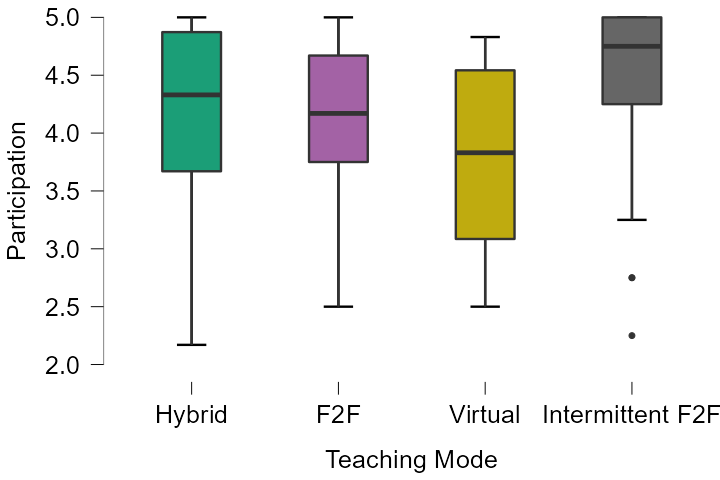
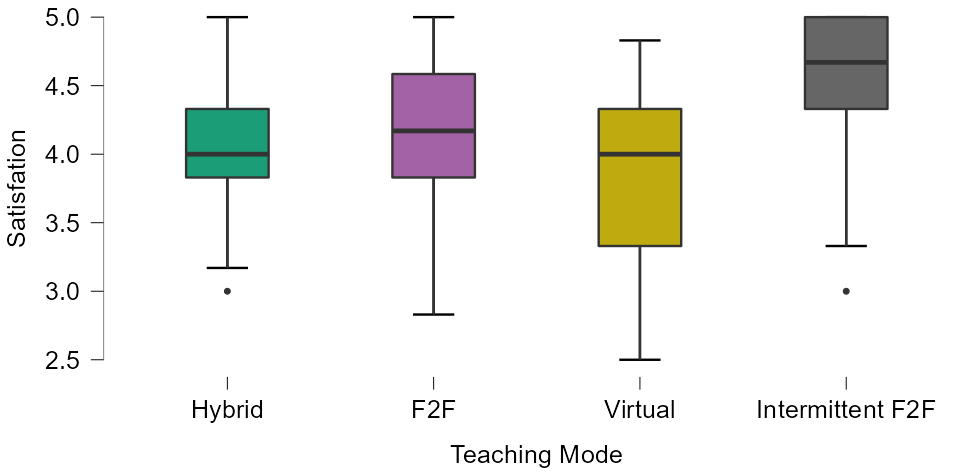
Finally, Table 3 shows the results of analysing the differences among F2F, virtual, hybrid and intermittent in-presence teaching and the satisfaction with de teaching model (FC). There are significant differences between the teaching model and participation, satisfaction, and average final grade. No significant differences are found in design, benefit, motivation, and academic performance.
The students value more their participation (H(3)=12.278; p<.006; εR2=.10) in the intermittent in-presence (Mdn=4.75) teaching mode than in the virtual mode (Mdn=3.93). Intermittent in-presence students (Mdn=4.67) are more satisfied (H(3)=16.111; p<.001; εR2=.14) than those from the virtual (Mdn=4), hybrid (Mdn=4), and F2F (Mdn=4.17) teaching modes. In addition, the average final grades (H(3)=11.576; p<.009; εR2=.10) are better in virtual (Mdn=7.30) students than in F2F (Mdn=7).
| Dimension/ Teaching mode (Median) |
1 Virtual |
2 Hybrid |
3 Intermittent F2F |
4 F2F |
H | p | ER2 | Contrast*2 |
| Design | 4.06 | 4.22 | 4.50 | 4.33 | 6.977 | .073 | .06 | - |
| Benefit | 3.93 | 4.14 | 3.87 | 4.00 | 3.169 | .366 | .03 | - |
| Participation | 3.83 | 4.33 | 4.75 | 4.17 | 12.278 | .006 | .10 | 1 < 3 |
| Motivation | 3.88 | 4.50 | 3.89 | 4.25 | 4.553 | .208 | .04 | - |
| Academic performance | 3.86 | 4.29 | 3.75 | 4.14 | 9.364 | .025 | .08 | - |
| Satisfaction | 4.00 | 4.00 | 4.67 | 4.17 | 16.111 | .001 | .14 | 1, 2, 4 < 3 |
| Average final grade | 7.30 | 7.30 | 7.80 | 7.00 | 11.576 | .009 | .10 | 1 > 4 |
In Figure 2, the results show that students are less satisfied with de participation in the virtual mode than in an intermittent presence mode.
Box plot of satisfaction in ‘Participation’ dimension
The findings suggest that, in general, the students are significantly more satisfied with intermittent F2F than with the rest of the teaching modes (see Figure 3).
Box plot of ‘Satisfaction’ dimension
DISCUSSION AND CONCLUSION
The present study investigated the relationship between two key aspects of our FC design, namely technology appropriation and self-regulation, and students' academic performance satisfaction and learning outcomes. Additionally, we sought to examine whether the mode of teaching delivery had any impact on students' satisfaction and learning outcomes within the FC design.
Results show that the students who perceive better satisfaction with the technologies, as well as a high perception of self-regulation in the design of FC, are those who are more satisfied with their academic performance. However, only those who perceive that there is a higher integration of technology into the mode of teaching and feel able to reflect and organize their ideas for evidence and work have better learning outcomes (high average final grades). These findings are in accordance with previous studies that have reported a positive correlation between self-regulation and perceived academic performance (Hyppönen et al., 2019; Park & Kim, 2022) and contradict prior studies that relate FC with higher grades (Martin & Gallimore, 2020; Meyliana et al., 2022). According to Noguera et al. (2022), self-regulation might contribute to the consciousness of learning, which could let to an increase in the perception of academic performance. Furthermore, the course level could have affected the grades achieved. Considering that these were students from 1st course, it is reasonable to elucidate that the efforts to get involved in such a new teaching method and evaluation system could have positively impacted their learning process but not in their final deliveries and grades.
Likewise, according to Shyr and Chen (2018) and Witt et al. (2021) the perceived effective integration of technologies contributes to a positive perception of academic performance and obtaining better grades (Birgili et al., 2021; Fan et al., 2020; van Alten et al., 2019). This result might suggest that an FC design where technologies are carefully integrated to support learning could contribute to the feeling of effectiveness. In this sense, this study confirms that if technologies are at the service of pedagogies, students see them as facilitators and their academic performance and their grades are positive. This result proposes new evidence to the amount of research that highlights among the disadvantages of FC the need for technologies (e.g., Günduz & Akkoyunlu, 2020). In addition, the social use of technology also contributes to perceived academic performance. This finding is consistent with the social nature of the FC (Birgili et al., 2021). It might suggest the necessary balance between individual practices (such as those related to self-regulation) and social learning to get the most effective learning experience in FC. However, according to Weiss and Friege (2021), further studies are necessary in terms of effectiveness. Concretely, with the arrival of new forms of technology-mediated FC, we believe that the technological component should be explored beyond the use of specific tools as the context for learning. As reported by Mehring (2017) the use of technologies in the FC transforms the learning experience. In this regard, Bishnoi (2020) proposes that it is foreseeable that the digitalisation that accompanies the FC might also help support diverse assessment forms oriented to competence-based learning as in the case reported in our study.
The study found that there were no differences in the FC design dimension across various teaching modes, indicating that the teaching mode did not affect student satisfaction, benefits, motivation, or academic performance. However, students reported higher satisfaction, participation, and learning outcomes with intermittent F2F mode. This could be because it was perceived as the most blended and flexible mode. Previous research has also shown that the FC is suitable for blended learning (Campillo-Ferrer & Miralles-Martínez, 2021; Sadiq & Mahejabin, 2022). Further research is needed to compare all modes of teaching under an FC approach.
The study highlights the flexibility of the FC in adapting to different teaching modes while maintaining student satisfaction and learning outcomes. The blended mode was preferred by students, and positive perception of self-regulation strategies and technology integration predicted positive academic performance. However, this perception did not affect final grades in formative assessment.
It should be noted that this study has certain limitations, such as the relatively small sample size, which may limit the generalizability of the findings. Nonetheless, it is an exploratory study that provides initial evidence of the flexibility of the FC design. Moreover, despite the rigorous equivalence process, the use of two different instruments and the reliance on self-reports may introduce potential biases and reduce the precision of the evaluation. Therefore, it is recommended to further investigate the various factors that impact student satisfaction with class designs, as highlighted by Karaoğlan Yilmaz (2022). Future research could explore in depth the impact of the appropriation of digital technologies in FC investigating equal pedagogical designs in contexts with different degrees of technology appropriation. Furthermore, new studies could investigate if there is a correlation between self-regulation profiles (Martínez-Fernández, 2019) and the advantages that students may have in a FC context. The exploration of continuous assessment in relation to the FC is also needed. Finally, it would be necessary to conduct new research focusing on the differences among the application of the FC under diverse teaching modes with a larger sample of students, courses and disciplines.
In summary, the study suggests that institutions should dissolve the strict division between teaching modes to allow for more flexible learning. It also highlights the need for further investigation into the effectiveness of formative assessment and the need to revise assessment systems and technologies in FC.
REFERENCES
Ahmed, S., Taqi, H. M., Farabi, Y. I., Sarker, M., Ali, S. M., & Sankaranarayanan, B. (2021). Evaluation of flexible strategies to manage the COVID-19 pandemic in the education sector. Global Journal of Flexible Systems Management, 22(2), 81-105. https://doi.org/10.1007/s40171-021-00267-9
Akçayir, G., & Akçayir, M. (2018). The flipped classroom: A review of its advantages and challenges. Computers & Education, 126, 334-345. https://doi.org/10.1016/j.compedu.2018.07.021
Al-Samarraie, H., Shamsuddin, A., & Alzahrani, A. I. (2020). A flipped classroom model in higher education: a review of the evidence across disciplines. Education Tech Research Dev, 68, 1017-1051. https://doi.org/10.1007/s11423-019-09718-8
Alegre, M., Demuth, P., & Navarro, V. (2019). El aprendizaje invertido en la formación en Medicina. Miradas estudiantiles sobre la estrategia didáctica de aula inversa [Flipped learning in Medicine training: Students views on the didactic strategy of the flipped classroom]. Revista de Educación, 18, 397-415. https://fh.mdp.edu.ar/revistas/index.php/r_educ/article/view/3771/3712
Algashab, M. (2020). Flipping the writing classroom: Focusing on the pedagogical benefits and EFL learners’ perceptions. English Language Teaching, 13(4), 28-40. https://doi.org/10.5539/elt.v13n4p28
Aljaraideh, Y. (2019). Students’ perception of flipped classroom: A case study for private universities in Jordan. Journal of Technology and Science Education, 9(3), 368-377. https://doi.org/10.3926/jotse.648
Barua, A., Gubbiyappa, K. S, Baloch, H. Z., & Das, B. (2014). Validation of feedback questionnaire on flipped classroom (FC) activity. Journal of Advanced Pharmacy Education & Research, 4(3), 339-349. https://japer.in/article/validation-of-feedback-questionnaire-on-flipped-classroom-fc-activity
Beardsley, M., Albó, L., Aragón, P., & Hernández-Leo, D. (2021). Emergency education effects on teacher abilities and motivation to use digital technologies. British Journal of Educational Technologies, 52(4), 1455-1477. https://doi.org/10.1111/bjet.13101
Beason-Abmayr, B., Caprette, D. R., & Gopalan, C. (2021). Flipped teaching eased the transition from face-to-face teaching to online instruction during the COVID-19 pandemic. Adv Physiol Educ, 45, 384-389. https://doi.org/10.1152/advan.00248.2020
Birgili, B., Seggie, F. N., & Oğuz, E. (2021). The trends and outcomes of flipped learning research between 2012 and 2018: A descriptive content analysis.Journal of Computers in Education, 8, 365-394. https://doi.org/10.1007/s40692-021-00183-y
Bishnoi, M. (2020). Flipped classroom and digitization: an inductive study on the learning framework for 21st century skill acquisition. Journal for Educators, Teachers and Trainers, 11(1), 30-45. https://doi.org/10.47750/jett.2020.11.01.004
Bland, J. M., & Altman, D. G. (1995). Multiple significance tests: the Bonferroni method. BMJ (Clinical research ed.), 310, 170. https://doi.org/10.1136/bmj.310.6973.170
Campillo-Ferrer, J. M, & Miralles-Martínez, P. (2021). Effectiveness of the flipped classroom model on students’ self-reported motivation and learning during the COVID-19 pandemic. Palgrave Communications, 8(1), 1-9. https://doi.org/10.1057/s41599-021-00860-4
Chang, C., Kao, C., & Hwang, G. (2020). Facilitating students’ critical thinking and decision making performances: A flipped classroom for neonatal health care training. Educational Technology & Society, 23(2), 32-46. http://www.ncolr.org/jiol/issues/pdf/8.2.4.pdf
Charter, R. A. (2003). A breakdown of reliability coefficients by test type and reliability method, and the clinical implications of low reliability. The Journal of general psychology, 130(3), 290-304. https://doi.org/10.1080/00221300309601160
Chen, C.-C. (2021). Effects of flipped classroom on learning outcomes and satisfaction: An experiential learning perspective. Sustainability, 13, 9298. https://doi.org/10.3390/su13169298
Collado-Valero, J., Rodríguez-Infante, G., Romero-González, M., Gamboa-Ternero, S., Navarro-Soria, I., & Lavigne-Cerván, R. (2021). Flipped classroom: Active methodology for sustainable learning in higher education during social distancing due to COVID-19. Sustainability, 13(10), 5336. https://doi.org/10.3390/su13105336
del Arco Bravo, I., Flores Alarcia, O, & Silva, P. (2019). El desarrollo del modelo flipped classroom en la universidad: impacto de su implementación desde la voz del estudiantado [The development of the model flipped classroom at university: Impact of its implementation from student voice]. Revista de Investigación Educativa, 37(2), 451-469. https://doi.org/10.6018/rie.37.2.327831
del Arco Bravo, I., Mercadé-Melé, P., Ramos-Pla, A., & Flores-Alarcia, Ò. (2022). Bibliometric analysis of the flipped classroom pedagogical model: Trends and strategic lines of study. Front. Educ. 7.https://doi.org/10.3389/feduc.2022.1022295
Doo, M. Y., & Bonk, C. J. (2020). The effects of self-efficacy, self-regulation and social presence on learning engagement in a large university class using flipped learning. Journal of Computer Assisted Learning, 36(6), 997-1010. https://doi.org/10.1111/jcal.12455
Drozdikova-Zaripova, A., & Sabirova, E. (2020). Usage of digital educational resources in teaching students with application of "flipped classroom" technology. Contemporary Educational Technology, 12(2), ep278. https://doi.org/10.30935/cedtech/8582
Engel, A., & Coll, C. (2022). Entornos híbridos de enseñanza y aprendizaje para promover la personalización del aprendizaje [hybrid Teaching and Learning environments to Promote Personalized Learning]. RIED-Revista Iberoamericana de Educación a Distancia, 25(1), 225-242. https://doi.org/10.5944/ried.25.1.31489
Fan, J. Y., Tseng, Y. J., Chao, L. F., Chen, S.-L., & Jane, S.-W. (2020). Learning outcomes of a flipped classroom teaching approach in an adult-health nursing course: a quasi-experimental study. BMC Med Educ, 20, 317. https://doi.org/10.1186/s12909-020-02240-z
Fisher, R., Perényi, Á., & Birdthistle, N. (2021). The positive relationship between flipped and blended learning and student engagement, performance and satisfaction. Active Learning in Higher Education, 22(2), 97-113. https://doi.org/10.1177/1469787418801702
Freire, T., & Rodríguez, C. (2022). The transformation to an online course in higher education results in better student academic performance [La transformación a la virtualidad de un curso en educación superior mejora el desempeño académico estudiantil]. RIED-Revista Iberoamericana de Educación a Distancia, 25(1), 299-322. https://doi.org/10.5944/ried.25.1.31465
Galindo-Dominguez, H. (2021). Flipped classroom in the educational system: Trend or effective pedagogical model compared to other methodologies? Educational Technology & Society, 24(3), 44-60. https://www.jstor.org/stable/27032855
Gillette, C., Rudolph, M., Kimble, C., Rockich-Winston, N., Smith, L., & Broedel-Zaugg, K. (2018). A meta-analysis of outcomes comparing flipped classroom and lecture. American Journal of Pharmaceutical Education, 82(5), 433-440. https://doi.org/10.5688/ajpe6898
Gopalan, C., Butts-Wilmsmeyer, C., & Moran, V. (2021). Virtual flipped teaching during the COVID-19 pandemic. Adv Physiol Educ, 45, 670-678. https://doi.org/10.1152/advan.00061.2021
Gündüz, A. Y., & Akkoyunly, B. (2020). Effectiveness of gamification in flipped learning. SAGE Open, 10(4). https://doi.org/10.1177/2158244020979837
Hew, K. F., Bai, S., Dawson, P., & Lo, C. K. (2021) Meta-analyses of flipped classroom studies: A review of methodology. Educational Research Review, 33.https://doi.org/10.1016/j.edurev.2021.100393
Huang, R. H., Liu, D. J., Tlili, A., Yang, J. F., & Wang, H. H. (2020). Handbook on facilitating flexible learning during educational disruption: The Chinese experience in maintaining undisrupted learning in COVID-19 outbreak. Smart Learning Institute of Beijing Normal University. https://iite.unesco.org/wp-content/uploads/2020/03/Handbook-on-Facilitating-Flexible-Learning-in-COVID-19-Outbreak-SLIBNU-V1.2-20200315.pdf
Huang, X., Wang, Y., Zou, Y., Ai, W., & Zhang, L. (2021). Factors affecting learning performance in flipped classroom: An empirical study based on RCOI framework. Revista de Educación, 391(3), 98-122.
Hue, D. T. (2020). The advantages and disadvantages of virtual learning. Journal of Research & Method in Education (IOSR-JRME), 10(3), 45-48. https://iosrjournals.org/iosr-jrme/papers/Vol-10%20Issue-3/Series-5/H1003054548.pdf
Hyppönen, L., Hirsto, L., & Sointu, E. (2019). Perspectives on university students’ self-regulated learning, task-avoidance, time management and achievement in a flipped classroom context. International Journal of Learning, Teaching and Educational Research, 18(13), 87-106. https://doi.org/10.26803/ijlter.18.13.5
Jafarian, A., Salah, R. M., Alsadoon, A., Patel, S., Alves, G. R., & Prasad, P. W. C. (2021). Modify flipped model of co-regulation and shared-regulation impact in higher education, and role of facilitator on student’s achievement. In International Conference on Computational Science and Computational Intelligence (CSCI) (pp. 925-932). https://doi.org/10.1109/CSCI54926.2021.00066
Jia, C., Hew, K. F., Bai, S., & Huang, W. (2022). Adaptation of a conventional flipped course to an online flipped format during the Covid-19 pandemic: Student learning performance and engagement. Journal of Research on Technology in Education, 54(2), 281-301. https://doi.org/10.1080/15391523.2020.1847220
Jung, H., Park, S. W., Kim, H. S., & Park, J. (2022). The effects of the regulated learning-supported flipped classroom on student performance. J Comput High Educ, 34, 132-153. https://doi.org/10.1007/s12528-021-09284-0
Karaoğlan Yılmaz, F. G. (2022). An investigation into the role of course satisfaction on students’ engagement and motivation in a mobile‐assisted learning management system flipped classroom. Technology, Pedagogy and Education, 31(1), 15-34. https://doi.org/10.1080/1475939X.2021.1940257
Khan, M., & Abdou, B. (2021). Flipped classroom: How higher education institutions (HEIs) of Bangladesh could move forward during COVID-19 pandemic. Social Sciences & Humanities Open, 4(1). https://doi.org/10.1016/j.ssaho.2021.100187
Kim, Y., Kim, N., & Chae, M. (2021). Effects of flipped learning on nursing students: A mixed methods study. Jpn J Nurs Sci, 18(3), e12425. https://doi.org/10.1111/jjns.12425
Latorre-Cosculluela, C., Suárez, C., Quiroga, S., Sobradiel-Sierra, N., Lozano-Blasco, R., & Rodríguez-Martínez, A. (2021). Flipped classroom model before and during COVID-19: Using technology to develop 21st century skills. Interactive Technology and Smart Education, 18(2), 189-204. https://doi.org/10.1108/ITSE-08-2020-0137
le Cessie, S., Goeman, J. J., & Dekkers, O. M. (2020). Who is afraid of non-normal data? Choosing between parametric and non-parametric tests. European journal of endocrinology, 182(2), E1-E3. https://doi.org/10.1530/EJE-19-0922
Li, C. H. (2016). Confirmatory factor analysis with ordinal data: Comparing robust maximum likelihood and diagonally weighted least squares. Behavior Research Methods, 48, 936-949. https://doi.org/10.3758/s13428-015-0619-7
Martin, K. M., & Gallimore, J. M. (2020). Comparing student performance in flipped and non-flipped apace mechanics classrooms. International Journal of Engineering Education, 36(5), 1615-1624. https://www.ijee.ie/1atestissues/Vol36-5/16_ijee3974.pdf
Martínez-Fernández, J. R. (2019). El modelo de patrones de aprendizaje: estado actual, reflexiones y perspectivas desde el territorio de Iberoamérica [Learning Pattern Model: Current State, Reflections and Perspectives from Ibero-American Territory]. Revista Colombiana de Educación, 77, 227-244. https://doi.org/10.17227/rce.num77-9953
Mehring, J. (2017). Technology as a teaching and learning tool in the flipped classroom. In M. Carrier, R. Damerow, & K. M. Bailey (Eds.), Digital Language Learning and Teaching: Research, Theory and Practice (pp. 67-78). Routledge &TIRF. https://doi.org/10.4324/9781315523293-6
Memon, T. D., Jurin, M., Kwan, P., Jan, T., Sidnal, N., & Nafi, N. (2021). Studying learner’s perception of attaining graduate attributes in capstone project units using online flipped classroom. Education Sciences, 11(11), 698. https://doi.org/10.3390/educsci11110698
Meyliana, Sablan, B., Surjandy, S., & Hidayanto, A. N. (2022). Flipped learning effect on classroom engagement and outcomes in university information systems class. Educ Inf Technol, 27, 3341-3359. https://doi.org/10.1007/s10639-021-10723-9
Mosquera Feijóo, J. C., Suárez, F., Chiyón, I., & Alberti, M. G. (2021). Some web-based experiences from flipped classroom techniques in AEC modules during the COVID-19 lockdown. Education Sciences, 11(5), 211. https://doi.org/10.3390/educsci11050211
Muiños, J. F. M. (2021). Valor de corte de los índices de ajuste en el análisis factorial confirmatorio. Psocial, 7(1), 66-71. http://www.scielo.org.ar/scielo.php?script=sci_arttext&pid=S2422-619X2021000100066&lng=es&tlng=es
Noguera, I., Albó, L., & Beardsley, M. (2022). University students’ preference for flexible teaching models that foster constructivist learning practices. Australasian Journal of Educational Technology, 38, 4, 22-39. https://doi.org/10.14742/ajet.7968
Nortvig, A. M., Petersen, A. K., & Balle, S. H. (2018). A literature review of the factors influencing elearning and blended learning in relation to learning outcome, student satisfaction and engagement. The Electronic Journal of e-Learning, 16(1), 46-55. https://academic-publishing.org/index.php/ejel/article/view/1855/1818
Okmen, B., & Kilic, A. (2020). The effect of layered flipped learning model on students' attitudes and self-regulation skills. International Journal of Research in Education and Science (IJRES), 6(3), 409-426. https://doi.org/10.46328/ijres.v6i3.957
Othman, S. A., Kamarudin, Y., Sivarajan, S., Soh, E. X., Lau, M. N., Zakaria, N. N., Wey, M. C., Wan Hassan, W. N., Bahar, A. D., Mohd Tahir, N. N. Z., Razi, R. M., & Naimie, Z. (2022). Students' perception on flipped classroom with formative assessment: A focus group study. European journal of dental education. https://doi.org/10.1111/eje.12823
Park, S., & Kim, N. H. (2022). University students’ self-regulation, engagement and performance in flipped learning. European Journal of Training and Development, 46(1/2), 22-40. https://doi.org/10.1108/EJTD-08-2020-0129
Rojas-Torres, L. (2020). Robustez de los índices de ajuste del análisis factorial confirmatorio a los valores extremos. Revista de Matemática: Teoría y Aplicaciones, 27(2), 403-424. https://doi.org/10.15517/rmta.v27i2.33677
Romero-García, C., de Paz-Lugo, P., Buzón-García, O., & Navarro-Asencio, E. (2021). Evaluación de una formación online basada en flipped classroom [Evaluation of online training based on the flipped classroom-based model]. Revista de Educación, 391, 61-88. https://doi.org/10.4438/1988-592X-RE-2021-391-471
Ruiz-Jiménez, M. C., Licerán-Gutiérrez, A., & Martínez-Jiménez, R. (2022). Why do student perceptions of academic performance improve? The influence of acquired competences and formative assessment in a flipped classroom environment. Active Learning in Higher Education.https://doi.org/10.1177/14697874221133459
Sadiq, S., & Mahejabin. (2022). Comparison between flipped classroom and blended learning. Journal of Advance Research in Science and Social Science, 5(1), 202-211. http://jarssc.com/attachments/Perceived-Parenting-Style-and-Emotional-Intelligence-Among-Late-Adolescents-Abci-Joseph.pdf
Sanandaji, A., & Ghanbartehrani, S. (2021). An evaluation of online flipped instruction methods during the COVID-19 pandemic. Journal of Information Technology Case and Application Research, 23(1), 46-67. https://doi.org/10.1080/15228053.2021.1901360
Sánchez-Rivas, E., Sánchez-Rodríguez, J., & Ruiz-Palmero, J. (2019). Percepción del alumnado universitario respecto al modelo pedagógico de clase invertida [College student's perception about the pedagogical model of flipped class]. Magis. Revista Internacional de Investigación en Educación, 11(23), 151-168. https://doi.org/10.11144/Javeriana.m11-23.paur
Sandobal Verón, V. C., Marín, M. B., & Barrios, T. H. (2021). El aula invertida como estrategia didáctica para la generación de competencias: una revisión sistemática. RIED-Revista Iberoamericana de Educación a Distancia, 24(2), 285-308. https://doi.org/10.5944/ried.24.2.29027
Shao, M., & Liu, X. (2021). Impact of the flipped classroom on students’ learning performance via meta-analysis. Open Journal of Social Sciences, 9, 82-109. https://doi.org/10.4236/jss.2021.99007
Shi, D., Maydeu-Olivares, A., & Rosseel, Y. (2019). Assessing fit in ordinal factor analysis models: SRMR vs. RMSEA. Structural Equation Modeling: A Multidisciplinary Journal, 27(1), 1-15. https://doi.org/10.1080/10705511.2019.1611434
Shyr, W-J, & Chen, C-H. (2018). Designing a technology-enhanced flipped learning system to facilitate students' self-regulation and performance. J Comput Assist Learn. 34, 53-62. https://doi.org/10.1111/jcal.12213
Silverajah, V. S. G., Wong, S. L., Govindaraj, A., Khambari, M. N. M., Rahmat, R. W. B. O. K., & Deni, A. R. M. (2022). A systematic review of self-regulated learning in flipped classrooms: key findings, measurement methods, and potential directions. IEEE Access, 10, 20270-20294. https://doi.org/10.1109/ACCESS.2022.3143857
Swart, W., MacLeod, K., Wengrowicz, N., & Paul, R. (2021). Flipped classrooms and COVID-19 disruption: empirical results. Journal of Higher Education Theory and Practice, 21(3), 131-143. https://doi.org/10.33423/jhetp.v21i3.4150
Torres-Martín, C., Acal, C., El-Homrani, M., & Mingorance-Estrada, A. C. (2022). Implementation of the flipped classroom and its longitudinal impact on improving academic performance. Education Tech Research Dev, 70, 909-929. https://doi.org/10.1007/s11423-022-10095-y
Valdivia-Vizarreta, P., & Noguera, I. (2022). La docencia en pandemia, estrategias y adaptaciones en la educación superior: Una aproximación a las pedagogías flexibles [Approaching flexible pedagogies: Teaching in pandemics, strategies and adaptations in higher education]. Edutec. Revista Electrónica de Tecnología Educativa, 79, 114-133. https://doi.org/10.21556/edutec.2022.79.2373
van Alten, D. C. D., Phielix, C., Janssen, J., & Kester, L. (2019). Effects of flipping the classroom on learning outcomes and satisfaction: A meta-analysis. Educational Research Review, 28. https://doi.org/10.1016/j.edurev.2019.05.003
Weiss, L.-F., & Friege, G. (2021). The flipped classroom: Media hype or empirically based effectiveness? Problems of education in the 21st century, 79(2), 312-332. https://doi.org/10.33225/pec/21.79.312
Witt, C. M., Trivedi, C., & Aminalroayae, F. (2021). Using flipped instruction in a technology-enhanced learning environment: the case for scaffolding. Issues in Information Systems, 22(2), 52-62. https://doi.org/10.48009/2_iis_2021_52-62
Yilmaz, R. (2017). Exploring the role of e-learning readiness on student satisfaction and motivation in flipped classroom. Computers in Human Behavior, 70, 251-260. https://doi.org/10.1016/j.chb.2016.12.085
Zheng, X.-L., Kim, H.-S., Lai, W.-H., & Hwang, G.-J. (2020), Cognitive regulations in ICT-supported flipped classroom interactions: An activity theory perspective. Br J Educ Technol, 51, 103-130. https://doi.org/10.1111/bjet.12763
Recibido: December 01, 2022
Aprobado: February 28, 2023
OnlineFirst: March 20, 2023
Html: May 12, 2023
Publicado: July 03, 2023